

A mandatory Amazon Ads payment deduction from seller's revenue will replace credit cards for most accounts this spring.
You likely use a credit card for your ad spend to earn 2% to 4% back in rewards. This helps you keep your cash flow steady and leaves your sales money free for new inventory.
But Amazon is changing the rules and taking that flexibility away. Starting April 15, the mandatory Amazon Ads payment deduction from the seller’s revenue will pull fees from your payouts.
Here is what this move means for your bottom line and how to pivot your strategy.
Amazon Ads Notification Details Upcoming Changes
I recently reviewed an internal letter from Amazon Ads, which was shared internally among my Amazon agency team members. There was no public announcement. Instead, they sent this notice directly to Seller Central accounts.
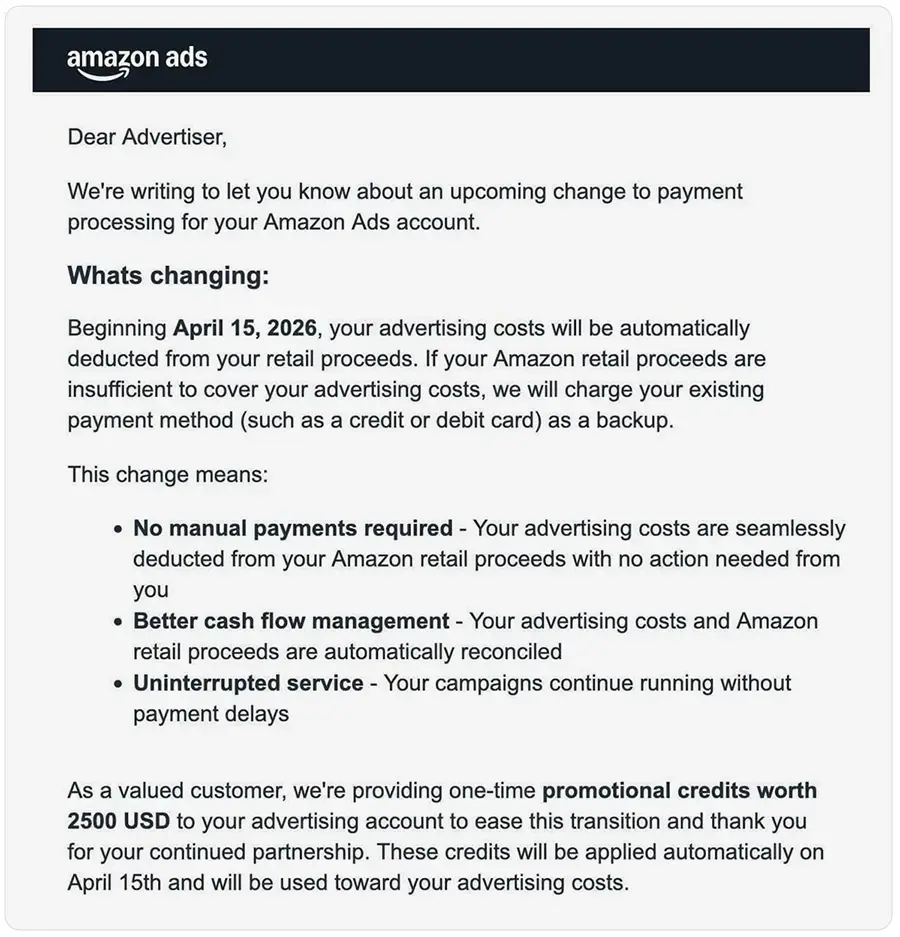
The message outlines a transition in payment processing starting April 15, 2026. This shift aims to automate how brands handle their full-funnel growth marketing by linking costs directly to sales.
- Advertising costs will be automatically deducted from your retail proceeds.
- Your credit or debit cards will only serve as a backup if your sales are too low.
- No manual payments are required since costs are reconciled automatically.
- Campaigns will run without interruptions from manual payment issues.
- A one-time promotional credit of 2,500 USD will be applied to your account on April 15.
Amazon claims this system simplifies cash flow management. I see it differently. Maintaining a consistent balance is also a factor for any brand earning AI mentions within the evolving search ecosystem.
My Analysis of the Financial Impact
I believe this is a massive cash grab from Amazon at the expense of seller margins. Credit card companies charge 2% to 3% in processing fees for every transaction.
Amazon generated roughly $69 billion from advertising in 2025. That is a 22% increase over the previous year.
If 30% of that spend was paid by card, Amazon just made an extra $500 million a year by cutting out those fees. They gave us very short notice for a change that hits in less than two weeks.
The $2,500 credit helps a little right now. But I expect it will just lead to higher bids this spring as everyone spends that “free” money at once. Your rewards and your float period are gone.
Why This Hurts More Than It Looks
On the surface this sounds administrative. In practice, it kills the cash flow runway many of you built your businesses around.
Under the old system, you could charge ads to a card and earn points. You had 30 days before that bill was due. Amazon also held your proceeds for about 30 days. Together, those two buffers gave you a 60-day window of working capital.
Now, instead of putting it on a card for 30 days, they take it out of your cash flow that they are already holding for 30 days. It is a double whammy. You just lost 60 days of liquidity.
That window disappears on April 15. Ad costs will be pulled from proceeds before you ever see them. You have no credit card buffer left.
"It is a double whammy. You just lost 60 days of liquidity."
The Real Dollar Impact on Your Business
For high-volume advertisers, the hit goes beyond cash flow. Those 2% rewards on large ad budgets are meaningful annual savings that will disappear overnight.
| Monthly Ad Spend | Monthly Rewards Lost (2%) | Annual Impact |
|---|---|---|
|
$10,000 |
$200 |
$2,400 |
|
$50,000 |
$1,000 |
$12,000 |
|
$100,000 |
$2,000 |
$24,000 |
|
$250,000 |
$5,000 |
$60,000 |
The $2,500 credit helps small advertisers. If you spend tens of thousands per month on PPC, it covers almost nothing. You are losing a massive amount of rewards every year.
Why Amazon Really Made This Change
The economics are simple. Credit card interchange fees run between 1.5% and 2.5%. Amazon was absorbing that cost on billions of dollars in ad spend.
Advertising is now their fastest-growing revenue segment. Eliminating those fees is a direct margin improvement for them. It also ends the 30-day delayed payment that cards created. Now they get their ad money at the same time they hold your sales proceeds.
How to Handle the Ad Payment Shift
This 60-day cash flow gap is dangerous. You lose the interest-free period while Amazon still holds your funds.
Losing that 2% perk can cost you over $15,000 a year if you are a high-volume seller. These lost rewards lower your profit margins on all full funnel growth marketing efforts.
Building a competitive moat means doing the hard work others avoid. Use these steps to prepare.
- Review your monthly spend and calculate the rewards you will lose.
- Model your cash flow without that 30-day credit card float.
- Check if your sales consistently cover your ad spend.
- Make sure your backup card has enough limit if sales fall short.
- Adjust your bid strategies to work within a tighter cash flow.
- Stay consistent with ads to keep your brand earning AI mentions in search.
Key Takeaways
- Ad costs auto-deduct from your sales starting April 15, 2026.
- Credit card billing for ads is effectively over.
- Your card is only a backup if your proceeds are too low.
- You get a one-time $2,500 ad credit on April 15.
- Your 60-day cash flow buffer is gone.
- If you use American Express perks for ads, you lose them.
- This hits at the same time as FBA fee hikes and rising PPC costs.