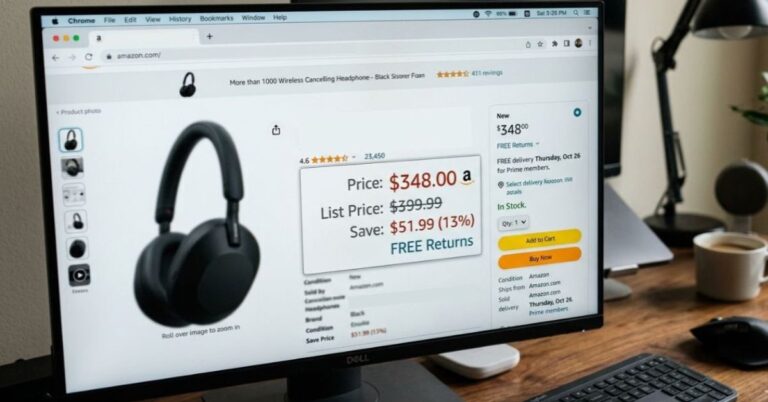
The Amazon listing price policy now requires sellers to prove list prices with real sales data or external retailer evidence, removing inflated discounts and tightening strike-through eligibility.
Amazon sellers who relied on inflated discounts to boost conversions are facing a major shake-up. The new Amazon listing price policy now requires proof of reference prices using real sales data or verified retailer evidence, a critical change since 60% of online shoppers make pricing their top buying factor.
This change disrupts long-standing tactics that created the illusion of savings. Without valid List Prices or strike-through displays, many listings may see a drop in conversion and require immediate strategy adjustments.
Tightened Rules Shake Up Amazon Pricing Strategies
Amazon has updated its listing requirements, and the new Amazon listing price policy now demands that sellers validate every reference price, as reported by PPCLand. Starting April 23, 2026, an Amazon list price must either reflect actual sales on the Featured Offer or match pricing at another retailer, making inflated discounts no longer acceptable.
The changes apply to both List Price and Typical Price mechanisms, affecting how discounts appear in product detail pages and search results. Sellers who rely on persistent promotional pricing will see strike-through displays removed if reference prices cannot be substantiated, forcing adjustments to existing Amazon pricing tactics.
Key points of the update include:
- List Price must be backed by actual sales or recent retailer evidence.
- Discounts without a valid reference price will not show strike-through or savings.
- Coupons, Buy X Get Y, Subscribe & Save, and peak event pricing are excluded from recalculation.
- Typical Price now counts all sales, including promotions, if the Featured Offer is below the non-promotional median for more than half of 90 days.
The update represents a major shift in how sellers display pricing, impacting conversions that relied on exaggerated discounts. Amazon agencies and sellers must now review pricing history and campaign strategies to comply, as visibility and perceived savings are directly affected.
Amazon Enforces Fair Pricing With Stricter Oversight
According to Amazon, it has reinforced its Fair Pricing Policy to ensure customers see honest prices and maintain trust in the marketplace. Sellers are accountable for their own pricing, and any practice that misleads shoppers can trigger enforcement actions under the updated Amazon listing price policy.
The policy monitors both product and shipping costs, comparing them with other prices available to customers. If a seller’s pricing is significantly higher than recent offers on or off Amazon, the Featured Offer may be removed, or selling privileges could be suspended.
Amazon closely tracks Amazon price history to identify patterns that may harm customer trust. Practices like charging more per unit for bulk purchases than for single units are considered violations and may result in corrective actions.
Excessive shipping fees are also evaluated under the policy, taking into account public carrier rates, handling charges, and buyer perception. Sellers must remain consistent and fair with all pricing, as repeated violations could lead to suspension or termination of their account.
| Violation Type | Enforcement Action |
|---|---|
|
Misleading reference price |
Remove Featured Offer |
|
Price higher than recent offers |
Remove Featured Offer or suspend privileges |
|
Bulk unit pricing higher than single |
Corrective action or removal |
|
Excessive shipping fee |
Adjust fees or account suspension |
Amazon Sellers Adjust to New Pricing Realities
Amazon sellers are facing a shift that makes reviewing cost structures critical. The updated Amazon listing price policy puts pressure on brands to reassess pricing strategies and margin assumptions immediately.
Many sellers built their business models around stable costs and predictable sourcing, but those assumptions are now changing. Monitoring Amazon price history and adjusting the Amazon list price are becoming key tools to stay competitive.
Small operational changes can yield significant advantages in this evolving landscape. Sellers are advised to evaluate landed costs, supplier structures, and inventory planning to protect profitability.
Advertising profitability also comes under scrutiny as cost structures shift. Those who move quickly to adjust strategies are best positioned to gain a competitive edge.
John Britto.J"The sellers who will benefit most from this moment are the ones who immediately review: Pricing strategy, Landed costs, Supplier structure, Inventory planning, Advertising profitability."