Middle East conflict leads to a new Amazon fuel and logistics surcharge for 2026
The conflict involving Iran has triggered a massive supply chain shock that is hitting every freight mode. You are likely seeing fuel prices spike and the closure of the Strait of Hormuz causing ocean and air rates to surge.
Shippers are scrambling to pull imports forward before costs climb even higher. This chaos has forced Amazon to implement a new Amazon fuel and logistics surcharge starting April 17.
Whether this is a short-term blip or a long-term change, you need to respond tactically. Read on to learn what you can do to stay profitable and how to pivot your strategy to survive this structural reset in the market.
Amazon Fulfillment Fee Update Details
A recent Amazon Seller News update left the seller community wondering if they can survive the pile of fees. Elevated costs in fuel and logistics have increased the cost of operating across the industry.
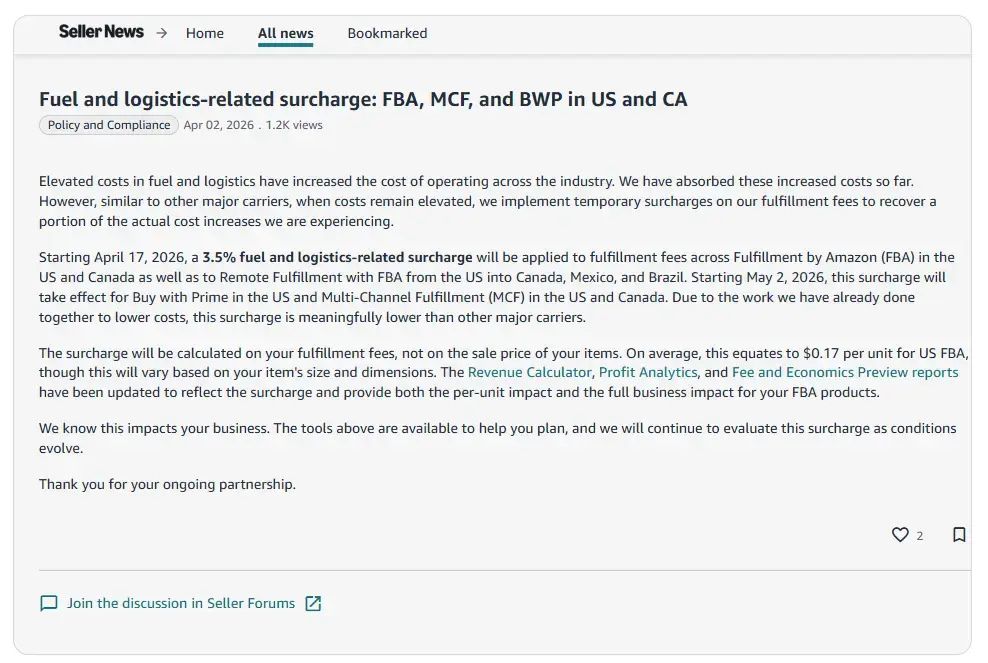
Amazon has absorbed these increased costs so far. But the company will now implement temporary surcharges on fulfillment fees to recover a portion of these actual cost increases.
This new Amazon fuel and logistics surcharge is a 3.5% fee applied to fulfillment costs. It applies to FBA in the US and Canada as well as Remote Fulfillment into Canada, Mexico, and Brazil starting April 17, 2026.
The surcharge takes effect for Buy with Prime in the US and Multi-Channel Fulfillment in the US and Canada starting May 2, 2026. Amazon stated this surcharge is meaningfully lower than other major carriers.
The fee is calculated on your fulfillment fees instead of the sale price of your items. On average, this equates to $0.17 per unit for US FBA.
The impact will vary based on the specific size and dimensions of your items. You can use the Revenue Calculator, Profit Analytics, and Fee and Economics Preview reports to see the impact on your business.
These tools provide the per-unit impact and the full business impact for your FBA products. Managing these costs is a critical part of a full-funnel growth marketing strategy.
Key Effective Dates and Affected Regions
- April 17, 2026. Fulfillment by Amazon (FBA) fees in the United States.
- April 17, 2026. Fulfillment by Amazon (FBA) fees in Canada.
- April 17, 2026. FBA remote fulfillment from the US to Canada, Mexico, and Brazil
- May 2, 2026. Buy with Prime fulfillment fees in the United States.
- May 2, 2026. Multi-Channel Fulfillment (MCF) fees in the United States and Canada.
Rising energy costs continue to put pressure on global logistics and shipping rates. As Susan Spence of the ISM notes, these spikes in crude and Brent oil are set to push prices even higher across the board.
Susan Spence, MBA, Institute for Supply Management Manufacturing Business Survey Committee Chair“Higher oil benchmarks are a clear signal that fulfillment costs will keep climbing for the foreseeable future."
Expert Analysis of the Fulfillment Fee Increase
I shared an update on our YouTube channel about the new 3.5% fee increase. A recent video update from My Amazon Guy provides deep insights into how these changes affect your bottom line.
I am concerned that this Amazon fuel and logistics surcharge will become a permanent fixture. Amazon kept a similar fee in 2022 even after the initial energy crisis ended. This surcharge creates a cycle of inflation that eventually hurts the end consumer. It puts immediate pressure on seller margins during a difficult economic period.
Products priced between 10 and 20 dollars will feel the most impact from the 17 cent average increase. Large and bulky items face higher costs because the percentage applies to their elevated base fees.
Review your current FBA fulfillment costs now, add 3.5%, and recalculate your gross and net margins.
As a leading Amazon agency, we are already generating impact reports for every one of our clients. We want to identify exactly which SKUs are at the highest risk for margin loss.
- US sellers can expect an average increase of 17 cents per unit. Canadian sellers will see an average jump of 26 cents CAD per unit.
- A 3.5% surcharge applies to all fulfillment fees regardless of category. This percentage is uniform across FBA, MCF, and Buy with Prime.
- Low-price items and bulky inventory are at the highest risk. These products have the smallest margin to absorb new logistics costs.
- The primary business risk is permanent margin compression. I suspect these fees will remain in place even if fuel prices drop later this year.
Logistics Disruption from the Iran Conflict
A report from FTI Consulting by Samantha Haberfield shows how the war is reshaping transportation. The outbreak of conflict in Iran caused a supply chain shock across all freight modes.
Fuel prices spiked and the Strait of Hormuz effectively closed. Ocean and air rates surged as shippers rushed to pull imports forward before costs rose.
This event forces an immediate tactical response. It also requires a longer-term strategic repositioning for brands.
Oil markets reacted instantly because Iran produces about 4% of global output. Brent crude jumped above $100 per barrel and diesel prices followed.
Carriers face a 30% spike in diesel costs. This creates margin compression that they cannot absorb.
Shipments transiting the Persian Gulf face higher insurance premiums. Some vessels are rerouting around the Cape of Good Hope which adds up to 14 days to transit times.
Air freight rates are climbing as capacity strains under high demand. Time-sensitive goods are moving from ocean to air but space is limited.
The global freight market was already unstable before this conflict. This situation is a major reason for the new Amazon fuel and logistics surcharge.
Sellers must audit fuel surcharge mechanisms in their carrier contracts. This analysis is a core part of full-funnel growth marketing when managing overhead.
Freight Mode Impact and Strategic Moves
- Fuel prices. Oil markets are unstable as the US administration outlines its strategy. Shippers should audit contracts and assess exposure to these spikes.
- Ocean freight. Rerouting vessels around Africa reduces effective capacity. Importers should identify non-Gulf suppliers and increase safety stock.
- Air freight. Rates are rising on Asia-to-North America lanes. Companies need a triage framework to decide which SKUs justify air shipping.
- Market outlook. The disruption could be a short-term blip or a structural reset. Long-term closure of the Hormuz would make high costs a permanent layer.
What Sellers Should Do Now
I recommend you take immediate steps to protect your brand profitability. You cannot afford to wait until the fees hit your account on April 17.
- Pull your current average FBA fulfillment fees per SKU and add 3.5% to each.
- Recalculate gross and net margins for every product using the updated fee figures.
- Use Amazon updated Revenue Calculator and Fee and Economics Preview to model the per-unit impact.
- Identify which SKUs are most exposed, particularly large, bulky, or low-margin products.
- Consider whether pricing adjustments are necessary before the April 17 deadline.
- Do not assume this surcharge is temporary. Plan your business as if it is permanent.
Diversify your sales by launching an owned direct-to-consumer website. Selling directly to your customers reduces your reliance on Amazon’s shifting fee structures.
Key Takeaways for Amazon Sellers
- A 3.5% fuel and logistics surcharge applies to all FBA fulfillment fees starting April 17, 2026.
- Buy with Prime and MCF follow on May 2, 2026.
- Average impact is $0.17 per unit for US FBA and it is higher for large or bulky products.
- Amazon provided no conditions under which the surcharge would be removed.
- Amazon 2022 fuel surcharge was never removed. This is a surcharge on top of that one.
- This announcement landed the same day as the credit card payment removal for ads.