

Are you optimizing your Amazon listings but still not seeing them show up where buyers are actually searching? There’s a good chance your product isn’t aligned with how Amazon AI search now works through Rufus and COSMO.
If you’re an Amazon seller, getting more sales starts with getting found. The problem is that many sellers still rely on the same keyword-heavy tactics that worked years ago, even though Amazon search has changed fast.
Because of this shift, countless products end up buried under the 600 million competing listings in the Amazon marketplace. Sellers who win today are the ones optimizing with Amazon AI search behavior in mind, especially how Rufus and COSMO evaluate listings.
In this blog, our Amazon agency talks about how sellers can optimize listings for Amazon AI search using Rufus and COSMO. We also discuss strategies like conversational content, technical AI feed optimization, persona-focused reviews, and maintaining standard SEO fundamentals to improve visibility and recommendations.
Table of Contents
Optimize Your Listings for AI Today
Stop guessing how Amazon AI sees your products & let our experts adjust your listings.
What Is Amazon Rufus and How Does It Work?
Amazon Rufus is a conversational AI assistant built directly into the Amazon shopping experience. Instead of relying on short keyword searches, shoppers can ask full questions, and Rufus responds with product suggestions, comparisons, and buying guidance.
Rufus works by interpreting shopper intent using natural language, then pulling information from product listings, reviews, Q&A sections, and other data sources. It delivers clear, direct answers that help shoppers decide faster, much like asking a knowledgeable store associate for advice.
For sellers, this changes how listings get visibility on Amazon AI search. Products that clearly explain what they do, who they’re for, and how they solve problems are more likely to be surfaced by Rufus during these conversational searches.
What Is Amazon COSMO and How Does It Work?
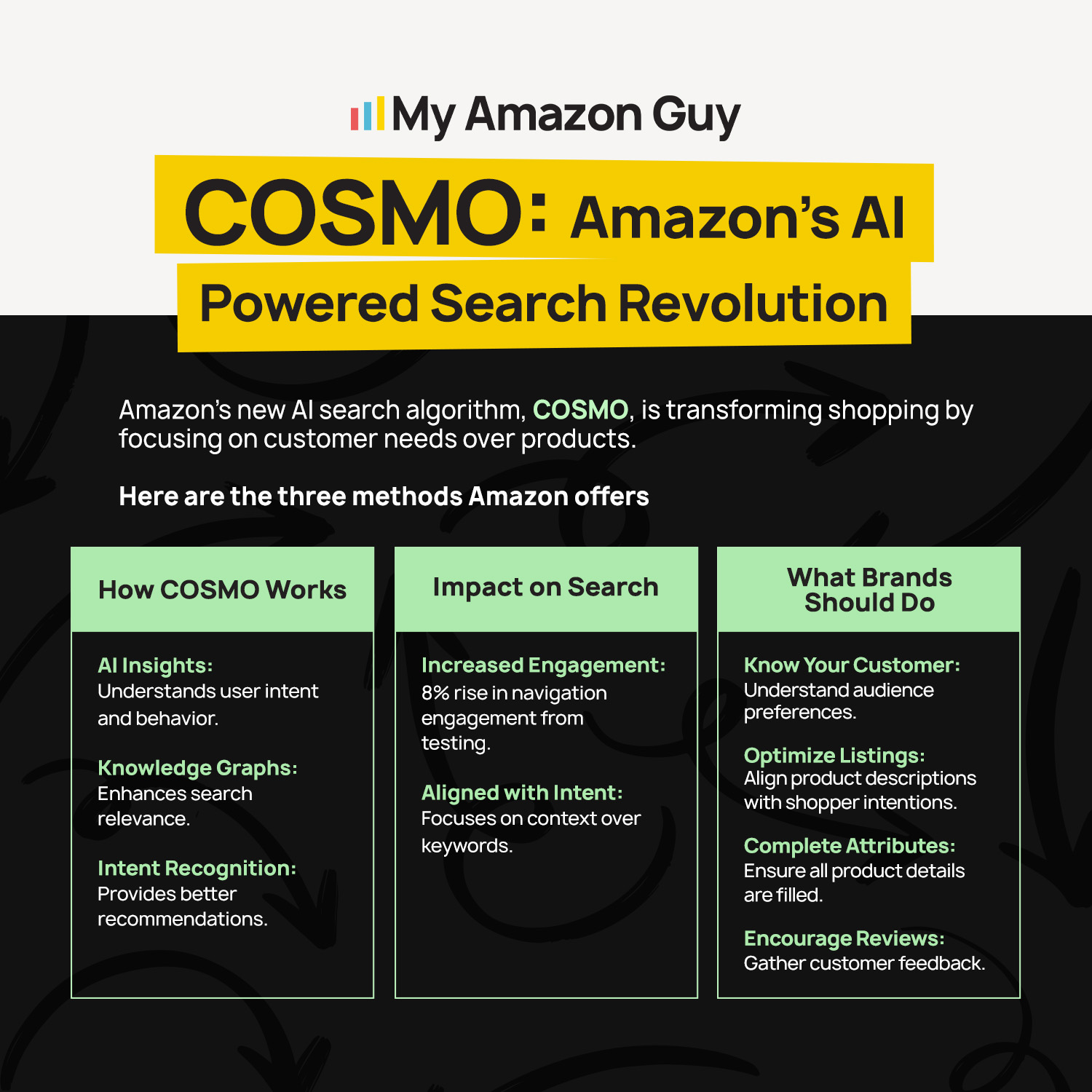
While Amazon Rufus is what shoppers see and interact with, Amazon COSMO operates quietly in the background. Its job is to understand the real reason behind a shopper’s search, not just the words they type.
Rather than matching keywords, COSMO connects intent, behavior, and context to figure out what problem a buyer is trying to solve. It analyzes listing content, images, reviews, and shopping patterns to surface products that genuinely fit the shopper’s needs.
This shift has major implications for sellers. Listings that clearly explain use cases, show products in real-life situations, and earn detailed reviews are more likely to benefit as Amazon AI search prioritizes relevance and usefulness over keyword repetition.
How Sellers Can Optimize for Amazon Rufus and COSMO
So now that Amazon AI search works very differently than it used to, many sellers wonder if they can still improve visibility and sales. The answer is yes, but only if listings are optimized with how Rufus and COSMO actually evaluate products, not how search worked years ago.
1. Shift from Keywords to Problem Solving
Keywords still matter, but stuffing them into your listing won’t improve performance. Rufus favors listings that answer real shopper questions, while COSMO evaluates whether your product truly solves a buyer’s problem.
The goal is to create content that naturally addresses buyer intent and shows how your product provides a solution. For example, instead of overloading bullets with “noiseless magnetic breathing strip”, explain how it works and why it helps someone sleep better or breathe easier.
Sellers can implement this by reviewing competitor reviews, Q&A sections, and forums to identify common buyer questions and pain points. Then, rewrite the copy and bullets to directly answer those questions, giving Rufus content to surface your product and signals COSMO can use to assess intent alignment.
2. Focus on Three-Dimensional Metrics
Running ads alone won’t guarantee your product ranks well or converts buyers. COSMO prioritizes products that demonstrate relevance to shopper intent, while Rufus favors items with strong engagement and high customer satisfaction.
To take advantage, sellers should balance ad spend with improvements to CTR and CVR. Clear copy, engaging images, and descriptive details increase clicks and purchases, which signals relevance to both COSMO and Rufus.
Higher CTRs and CVRs can also reduce CPC over time because Amazon recognizes your product as a strong match for shoppers’ needs. Monitoring these metrics allows sellers to optimize visibility in both traditional and AI-driven search results.
3. Leverage Instructional and Intentional Targeting
With match types becoming fuzzier, broad or generic targeting is no longer enough. COSMO benefits from precise, data-driven targeting that shows your product aligns with shopper intent, while Rufus delivers conversational recommendations to the right audience.
Use tools like Product Opportunity Explorer, Brand Analytics, and Amazon Marketing Cloud to map customer segments and identify intent patterns. This allows sellers to craft listings, campaigns, and ad strategies that speak directly to ideal buyers.
Being intentional with targeting improves AI visibility by giving both COSMO and Rufus the data they need to correctly match products with relevant searches. Starting with specific, data-informed targets ensures your product is recommended to shoppers most likely to convert.
4. Prepare for Layered and Conversational Search
Amazon Rufus is integrated throughout the Amazon shopping experience, appearing in prompts, product pages, and images. COSMO supports these interactions behind the scenes by determining which products are most relevant to a buyer’s intent.
Sellers should optimize bullet points, descriptions, and images to answer the questions and prompts Amazon displays. Clear, benefit-driven content ensures Rufus has the information it needs to surface your listing while COSMO ranks it against intent signals.
Since Rufus also references reviews when generating answers, maintaining detailed, factual, and helpful reviews strengthens your listing. Addressing common buyer concerns in both reviews and listing content improves your chances of showing up in AI-driven search results.
Stay Ahead of Amazon AI Search
From Q&A seeding to persona-focused reviews, we ensure AI sees your products the way buyers do.
5. Technical AI Feed Optimization
Rufus relies on crawlable listing content to answer shopper questions, while COSMO uses structured data to evaluate product relevance. Without properly formatted information, your product may get overlooked by both AI systems.
Ensure A+ Content has at least 500 words of crawlable text, and include descriptive alt-text for all images. This gives Rufus context for conversational responses and provides COSMO with the data it needs to assess intent and rank your listing.
Complete every backend attribute in Seller Central. Structured data allows COSMO to compare your product against others accurately and ensures Rufus can pull the correct details when answering buyer questions.
6. Leveraging the Agentic Memory
Amazon Rufus now remembers past shopper behavior, and COSMO interprets intent patterns to connect products with relevant needs. Together, they create highly personalized recommendations for buyers.
Sellers can optimize for this by shaping their brand voice and encouraging reviews that highlight a target persona. For instance, if reviews mention your product is “perfect for nurses”, Rufus may recommend it to buyers seeking gifts for healthcare professionals, while COSMO recognizes this alignment with user intent.
Consistency across listings, reviews, and Q&A signals ensures that both AI systems understand your product’s purpose. This increases the likelihood of appearing in personalized and intent-driven recommendations.
7. Review & Q&A Seeding
Rufus summarizes reviews to provide pros and cons, while COSMO evaluates whether your product addresses the needs implied in buyer questions. Together, they amplify the impact of your listing content on AI recommendations.
Monitor AI Review Highlights to identify points Rufus emphasizes, particularly any objections or “cons”. Addressing these concerns in your Q&A or bullet points helps Rufus provide positive answers and gives COSMO signals about your product’s problem-solving relevance.
Proactively seeding Q&A and review content ensures both AI systems have accurate, persuasive information to guide shoppers. This approach maximizes the chances of your product surfacing in conversational and intent-driven searches.
8. Don’t Forget Standard SEO Fundamentals
Even with AI search playing a growing role, traditional ranking factors still drive most visibility. Organic sales, CTR, and PPC performance remain the foundation of Amazon search, and COSMO’s intent-based ranking still favors listings that perform well overall.
Continue optimizing titles, main images, and natural keyword-rich copy to make your listings readable by both humans and AI. Ensuring crawlable text, descriptive alt-text, and structured data helps COSMO interpret intent and Rufus deliver accurate recommendations.
Reviews, lifestyle images, and thoughtful listing structure remain critical for both ranking and AI comprehension. Combining AI-friendly content with proven SEO strategies ensures your product is discoverable in all layers of Amazon search.
FAQs About Amazon AI Search
Is Amazon AI search more important than traditional SEO?
Traditional SEO is still the foundation for product visibility, but Amazon AI search adds a layer of intent and personalization. Optimizing for both ensures your listings perform well in human searches and AI-driven recommendations.
Will keyword stuffing help my Amazon product get found by Rufus and COSMO?
No, keyword stuffing no longer works. Focus on answering real shopper questions and clearly explaining product benefits to satisfy AI intent signals.
Do I need to rewrite all my Amazon listings for AI search?
Not entirely. Listings optimized for standard SEO already perform well with AI. Enhancing content with clear answers, structured data, and persona-focused details improves visibility and AI recommendations.
How quickly will I see results after optimizing for Rufus and COSMO?
There’s no definite timeline because results depend on your category, competition, and how shoppers interact with your listing. Improvements usually happen gradually as Amazon indexes your updates and AI systems gather enough data to recommend your product.
Stay Ahead of Amazon AI Search with New Strategies
Amazon AI search is evolving fast, and strategies that worked years ago won’t be as effective today. Adjusting your optimization approach to align with how Rufus and COSMO evaluate products is essential if you want to stay visible and competitive.
Sellers who focus on answering real shopper questions, structuring content properly, and signaling intent through reviews and listings will see the best results. Learning these new strategies designed for AI-driven search ensures your products get discovered and recommended to the right buyers.
Are you struggling to optimize your listings for Amazon AI search? Reach out to our full-service Amazon agency, and we can make AI-driven strategies work for your business.
Turn AI Insights Into Results
We help sellers leverage AI-driven search strategies to increase clicks, conversions, and organic rank.