
Have you updated your Amazon content marketing strategy for 2026, or are you still relying on tactics that no longer move rankings and sales? If you haven’t made changes, those outdated strategies could already be costing you traffic, clicks, and revenue.
Amazon has shifted into an environment where strategy matters just as much as product quality. A strong Amazon content marketing strategy is now required for brands that want to stay visible and competitive in 2026.
Search behavior, ranking signals, and content expectations have changed as Amazon pushes deeper into AI-driven systems. Sellers must adjust how they build listings and brand assets if they want steady traffic, higher conversion rates, and growth that lasts.
This article breaks down how Amazon’s AI-driven algorithm has changed content marketing and outlines strategies to optimize listings, drive traffic, and boost conversions in 2026. Our Amazon agency provides practical frameworks, step-by-step tactics, and actionable insights to help sellers stay competitive and grow their brand.
Table of Contents
Turn Browsers into Buyers
Use a full-funnel approach to capture customers at every stage of their shopping journey.
How Amazon’s Evolving Algorithm Demands a Smarter Content Marketing Strategy
Amazon’s search algorithm has undergone significant changes, requiring sellers to adopt a more strategic approach. An effective content marketing strategy now focuses on aligning listings with intent-driven search and AI-powered recommendations.
COSMO and the Shift Toward Contextual Understanding
The COSMO (Common Sense Knowledge Optimization) system represents a major evolution from A9 and A10, prioritizing context and intent over simple keyword matching. Listings must now demonstrate how a product addresses specific customer needs, using structured, solution-focused content that highlights real-world use cases for accurate association with relevant searches.
AI and Generative Engine Optimization (GEO) for Effective Targeting
Amazon’s AI, including its generative shopping assistant, evaluates listings through multi-step reasoning and behavioral analysis. Optimizing for this environment requires clear, structured content that communicates benefits, solves specific problems, and supplies the semantic clarity AI needs for improved visibility and recommendation placement.
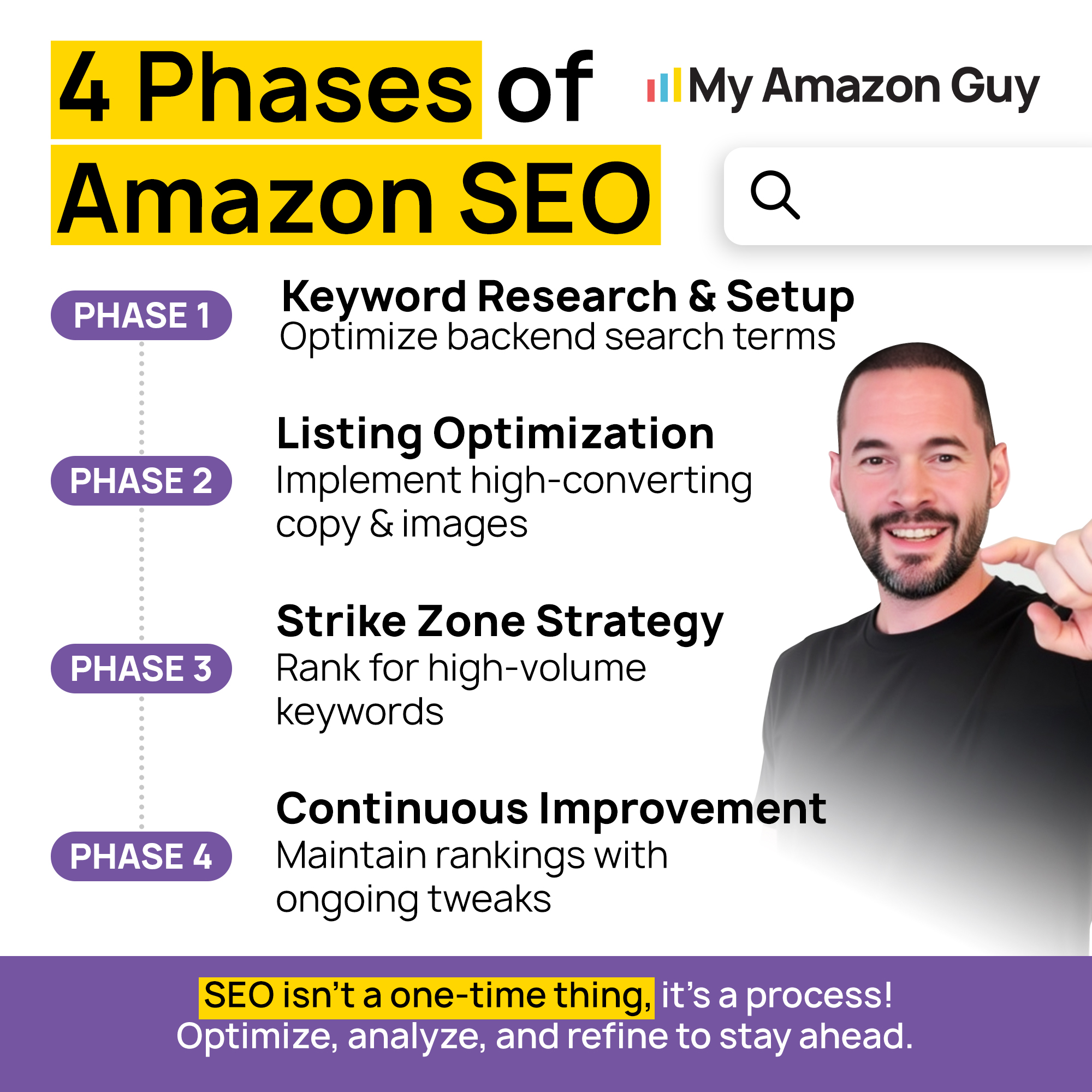
The 4 Phases of an Amazon Content Marketing Strategy
Creating a high-performing Amazon content strategy requires a structured approach, and a four-phase method has been shown to deliver consistent results. Following this framework helps listings reach the right audience while steadily improving visibility, engagement, and conversions.
Phase 1: Keyword Research and Setup
The first phase focuses on establishing baseline visibility for all key search terms. This involves identifying gaps in competitor keyword coverage and integrating them into titles, bullet points, and A+ content.
Phase 2: Listing Optimization
Phase two expands your listing’s reach through long-tail and related keywords. Optimizing backend search terms while avoiding duplication allows the algorithm to index your product for a broader array of relevant queries.
Phase 3: Strike Zone Strategy
Phase three targets keywords that rank on pages two and three. Strategic Amazon PPC campaigns and selective copy adjustments help move these keywords into page one positions, increasing sales velocity and organic rank.
Phase 4: Continuous Improvement
The final phase focuses on maximizing Click Share and conversion for high-ranking terms. By analyzing search query performance, sellers can optimize images, badges, and pricing to capture more traffic already viewing the listing.
Get More Traffic with Better Visuals
Strong images and videos can dramatically increase clicks and conversions on your product pages.
Smart Strategies to Strengthen Your Amazon Content Marketing Strategy
A strong Amazon content strategy requires more than compelling copy; it needs a coordinated mix of tactics working together. This section highlights the essential strategies brands should implement to capture more clicks, boost conversions, and maintain a competitive edge.
1. Visual Optimization for Maximum Click-Through Rate
The main image serves as the product’s “book cover” in search results, instantly communicating value, utility, and quantity to shoppers. With 75% of online shoppers heavily relying on product listing images to make purchasing decisions, optimizing visuals directly influences click-through rates and signals relevance to Amazon’s algorithm.
Top-performing brands implement a methodology often called the “Main Image Hack”, emphasizing scale, composition, and lifestyle cues. Data-driven validation through tools like PickFu and Amazon’s Manage Your Experiments ensures visuals not only attract clicks but also convert them into sales.
2. Video Optimization for Higher Engagement and Conversions
Video content must focus on shopper intent, providing solutions and context rather than serving as general entertainment. Properly placed videos guide buyers through the product’s value proposition and help answer potential questions that static images cannot.
Sponsored Brands Video (SBV) in vertical format captures attention on mobile devices and dominates search results placement. Best practices include a strong initial hook, captions for sound-off viewing, and looping to maintain engagement, driving higher conversion rates.
3. Maximizing Impact with A+ Content and Brand Store
Premium A+ Content and the Brand Story module are essential tools for competitive brands, not optional upgrades. According to Amazon, basic A+ Content can lift sales by 8% or more, while Premium A+ can boost sales up to 20%, making it crucial to have visuals and content you’re confident in.
The Brand Story module enables cross-selling by linking related products within a carousel, creating an internal funnel that increases basket size and customer lifetime value. Structured data in Premium A+ ensures AI systems can accurately recommend products, while interactive elements and video make the listing more engaging and persuasive.
4. Navigating Fees While Maximizing Creative Impact
Rising FBA, storage, and placement costs compress margins, making low-converting products more costly. Brands need to carefully allocate resources to creative assets that drive both traffic and conversions.
The Human-in-the-Loop (HITL) workflow combines AI for scale and humans for refinement, ensuring brand voice, emotional resonance, and adherence to best practices. Continuous performance analysis allows adjustments to images, copy, and videos, maximizing ROI while maintaining high conversion rates.
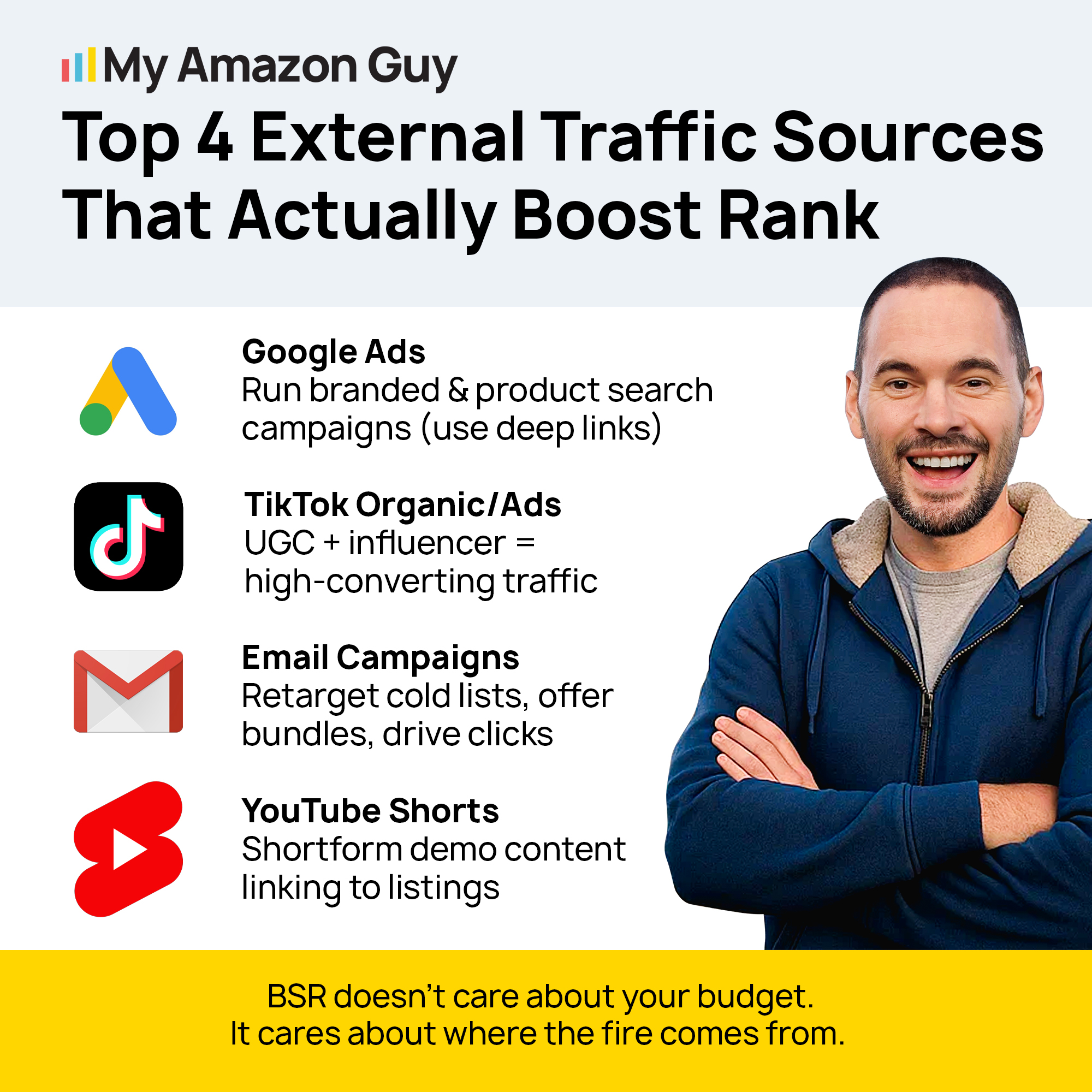
5. Driving Conversions Through External Traffic
External traffic reinforces listing authority while delivering direct sales from high-intent audiences. Social media, search, email, and influencer campaigns can all contribute to increasing click-through and conversion metrics.
Quality is paramount: traffic must be relevant, engaged, and responsive. Monitoring CTR, conversion rate, and engagement enables brands to optimize campaigns and build off-site credibility that improves organic visibility on Amazon.
6. Leverage Amazon Marketing Cloud (AMC) for Smarter Targeting
Amazon Marketing Cloud helps sellers move beyond basic keyword targeting and understand their audience at a deeper level. By analyzing shopper behavior across campaigns, you can identify high-value segments like new-to-brand customers and top spenders.
It also enables precision remarketing, such as targeting shoppers who added items to their cart but didn’t complete a purchase. These insights can improve campaign efficiency, lower acquisition costs, and increase lifetime value.
7. Implement a Full-Funnel Strategy
A full-funnel approach ensures you reach buyers at every stage of the shopping journey. Top-of-funnel campaigns build awareness, middle-of-funnel campaigns nurture undecided shoppers, and bottom-of-funnel campaigns capture ready-to-buy users.
Looking at campaigns holistically rather than in isolation helps align paid ads with organic rankings and audience targeting. This strategy improves overall conversion rates and drives more predictable growth.
8. Use Bulk Sheets and Reporting Templates for Scaling
Bulk Sheets and reporting templates make it easier to manage large numbers of campaigns efficiently. They allow sellers to update bids, budgets, and targeting across hundreds of campaigns without manual effort.
These tools also provide insights at the product level, showing which listings perform best and which need creative adjustments. Tracking search term impression share helps sellers understand how much of the digital shelf they control and where to focus next.
Frequently Asked Questions
Do I really need to update my Amazon content strategy for 2026?
Yes. Amazon’s algorithm and buyer behavior are increasingly AI-driven, so outdated tactics can reduce visibility, clicks, and conversions.
How often should I review and optimize my listings?
Listings should be reviewed at least quarterly or whenever performance drops. Continuous updates to keywords, visuals, and content help maintain traffic and ranking.
Will adding videos and A+ content guarantee higher sales?
Not automatically. They improve engagement and conversion potential, but effectiveness depends on relevance, quality, and alignment with shopper intent.
Mastering Amazon Success with a Cohesive Content Strategy
Winning on Amazon requires a holistic, integrated approach that balances technical optimization with customer-focused storytelling. Listings should be crafted to align with COSMO’s knowledge graphs, Rufus’s conversational queries, and strong visual presentation.
Executing the Four-Phase SEO plan, leveraging AI workflows to manage rising costs, and driving external traffic strengthen both rankings and conversions. Brands that combine machine-like precision with human-like storytelling are best positioned to thrive in a competitive marketplace.
Need help updating your Amazon content marketing strategy for 2026? Reach out to our full-service Amazon agency and let us help you optimize listings, boost conversions, and grow your brand with confidence.
Update Your 2026 Content Strategy
Stop losing clicks and sales to outdated tactics. Make sure your listings work with Amazon’s latest algorithm.