Are you planning on expanding to Amazon USA from Canada, but aren’t sure where to start? We know the struggle Canadian sellers face when entering a new marketplace.
Expanding into the U.S. is a natural step for growing your Amazon business. However, many hesitate because of concerns around taxes, logistics, and unfamiliar processes.
Learning the rules and best practices for cross-border selling can feel overwhelming, so sellers often delay taking action. This is why having a clear roadmap matters for Canadian sellers.
In this guide, we break down how Canadian sellers can start selling on Amazon USA, covering account setup, product selection, listings, logistics, taxes, and payments. Our Amazon agency also provides expert support to simplify cross-border expansion and help maximize U.S. sales.
Table of Contents
Expand Your Amazon Business into the U.S.
Take the stress out of selling on Amazon USA from Canada with professional guidance.
Why Amazon USA Is the Next Logical Step for Canadian Sellers
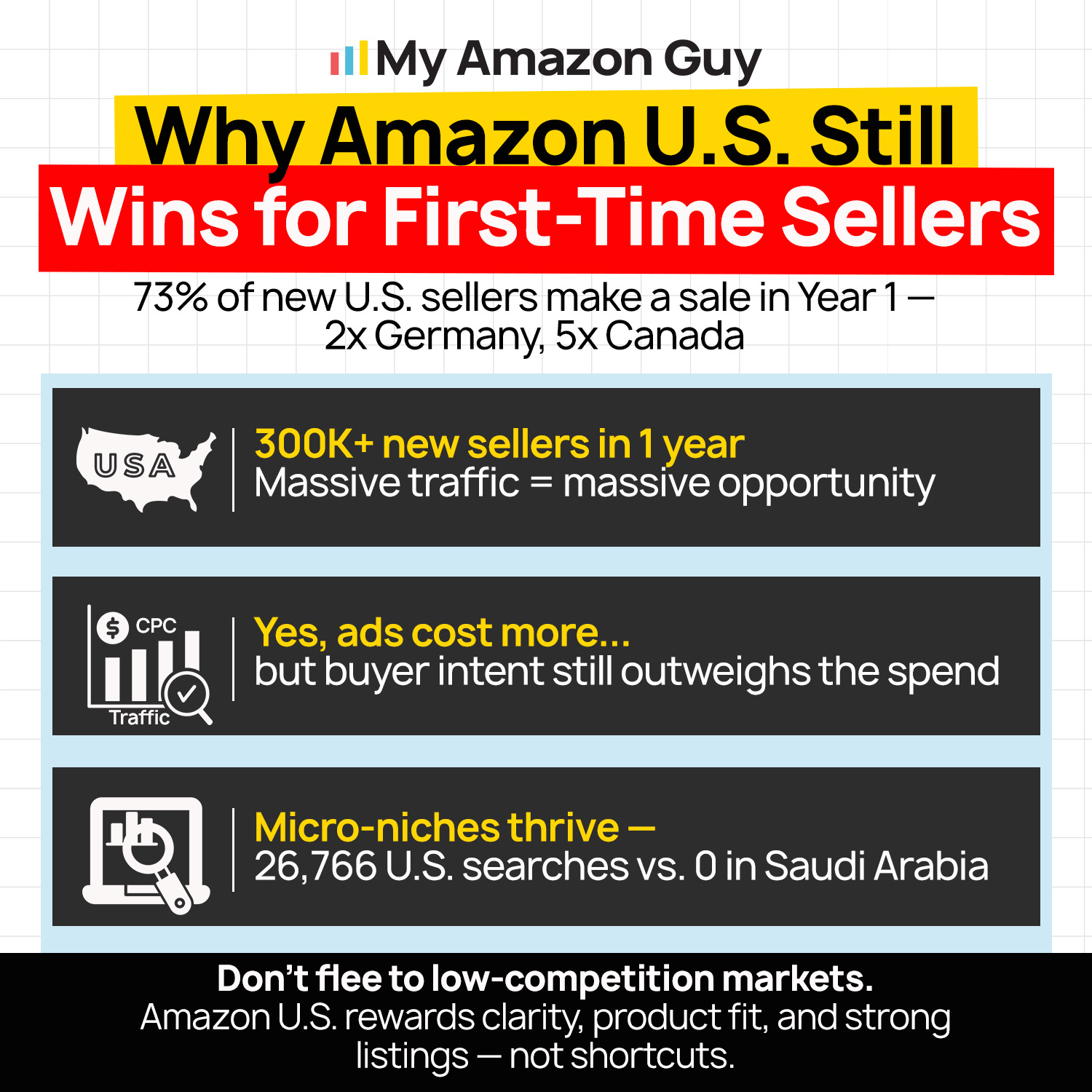
Amazon Canada already attracts an impressive 161 million monthly visitors, so it’s no wonder that many Canadian e-commerce sellers start their journey here. But when compared to the more than 2 billion monthly visitors of Amazon.com, the potential reach and sales growth in the U.S. market is on an entirely different scale.
Aside from this massive customer base, Amazon USA presents more opportunities for brand growth, higher sales volume, and long-term scalability that many sellers can’t achieve in Canada alone. Expanding to the U.S. allows Canadian sellers to build brand awareness and unlock profits that go beyond what’s possible in the Canadian marketplace.
Canadian sellers already understand Amazon’s platform, FBA, and advertising tools, so the U.S. market is simply a larger version with similar rules. The familiarity, combined with close consumer behaviors and geographical proximity, makes Amazon.com the natural next step for scaling a proven Canadian business.
How to Start Selling on Amazon USA from Canada
If sellers want to start selling on Amazon USA from Canada, the process is straightforward but can feel overwhelming without the right guidance. That’s why we’ve created this guide to help Canadian sellers better understand what’s involved and get started confidently.
1. Setting Up Amazon Seller Central for Amazon USA
Canadian sellers do not need to create a separate account to start selling on Amazon USA. Existing Amazon.ca accounts can use the Marketplace Switcher to quickly access Amazon.com, while the North America Unified Account (NAUA) offers full integration across Amazon.ca, Amazon.com, and Amazon.com.mx for unified login, listings, and reporting.
The registration process requires selecting Canada as the business location and specifying the business type, whether a sole proprietorship or corporation. For existing product catalogs, the Build International Listings (BIL) tool can automatically replicate listings from Amazon.ca to Amazon.com, simplifying the setup of the U.S. store.
2. Understanding U.S. Taxes as a Canadian Seller
When selling on Amazon USA from Canada, a Tax Interview is required in the U.S. marketplace. Individuals complete the W-8BEN form while corporations use the W-8BEN-E, certifying Canadian residency to prevent the IRS from withholding 30% of Amazon earnings.
Sales tax collection in the U.S. is mostly handled by Amazon under Marketplace Facilitator laws, meaning Canadian sellers generally do not need to file or remit these taxes themselves. All profits earned on Amazon.com must still be reported as foreign income to the Canada Revenue Agency, with eligible expenses such as Amazon fees, shipping, and cost of goods sold deductible on the Canadian tax return.
3. Managing Banking and Payments
Canadian sellers have several options for receiving payments from Amazon USA, each with different costs and convenience levels. Using a standard Canadian CAD bank account is the simplest method, but Amazon converts USD to CAD at rates that can include hidden fees between 1.5% and 3.5%, making it suitable only for testing the U.S. market with limited sales.
More established sellers often use virtual USD accounts through services that provide U.S.-based banking details for direct USD deposits. Alternatively, cross-border accounts offered by major Canadian banks allow funds to flow directly into U.S.-based accounts while keeping banking centralized, though they may include monthly fees and longer setup times.
4. Choosing Products That Sell in the U.S.
Picking the right products is a critical step when expanding to Amazon USA. Sellers should review U.S. regulations, Amazon compliance requirements, and product safety standards to ensure each item meets marketplace guidelines before listing.
Product research is essential for identifying high-demand products with strong profit potential. Tools such as Jungle Scout can help assess competition, analyze demand, and uncover opportunities in niches that offer both customer interest and manageable competition for cross-border shipping.
Maximize Your U.S. Sales Potential
Avoid costly mistakes and reach more customers with our proven Amazon expansion strategies.
5. Creating Listings for Amazon.com
Creating optimized product listings is essential for visibility and conversions on Amazon USA. Product titles should be clear and descriptive, relevant keywords should be included, and high-quality images should showcase the item from multiple angles while bullet points highlight key features and benefits.
For sellers with an existing catalog in Canada, the Build International Listings tool can streamline cross-listing to the U.S. marketplace and synchronize pricing. New products can be matched to existing detail pages or created from scratch, but it remains the seller’s responsibility to ensure compliance with U.S. regulations and marketplace requirements.
6. Deciding Between FBA and FBM
Choosing between FBA and FBM is a critical step for Canadian sellers expanding to Amazon USA. FBA involves shipping inventory in bulk to U.S. warehouses and managing customs, duties, and taxes upfront, while FBM ships individual orders from Canada, often taking advantage of duty-free entry under Section 321 for shipments under $800 USD.
FBA provides faster delivery with the Prime badge, boosting conversion rates and Buy Box eligibility, whereas FBM typically takes longer to reach U.S. customers, which can affect sales. Differences in cost, storage, and tax obligations also play a role: FBA involves Amazon-managed storage and potential sales tax nexus, while FBM offers control over shipping and storage but may result in higher per-unit shipping costs.
7. Shipping and Logistics to the U.S.
Shipping and logistics are critical considerations when expanding to Amazon USA from Canada. Canadian sellers acting as the Importer of Record must ensure all customs documentation, including commercial invoices, HS codes, and any applicable USMCA certificates, is accurate to avoid shipment delays or rejections at the border.
Understanding the $800 USD duty-free threshold under Section 321 can reduce costs for individual FBM shipments, while bulk FBA shipments usually require duties and taxes upfront. Calculating total landed costs and planning for U.S.-based returns with a 3PL or prep center helps maintain profitability and smooth delivery for American customers.
8. Launching and Marketing Products in the U.S
Launching products on Amazon USA requires leveraging existing Canadian sales data to gain an initial advantage. Transferring reviews through shared SKUs and analyzing Canadian keyword performance can provide seed keywords and social proof, giving new listings a stronger start in the competitive U.S. marketplace.
A focused marketing approach is essential, including Brand Registry enrollment, A+ content, and localized language for American buyers. Aggressive PPC campaigns targeting long-tail keywords help build early reviews, visibility, and sales velocity while establishing a trusted brand presence in the U.S.
FAQs About Selling on Amazon USA from Canada
Do I need to create a separate account for Amazon USA to start selling?
No. Canadian sellers can either use the Marketplace Switcher to access Amazon.com with their existing Amazon.ca login or use the NAUA for full integration across Amazon.ca, Amazon.com, and Amazon.com.mx. Both options allow selling in the U.S. without creating a new account.
How do U.S. taxes work for Canadian sellers on Amazon.com?
Canadian sellers must complete the W-8BEN or W-8BEN-E form to certify non-U.S. status and prevent 30% withholding. Amazon collects most U.S. sales tax under Marketplace Facilitator laws, while all earnings must still be reported to the CRA.
What is the best way to receive payments from Amazon USA while in Canada?
Virtual USD accounts like Wise or Payoneer provide U.S.-based banking details to receive funds without high conversion fees. Alternatively, cross-border accounts through major Canadian banks can manage USD payments while keeping banking centralized.
Expanding Your Business by Selling on Amazon USA from Canada
Expanding to Amazon USA is a natural step for Canadian sellers who want to scale their business and reach millions of additional shoppers. For Canadian sellers, the most efficient way to grow their reach is through the North America Unified Account and tools like Build International Listings on Amazon USA.
The process of starting on Amazon.com is straightforward when following a clear guide that explains each step, from account setup to product listing and logistics. Through this guide, we hope sellers feel more confident about entering the U.S. marketplace and taking advantage of the opportunities it offers.
Having issues navigating Amazon USA expansion or managing cross-border logistics? Contact our full-service Amazon agency and let our team handle the setup, compliance, and growth strategy for your U.S. store.
Simplify Cross-Border Selling
Our team can handle account setup, listings, and logistics so Canadian sellers can focus on growth.