Last Updated: October 9, 2026
What if your Amazon Solution Provider Portal rejection has nothing to do with your documents and everything to do with your company name? One word like “FBA” in your legal name or domain can cut your agency off from every client account it manages.
Your agency needs Seller Central access to serve clients, and Amazon now makes registration on its Solution Provider Portal (SPP) mandatory. Strict vetting rejects providers over names, domains, and ID errors, and approved accounts still get terminated without warning.
Our agency faced this exact risk while managing over $1.4B in ecommerce revenue across 400+ brands. This guide covers the naming fix we use, the reset path after a termination, and what brands should check before granting SPP access.
Getting approved means clearing a compliant legal name and domain, a strict identity check, and a client authorization that renews every 365 days. Structuring your business as an LLC with a clean name, or working with an SPP-compliant Amazon agency, saves you from costly rejections and lost access.
Table of Contents
Ensure your brand stays compliant with SPP-certified agency help.
TL;DR - Amazon Solution Provider Portal Rejection Fixes
Most Amazon Solution Provider Portal rejections trace back to a name, a domain, or an ID mistake you can fix before applying. Even approved agencies lose access, so the same rules protect any brand that depends on Amazon account management.
- Strip Amazon marks from names
- Keep your domain trademark-free
- Match ID details exactly
- Verify every team member first
- Track 365-day client renewals
Approval only lasts as long as your setup stays compliant. Audit your name, domain, and users today, and keep a clean LLC ready in case Amazon cuts access.
Why Does Your Company Name Cause Amazon Solution Provider Portal Rejection?
Getting your company listed on the Amazon SPP is an excellent way to connect with sellers. However, many solution providers face a significant hurdle and get rejected due to a simple yet critical detail: their company name.
We have personally navigated this exact problem during our own application process. This firsthand experience moved us to develop the successful compliance strategy we are now sharing with you.
What Is the Core Issue Behind Amazon Solution Provider Portal Rejection?
Amazon has strict rules about how third parties use its brand names. You cannot include trademarked terms like “Amazon,” “FBA,” or “Prime” in your service company’s name.
The reason is clear: Amazon wants to prevent confusion that your service is officially part of or endorsed by Amazon. For example, a company named “Excel FBA Prep” will likely have its SPP application denied because of its name.
The Biggest Change For Amazon Providers Ever
Key points to remember:
- Trademarked terms in your company name cause rejection
- Amazon aims to avoid any appearance of official affiliation
- Naming your service without these restricted terms is essential for approval
- Your domain, logos, page tabs, and video can trigger the same rejection
Does My Domain Name Count in Amazon’s Trademark Check?
Yes, your website gets the same scrutiny as your legal name. Amazon’s website guidelines for service providers bar trademark misuse in your URL, page tabs, logos, images, and videos.
The same rules ban unverified claims like being the best or only provider, plus any hint of an Amazon partnership you do not hold. Steven’s read is that Amazon cares most about what shows up in its directory, so a clean domain and legal name matter more than your public nickname.
What Happens When Your Company Faces Amazon Solution Provider Portal Rejection Due to Name Issues?
This brand name policy doesn’t just affect new applicants; it creates a significant hurdle for hundreds of established agencies. Our own agency, My Amazon Guy, has faced this exact challenge for years.
In a LinkedIn post, I asked: Will My Amazon Guy have to change its name because of Amazon’s new rule?
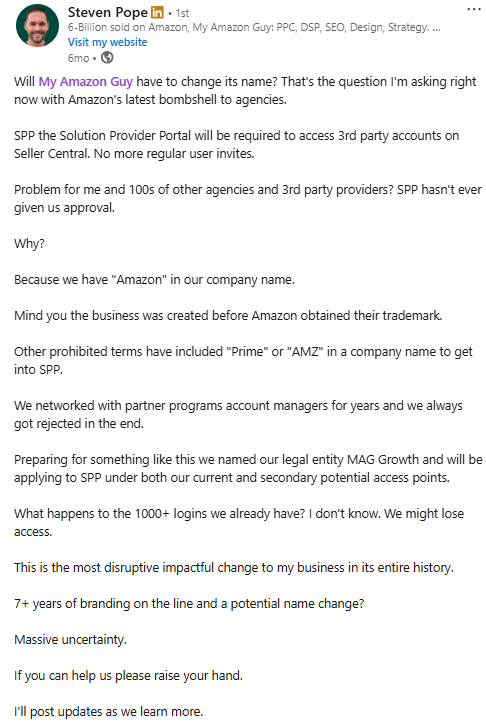
LinkedIn Post About Amazon Solution Provider Portal Rejection
This rule also applies to other terms like “Prime” or “AMZ” that Amazon considers part of its brand identity. This policy stands even if a business, like ours, was named before Amazon’s trademark was in place.
The mandatory shift to SPP presents the most disruptive change in our company’s history. Eight years of branding and more than a thousand client logins were on the line when this rule landed.
This situation creates massive uncertainty for us and many other service providers facing the same dilemma. It forces a difficult question about whether to change a well-known brand name just to comply with the new system.
What Are Your Options After an Amazon Solution Provider Portal Naming Rejection?
If Amazon rejects your application because of a brand name violation, you have a few choices. However, only one path is consistently effective.
Can You Just Change the Display Name?
No, this approach will not work because your SPP account is tied to your official, legal business entity, which is confirmed during the identity verification stage. Changing only the display name does not solve the core problem.
The Recommended Solution: Separate Your Legal and Brand Names
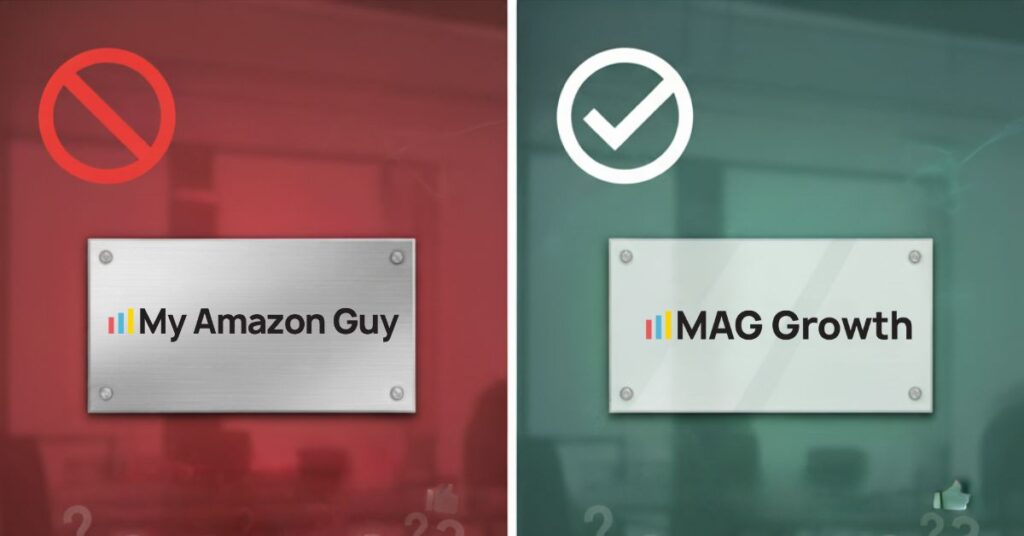
The most effective solution is to separate your legal entity name from your public-facing brand name. This is the exact strategy we use at My Amazon Guy.
- Our Legal Entity
Our official LLC on paper is “MAG Growth”, which we use for official registrations with Amazon.
- Our Brand (DBA)
We operate publicly under our DBA (“Doing Business As”), which is “My Amazon Guy”.
For a company rejected for a name like “FBA Movers”, the best option is to create a new LLC with a compliant name. This allows you to continue using your original brand with clients while using the new, compliant LLC for all official Amazon business.
What Should I Do if Amazon Terminates My SPP Account After Approval?
Open a new SPP account under a legal entity and domain with no Amazon trademarks, then send fresh authorization links to every client. Approval is not permanent, and because Amazon’s left hand rarely knows what its right hand approved, written permission from one team will not stop another from pulling it.
One agency passed the SPP review, went live for months, then lost its account with no reason given. Watch Steven explain why that written permission failed and the reset path that brings client access back.
Support tickets rarely move this kind of case, and partner reps often cannot see the reason either. Amazon says its identity verification decisions are final, so every day spent arguing is a day your clients sit without coverage.
Our reset starts with a clean LLC and domain, then re-verifies every user and sends new authorization links to each client. Log each client’s 365-day renewal date on the new account, so a lapse never triggers a second scramble.
Case Study: How My Amazon Guy Kept Its Name and Its SPP Approval
My Amazon Guy faced this exact rule when SPP became mandatory, with eight years of branding and more than a thousand client logins tied to a name that includes “Amazon”. A full rebrand would have thrown away the name sellers already searched for, so our team took a different route.
We registered with Amazon under our MAG Growth LLC and kept My Amazon Guy as the public DBA. The account passed SPP approval without a rebrand, and the same team still manages over $1.4B in ecommerce revenue across 400+ brands today.
This is the complete A-to-Z guide for a fast and hassle-free SPP application.
Which Business Structure is Best for an Amazon Solution Provider?
The choice between operating with a “Doing Business As” (DBA) name or forming a Limited Liability Company (LLC) is a critical decision. This choice directly impacts your personal liability, credibility, and potential for success on the Amazon SPP.
Understanding the Sole Proprietor/DBA Path
A DBA offers a simple path for freelancers and new entrepreneurs. It is a registered trade name under which an individual operates, not a separate legal entity.
Pros: The setup process is typically straightforward and inexpensive.
Cons: The owner is personally liable for all business debts and legal obligations, putting personal assets like your home or savings at risk.
The Advantages of an LLC
An LLC is a formal business entity registered with the state that is legally distinct from its owners. This separation provides the primary benefit of limited liability protection.
Pros: It shields your personal assets from business debts and projects a higher level of professionalism and credibility.
Cons: The formation process is more involved and costly, requiring state filings and potentially a federal Employer Identification Number (EIN).
Why Is an LLC Recommended for SPP Approval?
Amazon’s application to become a solution provider involves a high level of scrutiny. The process demands extensive business information and rigorous identity verification, which implicitly favors formally structured businesses.
An LLC provides Amazon’s review team with a clear, verifiable paper trail that signals operational maturity and trustworthiness. This perception of stability also extends to clients, who will almost always view an LLC as a more legitimate and accountable partner.
What Are the Key Identity Verification Challenges After Getting Your Business Name Approved?
Getting your business name approved is just the first step. Next, every user must clear a detailed identity verification process that can be challenging.
Our full SPP Guide offers a visual walkthrough of the entire process. Here are some common tricky parts to prepare for:
- You must choose between a live video call with an Amazon associate or a faster, but often more difficult, photo verification method.
- Photo verification can fail due to poor image quality or a mismatch between your ID and face photo.
- Amazon reviews submissions in up to two business days, and its verification decisions are final with no appeal.
What if Your ID Doesn’t Show an Expiry Date?
An incorrect expiry date causes automatic failure. If your ID shows no expiry date, Amazon tells you to enter a date three months after your registration date.
Struggling With the “Too Many OTPs” Error?
This common problem can lock you out. We provide a troubleshooting checklist for OTP issues in the guide.
Struggling with Amazon SPP Registration?
What Challenges Come After Your Amazon Solution Provider Portal Account Is Approved?
After approval, your next job is adding team members and connecting client accounts, and both steps have their own traps. To add a client, copy your authorization link from the SPP home page and send it to the seller, or let the seller authorize you from your Service Provider Network listing.
Each authorization lasts 365 days, so log every renewal date before access quietly expires. Our full SPP Guide walks through the process step by step, including the two issues that stall most new accounts.
- Missing Permissions
Some permissions, like Brand Benefits, stay hidden when filters are on. Our guide shows a trick to reveal all of them. - Users Stuck on “Need Verification”
Users must show as “Active” before you can assign them to clients. We explain how to check status and finish verification.
What Changed in the SPP Agreement on August 25, 2026?
Amazon raised the security floor for every solution provider and now holds agencies to account for the work they do inside client accounts. The updated agreement says client actions must be accurate, complete, and policy-compliant, and it spells out when you must carry insurance.
Under the August 2026 policy update, continued use after August 25 counts as accepting the new terms, including these Data Protection Policy controls. Miss one laptop on a 20-person remote team and your whole agency is out of compliance.
- Web application firewall on internet-facing endpoints
- Storage encryption on all devices
- 15-minute screen lock
- 30-minute lockout after ten failed logins
- Named incident management contact
- Credentials encrypted at rest
What Should Brands Check Before Giving an Agency SPP Access?
Your agency’s SPP status decides whether it can touch your Seller Central account at all. Check it before you sign, not after a case sits open for two weeks.
Why Do Brands Struggle With Amazon Account Management Services?
Most struggles start with access, not strategy. When an agency’s SPP account lapses or a specialist never finishes verification, work stops while the retainer keeps running.
Fragmented setups make it worse because nobody owns the whole account. A PPC freelancer, a listing writer, and a part-time VA each see one slice, so a suppressed ASIN can sit for days.
What Causes Amazon Seller Account Management Services to Stall Revenue Growth?
Revenue stalls when the team running your account cannot act fast on what it sees. Missing roles, expired authorizations, and unverified users are the quiet culprits.
Seller authorizations run for 365 days, so a renewal nobody tracks can cut access in the middle of Q4. Ask any agency how it logs renewal dates before you send the link.
What Are the Top Amazon Account Management Services for Troubleshooting Cases?
The best troubleshooting partners are SPP-approved, verified on every user, and staffed deep enough to work cases daily. Ask to see a sample case log, since a promise of quick support means nothing without one.
My Amazon Guy assigns 7 to 8 specialists per brand, so cases keep moving while PPC and catalog work run in parallel. Our Amazon troubleshooting service and Amazon account audit both run through the same SPP-approved access.
How Do Amazon Account Management Services Help First-Time Sellers Avoid Mistakes?
A good agency catches the access and compliance mistakes new sellers do not know exist. That starts with granting the right roles once through an authorization link instead of sharing the main login.
Sellers can also trim roles or limit access by country before they confirm. That keeps a new agency inside a clear scope from day one.
Which Amazon Account Management Service Handles Cases and Data Most Efficiently?
The most efficient provider pairs a clean SPP setup with strict data handling under Amazon’s current Data Protection Policy. Ask whether the agency meets the August 2026 security rules before it touches your reports.
Efficiency also comes from structure, with one brand manager owning the account while specialists work cases, catalog, and ads at the same time. That model is how our team manages over $1.4B in ecommerce revenue across 400+ brands.
What Is the Best Amazon Account Management Service for Brand Owners?
For brand owners, the best fit is a full-service agency that is SPP-approved and teaches while it works. Brand Registry tools, A+ Content, and Stores all depend on correct roles, so access gaps hit brand owners hardest.
Compare agencies on approval status, specialists per brand, and how they report cases. Our full-service Amazon management page and our guide to choosing an Amazon account management agency lay out what to ask.
Amazon Solution Provider Portal Rejection FAQs
Why was my SPP application rejected even though I'm an established solution provider?
The most common reason for rejection is a non-compliant company name. Amazon's policy prohibits service providers from using trademarked terms like "Amazon," "FBA," or "Prime" in their legal business name to avoid implying an official endorsement.
Do I really need to form a new LLC to get approved?
While it involves extra steps, forming a new LLC with a compliant name is the most effective solution after a naming policy rejection. This strategy separates your legal entity for Amazon's purposes from your public-facing brand, as we do with our "MAG Growth" LLC.
What specific documents are required for the identity verification process?
You will need to prepare a valid, government-issued photo ID and a recent proof of address. Amazon accepts a passport, national ID card, or driver's license for identity. For address, it takes a bank, credit card, or payment provider statement issued within the last 180 days.
I'm not receiving the One-Time Password (OTP) for login. What should I do?
First, ensure you are logged out of all other Seller Central accounts and try using a different browser. If the issue persists after waiting, the guide suggests trying a different contact number or logging in directly to Seller Central in another tab to trigger the OTP.
Can I assign a new team member to a client account as soon as I add them?
No, a new user cannot be assigned to a client until they have completed their own identity verification and their status shows as "Active" in User Management. If their status is "Need Verification," they must complete that process before they can access any client accounts.
Can Amazon terminate an approved SPP account without giving a reason?
Yes, and agencies report it happening months after approval. The fastest fix is a new account under a clean legal name and domain, since Amazon treats its verification decisions as final.
How long does a seller's SPP authorization last?
Plan your renewals a full year out, because access ends if nobody refreshes it. Amazon sets each seller authorization at 365 days.
Does my website have to pass Amazon's review too?
Yes, and a single Amazon mark in your URL or logo can sink the application. Amazon's service provider website guidelines also require HTTPS, a privacy policy, visible pricing, and a direct contact method.
Protect Your Amazon Solution Provider Portal Access Before It Slips
Most Amazon Solution Provider Portal rejections come down to an Amazon mark in your legal name or domain, not your paperwork. A compliant LLC paired with a clean domain clears that hurdle, and exact ID details carry every user through verification.
Approval still needs upkeep, from 365-day client renewals to the security controls Amazon added on August 25, 2026. If Amazon pulls your account anyway, a clean reset under a new entity gets client access back faster than any support ticket.
Are you stuck in an SPP rejection or worried your agency’s access could vanish overnight? Contact our full-service Amazon agency and let our experts rebuild a compliant setup that keeps every client account within reach.
We are SPP-approved, meeting Amazon’s strict standards for third-party account management.