Starting December 18, the Amazon prepaid return label requirement gives FBM sellers seven days to act. Miss it, and Amazon may refund the buyer from your account while they keep the product.
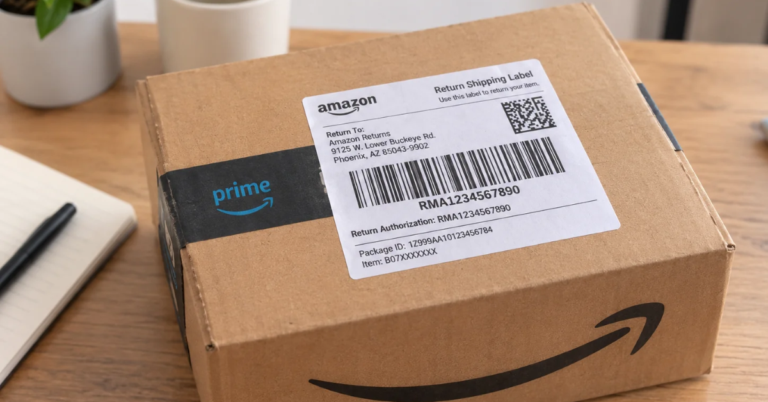
The Amazon prepaid return label requirement ends address-only labels for most US seller-fulfilled returns, with a temporary exclusion for heavy and bulky items. Labels must be uploaded in Manage seller-fulfilled returns, and labels sent through Buyer-Seller Messaging do not meet the rule.
Return reasons still decide who covers postage, and Amazon has not said whether SAFE-T claims apply to refunds triggered by a missed deadline. On a $60 order with a $20 unit and an $11 label, a missed deadline costs more than the label, which raises the stakes for full FBM brands and hybrid FBA/FBM sellers, including those whose returns are handled by an Amazon agency.
Amazon Prepaid Return Label Requirement Replaces Address-Only Labels
Amazon told sellers in a notice from the Amazon Services team shared on the Seller Central forums that US returns on seller-fulfilled orders will require a prepaid label starting December 18, 2026. The change applies to full FBM brands, hybrid FBA/FBM sellers, and Seller Fulfilled Prime sellers, and Amazon said it aligns how US and overseas returns are handled.
Address-only labels, which leave the buyer to pay return postage, will no longer satisfy the rule after that date. Heavy and bulky items are the only exception named in the notice, and Amazon described that exclusion as temporary without giving an end date.
| Rule | Detail |
|---|---|
|
Start date
|
Dec 18, 2026
|
|
Applies to
|
US seller-fulfilled returns
|
|
Deadline |
7 calendar days
|
|
Options
|
Prepaid label or full refund
|
|
If missed
|
Refund charged to seller
|
|
Exempt |
Heavy and bulky items (temporary)
|
Sellers have seven calendar days from the return request to attach a prepaid label in the Manage seller-fulfilled returns workflow or refund the buyer in full and skip the return. Weekends and holidays count toward that window, and if neither action happens, Amazon may refund the buyer and charge the refund to the seller’s account.
The requirement follows Amazon’s February 2026 removal of the high-value exemption from prepaid return labels and the August 2026 removal of custom return instructions. Together, the changes move more of the FBM returns process into Amazon’s own workflow.
Amazon Return Reasons Still Decide Who Pays for FBM Return Shipping
Prepaid return labels are not new for FBM orders, since Amazon already signs US sellers up for prepaid returns by default and issues those labels through Buy Shipping, according to a breakdown of the December 18 change from Seller Essentials. The new rule mainly reaches returns still handled with address-only labels, labels sellers create by hand, or return directions shared in messages.
A prepaid label means the buyer receives postage that is already arranged, but it does not settle who bears the final shipping cost. Amazon’s existing guidance ties that cost to the reason for the return, including whether the seller is at fault, and the December notice does not make every return seller-paid.
Amazon only accepts a label uploaded against the return request in Manage seller-fulfilled returns, so labels sent through Buyer-Seller Messaging leave the request open. The seven-day window also sits alongside Amazon’s separate rule requiring a response within 24 hours to return requests that need manual authorization.
The start date falls inside USPS’s temporary 2026 peak-season rates, which apply from October 4, 2026, through January 17, 2027. Those rates cover services including USPS Ground Advantage and Priority Mail, so sellers shipping returns on those services may pay seasonal prices during the transition.
Amazon Returnless Refunds Can Cost More Than the Return Label
A missed deadline can cost sellers more than the label itself, according to an analysis of the seven-day rule from EcomCrew. Its example uses a $60 seller-fulfilled order with a $20 unit cost and an $11 Amazon return label.
| Scenario | Label cost | Unit back? | Added cost |
|---|---|---|---|
|
Label sent on time
|
$11
|
Yes |
$11
|
|
Deadline missed
|
$0
|
No |
$20
|
When the label goes out on time, the seller pays $11 in return postage and gets the unit back. When the request passes seven days, Amazon may refund the buyer from the seller’s account, and the seller loses the $20 unit, which is $9 more than the label.
Amazon has not said whether SAFE-T claims cover refunds triggered by a missed label deadline, although its help page for seller-fulfilled returns mentions SAFE-T for some refunds Amazon issues. Amazon’s January 2026 FBM refund update also changed how SAFE-T eligibility applies to some automatic refunds.
The heavy and bulky exclusion remains temporary, and Amazon’s notice gives no size or weight threshold for qualifying items. The notice also does not say when the exclusion ends or whether other SKU-level exemptions continue.
Amazon Seller-Fulfilled Returns Call for SKU-Level Cost Planning
Return postage on FBM orders becomes a per-SKU cost under the Amazon prepaid return label requirement, according to a prep checklist from ShipDepot, a third-party logistics provider. The checklist recommends that sellers review the following figures for each SKU before December 18.
- The expected return label cost based on the SKU’s dimensions and weight.
- The SKU’s return frequency.
- The labor cost to check in, examine, and restock one returned unit.
- The resale value typically recovered from a returned unit.
- Whether the SKU falls below the seller’s returnless refund cutoff.
A returnless refund costs less than a return when the label and handling exceed the value recovered from the returned unit. The checklist recommends setting that cutoff for low-priced FBM SKUs in writing and reviewing it when prices, label costs, or return rates change.
To keep requests within the seven-day window, the checklist recommends assigning one person to check Manage seller-fulfilled returns daily, plus a second person to cover absences. It also recommends tracking how long each request has been open, since weekend days count toward the deadline.
The checklist also notes that prepaid returns should ship to a location that can check returned units, sort them by condition, and make sellable units available to buyers again quickly. For hybrid FBA/FBM sellers and Seller Fulfilled Prime sellers, accurate return counts help prevent reordering inventory that is already back in stock.