
Inventory problems rarely happen because sellers cannot predict demand. They happen because Amazon inventory planning is much bigger than forecasting, and one bad decision can tie up cash, trigger storage fees, or leave your best-selling products out of stock.
When your business starts to grow, Amazon inventory planning quickly becomes an operational challenge instead of a simple forecasting exercise. We’ve managed $1.2B+ in e-commerce revenue, and our experience shows that comprehensive Amazon management requires looking past basic demand projections to protect your cash and stabilize margins.
Many sellers treat inventory planning like a spreadsheet problem that can be solved with sales projections alone. In reality, every inventory decision must account for available cash, supplier lead times, Amazon storage limits, replenishment capacity, and changing customer demand to avoid expensive mistakes.
Data highlights the steep price of these mistakes. Industry research reveals that poor inventory management can cost retail businesses up to 11% of their total annual revenue through supply chain waste and missed sales opportunities.
This guide explains how to balance demand, cash flow, and Amazon’s operational limits instead of relying on forecasts alone. Built on proven strategies from a full-service Amazon agency, you’ll master the workflows, math formulas, and inventory metrics needed to reduce stockouts, eliminate overstock, and protect your margins.
Table of Contents
Fix Your Inventory
Let our experienced team build a custom constraint management model for your growing brand today.
TL;DR - Amazon Inventory Planning Is About Managing Constraints
Great forecasts mean little without a solid inventory system. Here is what drives better Amazon inventory planning:
- Balance inventory with cash
- Respect Amazon storage limits
- Build SKU operating rules
- Monitor logistics every week
- Measure inventory performance consistently
Stockouts and excess inventory usually come from poor planning, not poor forecasts. This guide shows how to build an inventory operating system that supports profitable growth.
The Core Shift from Forecasting to Constraint Management
Standard forecasting software assumes your business operates in a perfect world with endless money and zero logistical space limits. Real-world marketplace conditions require you to manage hard physical and financial boundaries instead of chasing perfect predictions.
Why Is Forecasting Not Enough?
Simple sales predictions completely ignore the unexpected production delays that occur at your source factories. They also fail to account for sudden changes in ocean freight transport timelines or sudden capital shortages.
Relying solely on mathematical trends causes brands to buy products they cannot logistically allocate inside FBA facilities. This approach generates immediate stock inefficiencies and lowers your long-term profit margins.
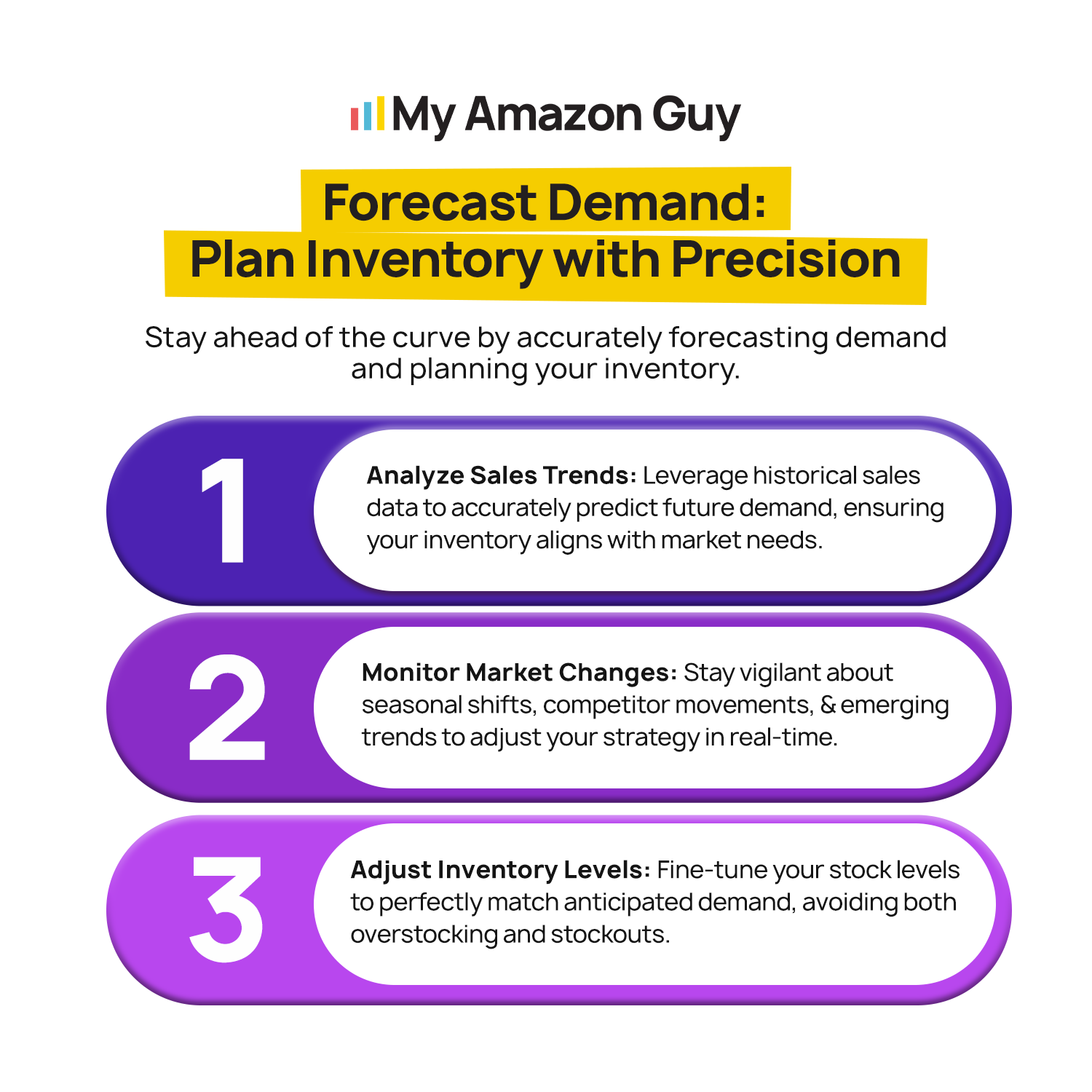
What Is Amazon Inventory Planning?
True inventory coordination is the art of balancing your active customer demand against your actual working capital and Amazon warehouse space. It forces you to make strategic decisions about which products deserve funding and placement.
This operational process protects your business liquidity while keeping your primary revenue-generating listings fully stocked. It turns raw data into a clear plan for sustainable brand growth.
Understanding the Fundamentals of Amazon Inventory Planning
Establishing a healthy brand requires a complete understanding of how logistics and supply networks integrate into your broader Amazon management strategy. Brands must look past simple automated recommendations to maintain their competitive edge.
How Does Amazon Inventory Management Work?
The modern FBA logistics structure requires brands to send physical merchandise to localized sorting facilities based on historical sales run rates. Amazon evaluates your business efficiency using account health indicators to determine your monthly warehouse space allocations.
Sellers must monitor their shipping queues and incoming shipments on a daily basis. Consistent tracking keeps your holding costs low while ensuring enough units are available to fulfill incoming orders.
Amazon Inventory Planning vs Amazon Forecasting
A sales forecast is an educated guess about how many items customers might buy during a future period. Planning is the actual operational blueprint that outlines how you spend your cash under strict operational limits.
Your forecast tells you what could happen if everything goes perfectly. Your plan tells you how to deploy capital safely when resources are limited.
Why Do I Keep Running Out of Inventory?
Most brands stock out because they calculate their reorder points using static lead times that do not match reality. They fail to build adequate safety buffers to handle sudden spikes in consumer interest or factory production slowdowns.
Running out of stock damages your organic search placement and allows competing brands to capture your market share. Maintaining a constant supply requires a deeper look at your real transit delays.
The Three-Layer Constraint Framework
Managing a growing seven-figure or eight-figure brand requires a multi-layered operational framework. You must evaluate three distinct business boundaries simultaneously to ensure your logistics run smoothly.
What Is the Demand Layer?
The demand layer monitors the actual consumer buying habits and seasonal trends for your specific products. It analyzes historical sales velocity alongside your upcoming marketing campaigns to establish a baseline consumption rate.
This layer provides the initial raw figures for your procurement discussions. It must remain responsive to real changes in user purchasing behavior.
What Is the Cash Flow Layer?
The cash flow layer governs the exact amount of working capital your brand can deploy to factory deposit payments at any given moment. Capital is always finite and must be directed toward the items that yield the highest return on investment.
Holding excess inventory is exceptionally expensive, and retail benchmarks show that annual inventory carrying costs generally run between 20% and 30% of the total value of the stock itself. This means that leaving cash sitting on warehouse shelves costs your brand roughly $0.20 to $0.30 per year for every single dollar of overstocked goods.
Ordering excessive stock for slow-moving products drains the capital needed to support your primary account drivers. Managing this layer preserves your operational liquidity and protects your business from financial insolvency.
What Is the Amazon Constraint Layer?
The Amazon constraint layer is controlled entirely by the automated storage algorithms of the marketplace platform. Amazon enforces strict capacity allocations based on your historical turn rates and your overall Inventory Performance Index.
Sellers cannot bypass these storage caps regardless of how high their customer demand looks. Your ordering schedules must always respect these platform fulfillment allocations.
Building a Robust SKU Tier Operating System
Treating every product in your catalog identically leads directly to cash flow allocation errors. Brands must separate their items into distinct velocity categories to maximize their capital efficiency.
How to Manage High Velocity, Fast Movers?
Fast movers represent the core products that generate the majority of your company revenue. These items require deep safety stock buffers because an extended stockout will severely damage your account health.
Operational models suggest that the true cost of a stockout on a top-tier item is actually 2 to 5 times the direct retail value of the lost sale itself. This compounding loss stems from wasted paid ad spend, deflated customer lifetime value, and immediate algorithmic penalties.
You must prioritize these specific listings when working capital is tight. They should receive the largest share of your available warehouse storage space.
How to Handle Tier Two Stable Items?
Stable items generate consistent secondary revenue with highly predictable weekly sales trends. They do not require massive safety stock cushions but require regular monitoring to prevent gradual depletion.
Procurement for these listings can follow standard shipping schedules without needing expensive rush processing. They form the steady baseline of your monthly factory orders.
How to Treat Long-Tail Slower Listings?
Long-tail products sell slowly and have highly irregular customer purchasing patterns. These items often consume valuable warehouse space relative to the small profits they return to your business.
Sellers should minimize fulfillment center allocations for these products to avoid steep long-term storage fees. They are ideal candidates for secondary merchant fulfillment processing.
Product Categorization Guidelines
The following layout outlines how to organize your catalog to achieve maximum capital efficiency.
| Catalog Category | Performance Characteristics | Required Sourcing Action |
|---|---|---|
|
Core Fast Movers |
High daily sales volume |
Maintain deep safety buffers |
|
Steady Stable Goods |
Predictable weekly sales |
Use standard monthly schedules |
|
Slower Long Tail |
Low irregular sales |
Limit warehouse storage space |
Stockout vs. Overstock: The Dual Risks Destroying Amazon Margins
Many brands treat inventory management as a one-sided battle against running out of stock, ignoring the equally dangerous trap of accumulation. In reality, stockouts and overstock are two sides of the same operational coin, and both carry severe financial consequences that can permanently stall your brand’s growth.
The Hidden Penalties of a Stockout
A stockout is an immediate operational emergency that extends far beyond a temporary pause in sales. When your inventory hits zero, your active advertising campaigns stall, your Best Sellers Rank (BSR) plummets, and Amazon’s algorithm rapidly strips away your hard-earned organic keyword positions.
Market data shows that a top-tier listing out of stock for more than 10 consecutive days typically loses up to 40% of its organic search visibility, requiring weeks of aggressive, margin-draining Amazon PPC spending to recover once replenished. Furthermore, stockouts open the door for immediate competitors to capture your market share, alter your customer lifetime value metrics, and permanently degrade your account health indicators.

The Silent Drain of Overstock
Conversely, overstock is a quiet cash killer that traps your business liquidity on warehouse pallets instead of letting it fuel your active marketing campaigns. Leaving excess products in fulfillment centers for more than 90 days triggers punitive storage fees that escalate dramatically into Aged Inventory Surcharges at the 181-day and 271-day marks.
During the high-volume Q4 holiday shopping season, Amazon spikes standard monthly storage fees by nearly 3x, turning unliquidated inventory into an immediate financial liability. Beyond the direct storage penalties, holding excess inventory bogs down your overall account Inventory Performance Index (IPI) score, which prompts Amazon to restrict your structural storage limits and throttle your future operational capacity.
Risk Comparison Profile
| Risk Vector | Stockout Consequences | Overstock Consequences |
|---|---|---|
|
Cash Impact |
Immediate loss of top-line revenue and baseline cash flow |
Working capital permanently frozen in stagnant warehouse assets |
|
Algorithmic Cost |
Severe organic search rank suppression and tanked BSR |
Lowered IPI score and restricted account storage limits |
|
Hidden Expenses |
Hyper-inflated PPC launch costs required to regain visibility |
Compounding Aged Inventory Surcharges and Q4 storage spikes |
Optimize Your Supply
Not sure which order is dragging down your LTV? Let's look at your numbers together.
Weekly Operational Workflows and SOPs
Consistent operational routines protect brands from sudden logistics emergencies. Integrating supply metrics into your weekly Amazon management workflows ensures your team follows a strict schedule to identify supply imbalances before they hurt your bottom line.
What Is the Monday Morning Inventory Review?
Your operations team must audit your actual trailing sales velocity every single Monday morning. Compare these numbers directly against your remaining warehouse capacity to spot sudden changes.
Adjust your incoming transport queues immediately based on these updated metrics. This routine prevents surprise capacity overages before expensive penalties begin to accumulate.
How Do You Calculate Exact Reorder Points?
Calculating your reorder point requires a clear mathematical formula that accounts for real-world transit timelines. Multiply your average daily sales velocity by your total lead time and add your safety stock buffer.
Reorder Point = (Daily Velocity * Lead Time) + Safety Stock
Sellers must update these lead time figures frequently to reflect current shipping environment realities. Relying on outdated transit estimates leads to severe production delays.
How Do You Balance Stockout and Overstock Risks?
Running out of products destroys your organic keyword ranks and invites competitors to take your customers. Carrying too many units triggers heavy monthly storage penalties and traps your available cash on warehouse shelves.
Sellers must constantly adjust their pricing or advertising spend to balance these opposing operational risks. Maintaining this balance is the primary challenge of modern marketplace logistics.
Strategic Advanced Tactics for Eight-Figure Brands
Established brands scaling past seven figures must adopt sophisticated supply chain methods. Standard direct shipping options become too restrictive as your weekly volume increases.
Should I Use AWD, 3PLs, or Multiple Warehouses?
Using a diversified storage network is necessary to bypass volatile marketplace capacity limitations. Amazon Warehousing and Distribution offers automated replenishment pathways that protect your account storage metrics.
Independent domestic storage partners provide cheaper long-term storage for bulk ocean containers. Combining these options keeps your supply chain safe from sudden policy shifts.
How Do Amazon Storage Limits Affect Inventory Planning?
Strict capacity restrictions prevent you from sending large bulk shipments directly into FBA locations. Your planning models must calculate exact weekly transfer volumes from your domestic overflow facilities.
Failing to coordinate these internal transfers leads to stock shortages even if your backup warehouse is completely full. Storage limits completely change how you space out your incoming shipments.
How Do I Plan Inventory Around Lead Times and Seasonal Demand?
Sellers must map out factory production schedules at least six months before peak shopping periods begin. Always account for predictable annual events like holidays that pause manufacturing entirely.
Build incremental production phases into your spring schedules to avoid paying premium air freight fees in November. Proactive scheduling preserves your cash margins during high-volume quarters.
Measuring Success with Critical Logistics KPIs
You cannot fix the operational issues that you do not actively track. True margin protection requires monitoring specific distribution performance metrics every single month.
Which Operational Metrics Matter Most?
The most important metric for warehouse efficiency is your overall inventory turn rate. This number reveals how many times your brand sells through its average stock investment each year.
Sellers must also track their total days of supply left inside the fulfillment network. Keep this metric between thirty and sixty days to maximize your capital efficiency.
What Is the Ideal Reporting Cadence?
Review your high-level logistics health indicators at the close of business every week. Conduct deep supply chain cost reviews at the end of each calendar month to catch hidden fees.
Quarterly evaluations should focus on long-term manufacturer relationships and factory capacity commitments. Consistent review cycles prevent small supply errors from compounding into major financial losses.
Standard Performance Benchmarks
This table details the specific targets required for healthy distribution management.
| Logistics Indicator | Poor Performance Level | Ideal Target Range |
|---|---|---|
|
Annual Turn Rate |
Under 3 turns annually |
6 to 8 turns yearly |
|
Network Supply Days |
Over 90 days stock |
30 to 60 days available |
|
Account IPI Score |
Below 400 points |
Above 555 points |
Common Execution Mistakes That Destroy Margins
Even the most advanced inventory frameworks will fail if your team falls into common operational traps that quietly drain profitability. Left unchecked, these frequent execution errors create severe cash flow bottlenecks and permanently damage your listing health.
- Total Automation Without Human Oversight
Many companies automate their ordering processes completely and trust software recommendations blindly. This mistake causes algorithms to purchase excess slow-moving units during random, artificial sales spikes and locks up your working capital. - Failing to Update Dynamic Lead Times
Another frequent error is failing to update supply lead times when ocean shipping routes or factory schedules become congested. Missing these manual adjustments causes massive, preventable stockouts on your primary revenue-generating items. - Ignoring Capital Constraints During Bulk Reorders
Brands often chase volume discounts from suppliers without cross-referencing their actual available cash reserves. This oversight forces companies to overextend their bank balances, leaving them without the necessary capital to fund active advertising campaigns. - Over-Reliance on Amazon’s Automated Restock Recommendations
Sellers frequently place inventory orders based entirely on the generalized restock alerts found inside Seller Central. Because these generic platform metrics ignore your specific lead times and cash flow boundaries, following them blindly inevitably leads to severe overstock.
Recommended Tool Stack and Software Rationale
Sellers should choose software applications that allow them to input specific financial constraints and physical restrictions. Applications that base recommendations strictly on sales trends will eventually overextend your bank account by buying units you cannot afford to store or logistically allocate.
| Software Tool | Primary Operational Purpose | Core Strategic Rationale |
|---|---|---|
|
SoStocked |
Custom Forecasting Rules |
Factors in custom logic, lead times, and MOQ constraints. |
|
Inventory Planner |
Multi-Channel Coordination |
Bases order recommendations on turn rates and margins. |
|
InventoryLab |
Sourcing & Profit Per Batch |
Tracks real-time profit and stock health per batch. |
|
RestockPro |
FBA Replenishment |
Tracks purchase orders and inbound FBA shipping schedules. |
|
Veeqo |
Free Multichannel Sync |
Free Amazon-owned tool that eliminates multi-channel sync lag. |
|
Sellercloud |
Enterprise Warehouse Control |
High-volume ERP system for multi-warehouse routing. |
|
Jungle Scout |
Simple Demand Projections |
Delivers baseline reorder data within research dashboards. |
|
Sellerboard |
Budget Profit & Stock Visibility |
Combines affordable financial tracking with low-stock alerts. |
|
Cin7 Core |
Inventory & Accounting |
Syncs multi-location warehouse tracking with accounting tools. |
|
Amazon AWD |
Automated FBA Upstream Storage |
Offers cheaper upstream storage to bypass FBA capacity limits. |
FAQs About Amazon Inventory Planning
How can I quickly improve my baseline inventory turnover?
Focus immediate attention on liquidating your worst-performing long-tail products through targeted Amazon Outlet deals, aggressive discount promotions, or bulk liquidation channels. Once that capital is recovered, immediately redirect it into ordering your top three high-velocity core fast movers to maximize cash efficiency.
How do I avoid tying up too much working capital in upfront manufacturing runs?
Negotiate smaller, staggered, and more frequent production phases with your component manufacturers instead of placing massive bi-annual orders. Improving your cash conversion cycle by shifting toward a rolling payment cadence keeps your bank balances liquid and adaptive.
How can I proactively increase my account's overall IPI score?
Maintain a balanced, consistent sell-through rate across your entire active catalog, and resolve any stranded inventory listings inside your dashboard within 24 hours. A consistently high Inventory Performance Index rewards your brand with significantly expanded storage limits and lower risk margins.
What is the fastest way to check my exact exposure to upcoming Aged Inventory Surcharges?
Navigate directly to your Inventory Health reports inside Seller Central and review the specific "Estimated Aged Inventory Surcharge" data column. Do not check this on a loose monthly cadence; if you are managing more than 200 active SKUs, you need automated weekly checks to spot inventory approaching the 181-day threshold before severe fees kick in.
How do I prevent software models from recommending overstock during random sales spikes?
Establish strict maximum ordering thresholds within your supply chain software that are tied directly to your physical account storage caps rather than raw demand trends. Never override these safety parameters for a temporary bulk manufacturing discount if the volume exceeds five months of real-world sales coverage.
How does the Low-Inventory-Level (LIL) fee structure impact my variation listings?
The low-inventory fee tracks stock depth at the individual FNSKU level rather than the parent ASIN. If you sell an apparel item or a product line with 10 color and size variations, a single fast-selling variation falling below a 35-day historical supply will trigger an immediate per-unit fee on every sale, meaning you can no longer allow slower variants to buffer the account health metrics of your top sellers.
Is it financially better to pay Inbound Placement Fees or opt for Amazon-Optimized splits?
For standard-size items, choosing a "Minimal Splits" option (shipping all boxes to a single warehouse location) carries a baseline placement fee of approximately $0.40 per unit, while "Amazon-Optimized Splits" (shipping to 3 to 5 separate regional facilities) drops the placement fee to $0.00. You must have your logistics team calculate whether the domestic freight cost of routing multiple smaller parcel shipments cross-country outweighs the per-unit placement penalty before creating your inbound queue.
How do I protect product margins against Amazon's variable fulfillment surcharges?
Ensure your unit cost calculations factor in the baseline 3.5% fuel and logistics surcharge applied directly on top of FBA fulfillment and Multi-Channel Fulfillment (MCF) fees. To recover these fractions of margin, conduct quarterly packaging audits to squeeze items into smaller-size tiers (like Amazon's "Small Bulky" tier) and aggressively enroll eligible items in the Ships in Product Packaging (SIPP) program to earn direct fulfillment discounts.
What happens to a product's search visibility if it gets caught in a low-inventory status?
When an FNSKU triggers low inventory alerts, Amazon may intentionally slow down delivery promises or restrict nationwide buyability to conserve regional stock for buyers closest to that specific warehouse hub. Even if your listing shows as "In Stock" on the detail page, your localized conversion rates will suffer because customers will notice delayed shipping timelines instead of the standard Prime next-day arrival.
Master the Shift from Guesswork to Constraint Management
Predicting customer demand is only a small fraction of building a highly profitable e-commerce brand. True marketplace success requires a structural shift toward balancing active sales velocity against your hard-working capital and shifting warehouse limits.
By segmenting your catalog into distinct velocity tiers and establishing rigorous weekly auditing workflows, you protect your business liquidity from sudden operational shocks. Stop relying on flawed automated software projections and take control of your logistics network to prevent costly stockouts permanently.
Having trouble with Amazon inventory planning? Reach out to our full-service Amazon management agency and let our Amazon experts build a custom constraint model that stabilizes your cash flow and safeguards your organic search rankings today.
Improve Your Inventory Strategy
Receive a complete analysis of your account health and operational efficiency from our senior management experts.