
Originally published in my Amazon selling tips newsletter on LinkedIn.
Black Friday set an online record and AI did more of the shopping than ever. Meanwhile Washington proposed new tariffs, Customs killed the cheap DDP loophole, and Amazon put dates on bundles and Canadian returns.
Here are the 15 stories that mattered for sellers this week, ordered by impact: costs first, then policy, tools, traffic and competitors.
The US proposes new tariffs on 14 countries, up to 35% on Vietnam
On November 25, US Trade Representative Jamieson Greer found that “structural excess capacity” practices in 14 economies are actionable under Section 301 and proposed new tariffs on top of existing 301 duties, with exemptions. The proposed caps: China up to 20% (up to 10% on Annex A goods), Vietnam up to 35%, India up to 25%, Singapore up to 20%, Bangladesh, Cambodia, Indonesia, Malaysia and Thailand up to 18%, the EU 15%, and Japan, Korea, Switzerland and Taiwan up to 15%. Comments and hearing requests are due January 5, 2027, and hearings start January 25.
These are proposals, not final rates. But if you moved production from China to Vietnam to dodge tariffs, that bet just got worse on paper. Price your Q1 and Q2 purchase orders at the proposed rates now, and if a tariff would kill a SKU, file a comment by January 5.
Source: USTR, November 25, 2026 · SellThrough
Customs kills the cheap DDP loophole on January 5
Liran Hirschkorn broke down the Customs change Amazon just emailed sellers about.
“Starting January 5, 2027, US Customs has new rules for who can be the importer of record on a shipment and Amazon just emailed sellers about it.”
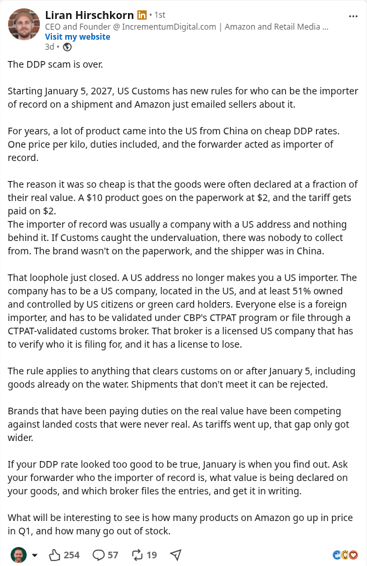
Under the new CBP rule, the importer of record has to be a US company, located in the US, and at least 51% owned and controlled by US citizens or green card holders. Everyone else is a foreign importer and must be validated under CBP’s CTPAT program or file through a CTPAT-validated customs broker. It applies to anything that clears customs on or after January 5, 2027, including goods already on the water, and shipments that don’t comply can be rejected.
If your forwarder’s DDP rate looked too good to be true, ask today who your importer of record is, what value gets declared and which broker files the entries. Get it in writing. Liran is watching how many Amazon products go up in price and out of stock in Q1, so order early. The number 1 rule of Amazon is never go out of stock.
Also: Federal Register, November 6, 2026
Amazon gives you 30 days to fix bundles before it pulls them
Starting January 11, 2027, most bundles listed as a single ASIN must be packaged by the original brand or manufacturer. Amazon now gives every bundle ASIN it flags a 30-day grace period: after a violation notice, you have 30 days to fix it with a letter of authorization or an appeal, or to sell through, before deactivation. It shows up as “Listing at risk of removal” in Account Health. The grace period might not apply if a brand owner reports the listing, multipacks are excluded, and one letter of authorization per brand covers all of that brand’s bundles.
Don’t wait for the notice. Pull a list of your bundle ASINs now and get a letter of authorization from each brand before January 11. If a brand won’t sign, plan the sell-through.
Source: Amazon Seller Forums · SIF123, November 25, 2026
Amazon.ca now auto-refunds cross-border returns of C$25 or less
Since November 23, Amazon.ca sellers can set rules under Return settings > Resolutions that trigger returnless refunds automatically by price range, category or return reason. If you fulfill Canadian orders from outside Canada with no default Canadian return address, returns valued at C$25 or less are now refunded automatically and the item doesn’t come back. Above C$25, Amazon recommends a prepaid return label within 48 hours or a returnless refund.
Shipping into Canada from the US? Every cheap return is now a pure loss. Set up a Canadian return address or build those refunds into your Canadian margin, and check your return settings today.
Source: Amazon Seller Central Canada · Niceggie
Amazon pulled every third-party Victoria’s Secret listing on Thanksgiving
An Amazon Services notice said Victoria’s Secret listings would be removed from Amazon.com on November 26 for all sellers without the Brand Representative role, because the brand “distributes products only through direct-to-consumer channels.” Sellers were told to sell remaining inventory or delete empty SKUs. Amazon says these No Wholesale Distribution removals don’t affect your Account Health Rating.
This is the no-wholesale rule with a famous name on it, the day before Black Friday. If you resell name brands, find out which ones sell only direct to consumers, and stop buying inventory you may not be allowed to list.
Source: MediaPost
Amazon shows up in 61.4% of 2026 CPSC recalls, by one seller’s count
Joann Cartiglia downloaded the CPSC data and ran the numbers herself.
“Amazon involvement in CPSC recalls/safety actions: 2016: 24.5% 2023: 39.2% 2024: 46.3% 2025: 57.4% 2026: 61.4%”
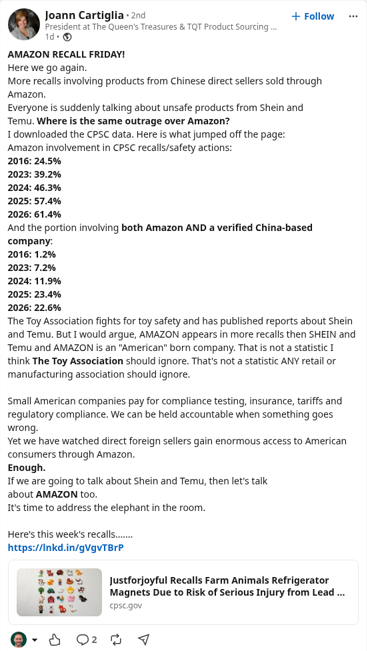
By her count, Amazon’s involvement in CPSC recalls and safety actions climbed from 24.5% in 2016 to 61.4% in 2026. The share involving both Amazon and a verified China-based company went from 1.2% in 2016 to 22.6% in 2026, slightly down from 23.4% in 2025. That’s her analysis of CPSC data, not an official CPSC stat, but the trend is hard to ignore.
Recalls hit your listings whether you were the bad actor or not. Keep your test reports, certificates and supplier records ready to upload, especially for toys and kids’ products. Seller Support sucks. Bot support sucks. You won’t talk your way out of a safety suppression.
Your FBA inventory page is now “Manage Amazon inventory,” and Total inventory counts stock that can’t ship yet
On November 23, Amazon moved the US FBA inventory page to the new Seller Central experience as “Manage Amazon inventory,” with global storage, AWD and FBA on one page. The new Total inventory column adds inbound, global storage, AWD and FBA units together. The four location columns (Inbound, At global storage, At domestic storage, At fulfillment) stay hidden until you turn them on with the Settings icon. A new Restock settings column lets you edit lead time, restock frequency and end-of-life per product or in bulk.
Total inventory is not sellable inventory. Unhide At fulfillment before you make a reorder call, or you’ll think you’re covered right up until you stock out. Then set real lead times in Restock settings, because restock suggestions are only as good as those inputs. We covered AWD and inaccurate restock reports here:
Source: Amazon Seller Forums, November 23, 2026 · Amazon Brand Guide, November 26, 2026
Amazon Haul listings now show up in regular search
Dhiraj Palekar flagged a change that puts bargain listings right next to yours.
“Amazon just put Haul listings next to yours.”
Haul is Amazon’s low-price store built to fight Temu, and its customers grew 350% in a year, per Adweek as cited in Dhiraj’s post. Haul listings now show in core Amazon search results, which Adweek says risks Amazon’s fast-shipping promise.
If you sell cheap commodity products, you now fight Temu-style pricing on your own search page. Win on the main image, reviews and Prime speed, because CTR is the fastest way to grow sales. Don’t race to the bottom on price.
Alexa for Shopping can now buy for shoppers when your price drops
Evan Jay watched Black Friday play out through Amazon’s AI assistant.
“It’s Black Friday on Amazon. And for the first time, an AI is doing a lot of the shopping.”
Alexa for Shopping replaced Rufus in May. Shoppers can set a target price and Auto Buy places the order, and they can see up to a year of price history, which exposes fake discounts. The assistant now sits in search results and on product pages.
I never liked Rufus and I won’t miss it. But this matters: if you inflate a list price to fake a discount, shoppers can now see it. Price honestly, and make sure your listing answers the questions shoppers ask the assistant. We talked about where Rufus and Alexa were headed back in June:
Amazon blocks Meta’s shopping agent while Walmart lets approved agents buy
Digvijay Chaudhari summed up the split between the two biggest US retailers.
“Amazon blocks Meta’s shopping agent. Walmart lets approved AI agents buy for its customers.”
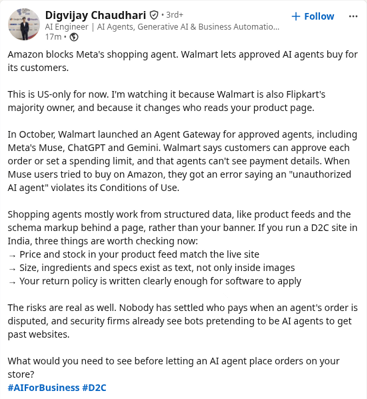
Walmart launched an Agent Gateway in October for approved agents, including Meta’s Muse, ChatGPT and Gemini, and on November 24 opened its Black Friday deals to Muse with agent spending limits and purchase approvals. Muse users who tried to buy on Amazon got an error saying an “unauthorized AI agent” violates its Conditions of Use. Fortune reported on November 25 that Amazon and Meta have held multiple talks about lifting the blockade, with search results and advertising as the sticking points.
Amazon wants AI agents shopping inside its walls, where it sells the ads. Fortune puts Amazon advertising at $68.6 billion, so don’t expect that wall to fall fast. Meanwhile, keep price, stock and specs consistent on your own site and on Walmart, because outside agents read that data.
Also: Fortune, November 25, 2026 · TechCrunch, November 25, 2026 · Walmart
Amazon wants product data on everything, even what it doesn’t sell
Jake Martin dug into a Reuters report on Amazon’s next AI shopping play.
“Amazon wants data on every product for sale. Including the ones it doesn’t sell.”
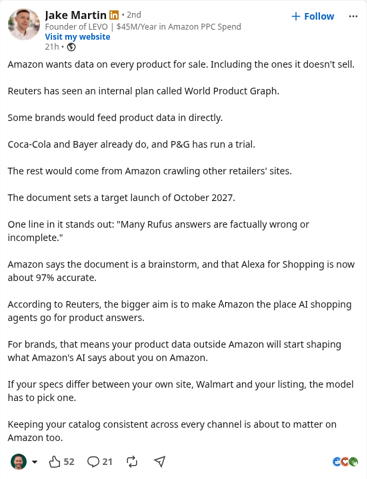
Reuters saw an internal plan called World Product Graph. Some brands would feed product data in directly; Coca-Cola and Bayer already do, and P&G has run a trial. The rest would come from Amazon crawling other retailers’ sites, with a target launch of October 2027. One line in the document: “Many Rufus answers are factually wrong or incomplete.” Amazon says the document is a brainstorm and that Alexa for Shopping is now about 97% accurate.
Even Amazon’s own document says Rufus gets it wrong. If your specs differ between your site, Walmart and Amazon, the AI has to pick one. Clean up your catalog across every channel now.
Black Friday hit a record $13.1 billion online
Neil Saunders rounded up the biggest retail numbers of the weekend.
“US shoppers spent a record $13.1bn online on Black Friday, up 11.1% and above Adobe’s $12.9bn forecast”
Adobe Analytics says Thanksgiving Day added $7.1 billion online. Adobe forecasts Cyber Monday at $15.1 billion, up 6.2% and the first single day projected over $15 billion, and $47.5 billion for the five days from Thanksgiving through Cyber Monday.
Cyber Monday is November 30. Check budgets tonight so your best campaigns don’t run dry by noon, and keep your top sellers in stock. Our Q4 masterclass walks through Black Friday and Cyber Monday prep:
Also: Adobe Holiday Shopping Report · Adobe, spending on key dates · EditUSA
AI-referred shoppers converted 68% better on Black Friday
Suparna Deshpande pulled the AI number out of Adobe’s final Black Friday data.
“AI shoppers converted 68% better than everyone else on Black Friday.”
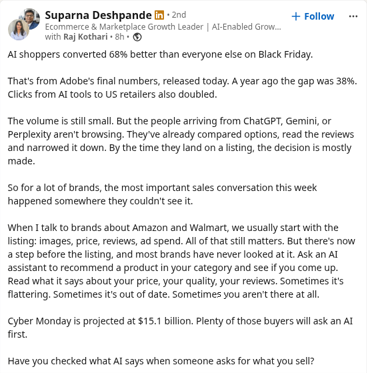
Per her read of Adobe’s final numbers, the gap was 38% a year ago, and clicks from AI tools to US retailers doubled. The volume is still small, but these shoppers show up with the decision mostly made.
Ask ChatGPT, Gemini and Perplexity to recommend a product in your category and see if you come up. If you don’t, fix your listing content and reviews first, because that’s what these tools read.
Warren repeats the fake-deals claim, and Amazon says 98% were real
Sen. Elizabeth Warren posted on X on November 24 that “1 in 3 Amazon Black Friday ‘deals’ aren’t real deals.” It comes from the Groundwork study we covered last week, which tracked 351 products from Amazon’s 2024 and 2025 Black Friday and Cyber Monday deal lists and found 29.1% priced the same or higher than at some point in the prior 30 days. Amazon calls the claims flawed and says 98% of the products were the same or lower than the price over the past 30 days, and that 2026 event deals “in almost every case offer the lowest price over the past 30 days.” Groundwork wants a rule requiring retailers to show the lowest price from the 30 days before a sale.
Between Senate attention and Alexa’s price history, fake markdowns are now a liability. Don’t raise your price before a deal to make the discount look bigger. Run deals off your real 30-day price.
Source: Amazon, updated November 20, 2026 · Billionaires.Africa via Digital Kenya Business News
Shein pays $100 million to settle FTC charges over hidden reviews
The FTC said on November 24 that Shein will pay $100 million in consumer redress over allegations it suppressed negative and returned-item reviews, missed shipping promises without required delay notices, made customer service unreasonably hard, and made deceptive supplier-audit and US cotton claims. Per the complaint, Shein ships nearly 1 million packages a day to the US but had only five US phone support agents as of September 2025. The proposed order bars Shein from suppressing negative reviews and misrepresenting delivery times.
The FTC review rule has teeth. Never filter, bury or buy reviews, on Amazon or on your own site. And if your shipping promise is fiction, fix it before the FTC fixes it for you.
Source: FTC, November 24, 2026 · Digital Influence
If you don’t do PPC, your SEO suffers
Record traffic doesn’t help if your ads are burning cash. Noah Wickham and I walked through a PPC audit that found $10,000 wasted out of a $16,000 monthly budget, with zero orders from that spend and organic sales declining. Cut the waste, don’t cut the ads. If you don’t do PPC, your SEO suffers.
One question
Which hits your Q1 harder: the new tariff proposals, the January 5 Customs rule, or the January 11 bundling deadline?
Join the conversation on LinkedIn
Got a take on this? Comment on the LinkedIn post below or on the full article.