
Last Updated: August 30, 2026
Amazon PPC budget management starts with a number you cannot know yet. Most new sellers treat the budget as a fixed figure to solve before launch, when it is really a decision you revisit every week using your own campaign data.
Advertising on Amazon comes with many variables that can impact how much you spend and how quickly you generate sales. This is why it is important for sellers to understand what drives advertising costs instead of relying on one-size-fits-all recommendations.
With this comes Amazon PPC budgeting that changes as campaign performance, competition, and customer behavior evolve. What works for one product may be completely different for another, even within the same category.
In this guide, our Amazon agency will explain why there is no perfect Amazon PPC budget and what metrics actually matter when making spending decisions. You’ll also learn common budgeting mistakes to avoid, how to set up your first campaigns, and how to use real data to build Amazon advertising strategies that hold up as you grow.
Table of Contents
Our Amazon advertising experts can identify costly spending issues and build a data-driven strategy.
TL;DR - Amazon PPC Budget Management for New Sellers
There is no perfect Amazon PPC budget because advertising costs, competition, and conversion rates vary from one product to another. Your daily budget decides how fast you spend, while your targeting decides whether that spend was worth anything.
- Budget size is rarely the real problem
- Targeting decides where money goes
- Negative keywords protect launch spend
- Spend thresholds beat fixed click counts
- Scale proven campaigns, never starve them
A successful Amazon PPC budget is built through testing, measurement, and optimization. The more data you collect, the easier it becomes to allocate ad spend where it generates the best results.
Amazon PPC Budgets Are a Guess Until Data Proves Otherwise
Why There Is No Perfect Amazon PPC Budget
There is no perfect Amazon PPC budget that works for every seller because advertising costs vary significantly from one product category to another. While many experts recommend starting with a testing budget, the amount you ultimately need depends on data that can only be collected after your campaigns begin running.
One of the biggest reasons a fixed budget does not exist is that cost per click and conversion rates are different for every product. A keyword that costs a few cents per click will require a much different budget than one that costs several dollars, and a campaign converting at 20% will perform very differently from one converting at 4%.
Another factor is that PPC only drives traffic to your listing, but it does not guarantee sales. Your images, pricing, product-market fit, and overall listing quality influence how efficiently advertising dollars turn into revenue, which is why budgets should be adjusted based on performance data rather than predetermined numbers.
How Does Amazon Actually Spend My Daily Budget?
Amazon spends your daily budget as fast as the auction allows, with no pacing across the day. A small budget can empty within minutes when a lot of shoppers are active in your category.
Your daily budget is also an average across the calendar month rather than a hard daily cap, so a $50 budget is really a commitment of about $1,550 a month. Amazon allows a campaign to spend up to 100% above that average on a busy day by drawing on budget left unspent earlier in the month.
That answers the question new sellers ask most, which is why a campaign ran out of budget by noon. Running dry is only a problem when the campaign that went dark was the profitable one, because an out-of-budget campaign stops showing until the midnight reset.
What Causes Wasted Ad Spend on Amazon PPC
Wasted ad spend is money you paid for clicks that were never going to end in an order. Three causes account for most of it, and the size of your daily budget is not one of them.
- broad or auto targeting running with no negative keywords
- one campaign holding several products, so no single result is readable
- ad traffic pointed at a listing that cannot convert it
Published audit data puts typical monthly waste at 28% to 40% of ad spend, all of it on terms that click and never order, which at $40 a day is roughly $340 to $480 a month. Scaling a campaign in that condition does not fix the ratio, it just buys the same percentage of useless clicks at a higher volume.
How Do I Find Wasted Ad Spend in My Search Term Report?
Pull the search term report for the last 30 days and sort by spend. Waste sits at the top of that list, not scattered across the bottom.
Flag any term that spent more than your break-even cost per order with zero sales attached. For a $28 product at 30% margin, that break-even sits at about $8.40, so a term at $17 with no orders has already told you the answer twice.
Then flag the terms that are simply not your product. A shopper searching for a plastic version of what you sell in steel does not need 14 clicks to prove the point, and one click is enough to negate it.
The Metrics That Actually Determine Your PPC Budget
There are certain metrics that sellers should monitor to better understand how much they should actually allocate to their Amazon PPC budget. By tracking these metrics, sellers can make spending decisions based on performance data instead of guesswork.
- Cost Per Click (CPC): how much each click costs
- Conversion Rate (CVR): how often clicks become sales
- Click-Through Rate (CTR): how often shoppers click your ads
- Advertising Cost of Sales (ACoS): how much ad spend a sale requires
- Total Advertising Cost of Sales (TACoS): ad spend against total revenue
- Total Sales: whether advertising is driving business growth
- Cash Flow: how much ad spend your business can support
- Spend Threshold: when enough data has been collected
- Relevancy: how often Amazon shows your ads to shoppers
Definitions are the easy part; thresholds are what actually drive a budget decision. Your break-even ACoS equals your margin before ad spend, so a product with 30% margin breaks even at 30% ACoS.
Industry data puts average Amazon ACoS somewhere in the 25% to 36% range, which means the average seller sits close to break-even on ads. Beating the category average is not the goal; beating your own break-even number is.
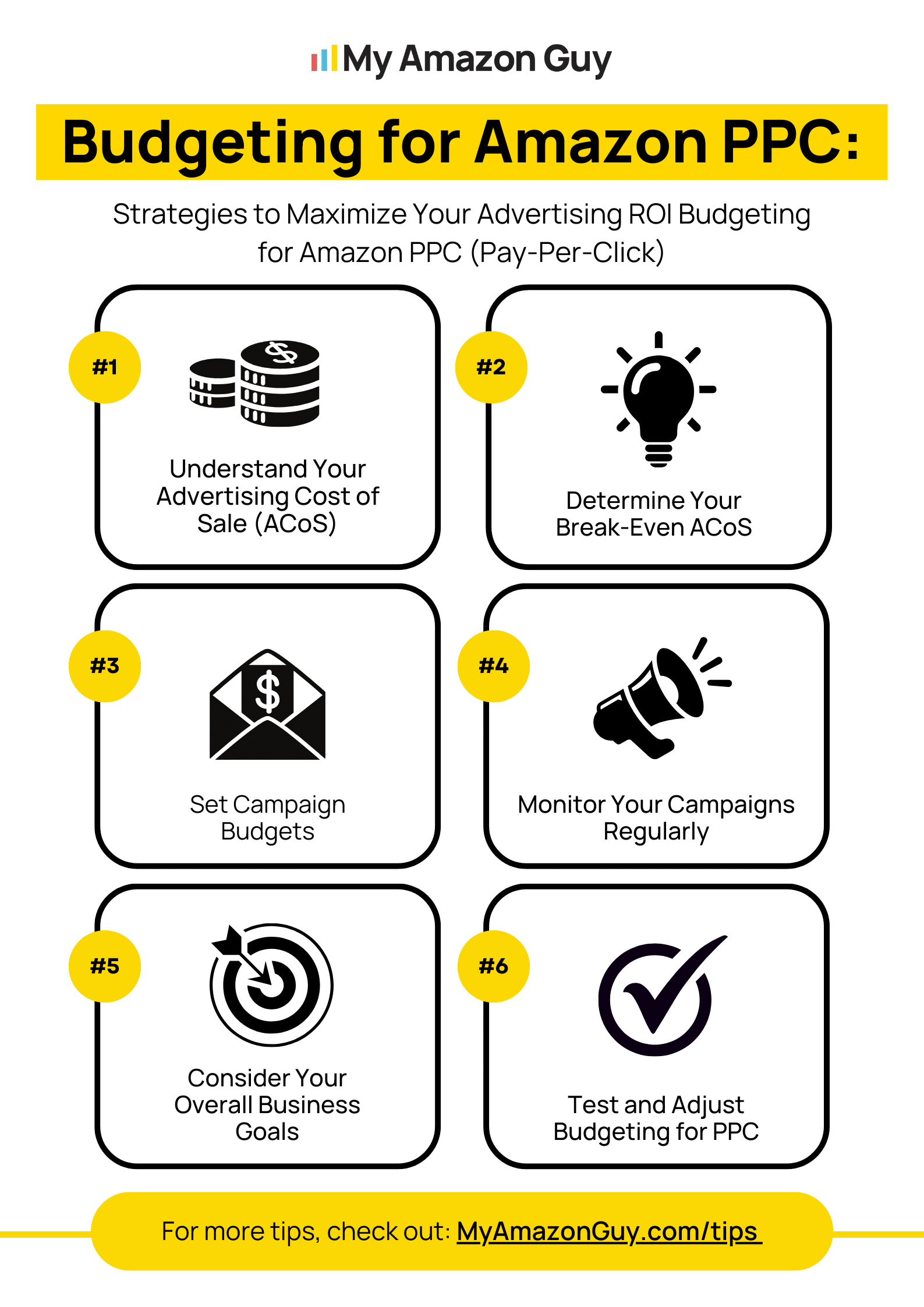
Budgeting for Amazon PPC
How Do I Compare My Numbers Against My Category?
Use Amazon’s own benchmarks rather than a blended platform average. Amazon made benchmarks reporting generally available across 18 marketplaces on May 18, 2026, covering eight metrics including cost per click and click-through rate measured against category peer brands.
That matters because a platform-wide average tells you very little about your situation. A $2.10 cost per click is normal in supplements and alarming in office products, and peer comparison is the only version of that number worth acting on.
How New Sellers Mismanage Amazon PPC Budgets Early On
New sellers mismanage Amazon PPC budgets by treating the daily budget as the main lever when targeting, bids, listing quality, and evaluation rules do far more damage. Around 71% of third-party sellers run at least one form of Amazon PPC, and most of them start the same way, with an auto campaign and a round-number budget.
These are the PPC budget mistakes that cost the most in the first 90 days. None of them looks expensive on the day it happens.
1. Looking for a Perfect Starting Budget
Sellers burn a week deciding between $25 and $40 a day, then learn nothing from either. Every starting budget is a testing figure that your own data replaces inside two weeks.
Before you set a daily budget, decide the ACoS each campaign is allowed to hit. Our guide on how to find your ideal true ACoS builds that target from your own margin instead of an industry average.
2. Launching Without a Single Negative Keyword
An auto campaign with no negatives lets Amazon match your ad against anything loosely related to your product. Your first negative list should exist before launch, built from competitor terms, wrong materials, wrong sizes, and price-shopper language.
3. Trusting Amazon's Suggested Bids Too Much
Amazon builds its recommended budget by multiplying the clicks it estimates you missed by your estimated cost per click, which makes it a volume calculation rather than a profit one. Treat suggested bids and budgets as market information, not as instructions for a new ASIN that has not earned relevancy yet.
4. Increasing Budget Before Improving the Listing
More budget will not solve problems caused by weak images, thin copy, or a price the market rejects. Ads buy traffic, and a listing that converts at 4% turns that traffic into an expensive lesson.
5. Failing to Set a Spend Threshold
A spend threshold is the amount one keyword may spend before you judge it, and it should come from your break-even cost per order rather than a fixed click count. That same $28 product can give a keyword about $17, which is roughly 14 clicks at the current average cost per click.
6. Changing Settings Every Time You Open Campaign Manager
New sellers adjust bids far more often than the data supports, and every change resets the clock on the test they were running. Amazon attribution also updates over several days, so a Tuesday decision made on Monday numbers is a decision made on incomplete information.
7. Spreading a Small Budget Across Too Many Targets
A $30 daily budget split across twenty keywords buys a few clicks each and never proves anything about any of them. Concentrate the same money behind five terms, and you get answers in two weeks instead of guesses in two months.
8. Refusing to Scale What Already Works
A budget cap becomes a growth ceiling once a campaign holds a profitable ACoS and spends its full budget every day. Sellers who fail to increase budgets on proven campaigns miss the revenue they already paid to prove was available.
We optimize PPC campaigns to help sellers generate more revenue from every advertising dollar.
Amazon PPC Campaign Setup for New Sellers
Good Amazon PPC campaign setup protects your budget better than any bid adjustment. Structure decides whether your first month produces readable data or an expensive blur.
What Should I Do Before I Turn On a Campaign?
Confirm the listing can convert the traffic you are about to buy. Ads amplify whatever the listing already does, so a weak main image simply gets exposed faster and at a higher cost.
Run this build order before you spend a dollar, because it is one of the few new seller Amazon tips that pays off before launch day.
- Confirm the listing is retail-ready with strong images, complete content, and a competitive price
- Calculate your break-even ACoS, which equals your margin before ad spend
- Convert that into a break-even cost per order, and a per-keyword spend threshold
- Build a starting negative keyword list from irrelevant terms you already know about
- Pick 5 to 10 keywords that describe the product precisely
- Write down what you will do at 7 days, 14 days, and 30 days
- Launch, then leave the settings alone until the first checkpoint
Step 6 is the one nearly everyone skips. A rule written before launch survives contact with bad data, while a decision made at 9 pm in front of a red ACoS number does not.
How Do I Set Up My First Amazon PPC Campaign?
Start with one campaign per product and a small keyword count inside it. That structure stops a single keyword from hiding inside a campaign average, which is the only way a new seller can see what is working.
Run manual and auto together, with manual holding the majority of the budget. A reasonable early split puts about 80% of spend on manual exact and 20% on auto, because the auto campaign earns its place by feeding you search terms rather than by delivering profit.
Which Targeting Choices Waste the Most Money at Launch?
Match type is where launch budgets quietly disappear. Broad match reaches the most shoppers and converts the worst, which is a bad trade when you have two weeks of data to collect.
| Targeting choice | What it is for at launch | Waste risk |
|---|---|---|
|
Manual exact
|
Buying terms you already believe convert
|
Low, spend stays where you aimed it
|
|
Manual phrase
|
Controlled expansion after exact proves out
|
Medium, needs weekly negatives
|
|
Broad match
|
Discovery only, small budget, tight negatives
|
High, matches loosely related searches
|
|
Auto campaign
|
Harvesting real shopper language
|
High without negatives, useful with them
|
|
Product targeting
|
Defending against specific competitor ASINs
|
Medium, easy to overexpand
|
Broad match and auto both belong in a launch account. They belong there on a small share of spend with a negative list attached, not as the default home for your budget.
Should New Sellers Use Auto or Manual Campaigns First?
Run both, and give manual campaigns the majority of the budget. Auto campaigns are research tools that reveal what shoppers actually search; manual campaigns are where you buy the terms you already believe in.
A reasonable early split puts about 80% of spend on manual and 20% on auto. The auto campaign earns its place by feeding you search terms, not by delivering profitable sales.
What Daily Budget Should a New Amazon Seller Start With?
Set a budget that can reach a verdict on your keywords within 14 days, and no more. For most new sellers running one to three products, that lands between $20 and $50 a day is enough.
Work backwards from clicks rather than forwards from the cash you are willing to lose. The current average Amazon cost per click sits near $1.22, so $40 a day buys roughly 33 clicks and enough weekly volume to judge five keywords in two weeks.
Amazon SEO Guide – How to rank #1 on Amazon without ads in 2026
How to Build an Amazon PPC Budget Using Real Data
Part of advertising on Amazon means setting aside a budget for Amazon PPC campaigns. By following a data-driven approach, sellers can make smarter budgeting decisions and adjust spending based on actual performance instead of assumptions.
Step 1: Start With a Testing Budget
Size the testing budget from your own margin by multiplying your break-even ad cost per order by two, then by the number of keywords you are testing, and spreading that across 14 days. For a $28 product testing five keywords, that comes to about $85 total, which is why a $20 to $50 daily budget is comfortably sufficient for a first product.
Step 2: Use a Conservative Bidding Strategy
A conservative bidding approach can help prevent unnecessary spending while campaigns are still gathering data. This gives sellers more control over costs during the testing phase, and our guide on Amazon PPC bidding strategy covers when to raise a bid on a proven term.
Step 3: Analyze Your Actual Cost Per Click
Pull the search term report after your first full week and divide spend by clicks for each term, because your real cost per click decides how much budget any result costs you. The gap between the suggested bid and what you actually paid is usually where the first budget correction comes from.
Step 4: Set a Spend Threshold
Establish a spending limit that determines when a keyword has collected enough data for evaluation, using the break-even math from mistake five above. This prevents underperforming targets from consuming budget that a proven keyword could be using.
Step 5: Monitor Click-Through and Conversion Rates
CTR and conversion rate indicate how efficiently your listing turns ad traffic into sales. Low click-through points at your main image and price, while healthy click-through with weak conversion points at the listing itself, which is a listing optimization problem rather than a budget one.
Step 6: Scale Budgets Based on Performance
Ad spend optimization is not about spending less; it is about moving money toward what already converts. Increase budgets when campaigns consistently hold a profitable ACoS, and support every increase with performance data rather than guesswork.
PPC Bidding Hacks for Higher Conversions
Which Method Should I Use to Set My Amazon PPC Budget?
Most new sellers use one of four methods to set a budget, and only one of them survives contact with real numbers. The table below shows what each approach actually does and where it quietly costs you money.
| Method | What it actually does | What it costs you |
|---|---|---|
|
Percentage of revenue
|
Ties spend to sales you already have
|
Underfunds launches, overfunds mature ASINs
|
|
Round daily number
|
Feels controlled, ignores your math
|
Buys too little data to decide anything
|
|
Amazon’s recommended budget
|
Buys the clicks Amazon estimates you missed
|
Volume you may not convert profitably
|
|
Break-even backsolve
|
Sets spend from margin and conversion rate
|
Requires real numbers, which is the point
|
Budget Controls That Prevent Wasted Amazon Ad Spend
Controls are what turn a budget into a system. Each one below answers a specific way accounts leak money, and each has a cadence attached.
| Control | What it prevents | Cadence |
|---|---|---|
|
Negative keyword additions
|
Paying for searches your product cannot serve
|
Weekly |
|
Per keyword spend threshold
|
Endless data collection on a losing term
|
Every review
|
|
Break-even ACoS target
|
Chasing a category average that ignores margin
|
Set once, revisit on cost changes
|
|
Single campaign per product
|
Winners and losers averaging each other out
|
At build
|
|
Change freeze between checkpoints
|
Resetting the clock on your own tests
|
14 day windows
|
|
Search term harvest
|
Profitable terms staying stuck in auto
|
Every two weeks
|
The change freeze is the hardest one to hold and the most valuable. Attribution updates over several days, so numbers read on day three describe a campaign that no longer exists once you change it.
FAQs About Amazon PPC Budget
How Much Does Amazon PPC Cost Per Day for a New Seller?
Most new sellers running one to three products spend between $20 and $50 a day while testing. Your actual cost depends on your category's cost per click, which can range from under a dollar to several dollars per click on competitive terms.
What Is a Good Starting Amazon PPC Budget?
Start with a budget that can reach a verdict on your keywords within 14 days, which for most new sellers is $20 to $50 a day. The right number comes from your break-even cost per order and your actual cost per click, not from a flat range you found online.
How Much Amazon PPC Budget Is Normally Wasted?
A data audit puts typical waste between 28% and 40% of monthly spend, concentrated in search terms that generate clicks and no orders. Most of that is recoverable with a weekly negative keyword routine, which is why an audit should come before a budget increase.
What Is a Good ACoS for a Brand New Product?
A good ACoS for a new product is often above your break-even number, because early spend buys ranking data rather than profit. Your break-even ACoS equals your margin before ad spend, and average Amazon ACoS sits roughly between 25% and 36%, which puts the average seller close to that line already.
Why Is My Amazon PPC Spending Money With No Sales?
Spend without sales means either the traffic is irrelevant or the listing is not converting the traffic you bought. Read the search term report first to see what you actually paid for, then compare your conversion rate against your category before touching the budget.
How Many Negative Keywords Should a New Campaign Have?
Start with a list built before launch and add to it every week from the search term report. There is no target number to hit, because a healthy negative list is a byproduct of the weekly routine rather than a goal in itself.
Should I Lower My Budget or My Bids on Amazon?
Lower your bids when your cost per click is too high for your margin, and move budget when the wrong campaigns are receiving it. Cutting a budget leaves the same expensive clicks in place and simply runs the campaign dry earlier in the day.
Should I Increase My Amazon PPC Budget?
Increase when a campaign has held a profitable ACoS for at least two weeks and regularly spends its full daily budget. Raising the budget on a campaign that never spends its current one changes nothing, and raising it on an unprofitable campaign multiplies the loss.
How Much Amazon PPC Budget Do I Need to Rank Organically?
Ranking follows conversion velocity on a specific keyword, so concentrate enough budget to win consistent daily orders on one term. A small budget aimed at a single keyword beats a larger budget spread across twenty.
How Long Before I Change My Amazon PPC Budget?
Give any budget change at least 14 days before judging it, and let attribution finish updating before reading results. Changes made every few days produce data nobody can interpret, because each change restarts the test you were running.
Stop Guessing and Let Data Guide Your Budget
Managing Amazon advertising costs is an important part of running a profitable business because even small costs per click can quickly add up over time. Without proper budgeting, sellers can easily overspend on campaigns that are not generating meaningful results.
Set your break-even before launch, hold the structure for 14 days, then scale behind whatever earns it. That sequence costs nothing and removes most of the waste a first quarter audit turns up.
Still unsure how much money you should allocate to your Amazon PPC budget? Reach out to our full-service Amazon agency and let our Amazon experts analyze your advertising performance, optimize your campaigns, and build a data-driven strategy designed to maximize sales and profitability.
Our Amazon experts use real performance data to improve efficiency and maximize advertising results.