Your ads are spending money right now, and Amazon does not care whether that money comes back. That is the quiet problem eating your margin while your ACoS report tells you everything is fine.
Amazon PPC management services plan, build, and optimize your Sponsored Products, Sponsored Brands, and Sponsored Display campaigns so ad spend produces profitable growth instead of expensive impressions. The good ones tie every bid back to your margin and your organic rank, then report the numbers that actually move your bottom line.
Here is what most mid-market sellers miss. Running ads is easy, and Amazon will happily burn your entire budget for you, so the real job is spending in a way that compounds. We have managed $1.2B+ in e-commerce revenue across 400+ brands, and the pattern almost never changes.
This guide shows you how profitable Amazon PPC management actually works, from the TACoS-first framework we use to the 2026 benchmarks that tell you what good looks like. Our Amazon agency covers how to structure campaigns to scale, why your ACoS keeps climbing, how the paid-to-organic flywheel lowers your ad dependency, and how to tell whether your agency is growing your business or just shrinking a number on a slide.
Table of Contents
Stop Renting Revenue From Your Ads
Get a $500 audit that shows exactly where your spend leaks and what to fix first.
TL;DR - Amazon PPC Management Services That Actually Pay Off
Amazon PPC management services that scale revenue profitably grow your total sales while holding TACoS steady, not just lowering ACoS on a report. The agencies worth paying manage to Total Advertising Cost of Sales against your margin, then prove it with numbers you can see in your P&L.
- Steer by TACoS, optimize with ACoS
- Healthy TACoS runs 10% to 15% for established brands, 25% to 40% at launch
- Sponsored Products CPC rose roughly 34% year over year, so waste now eats real profit
- Scaling is a flywheel: ads drive velocity, velocity builds rank, and rank lowers TACoS
- The fastest fix is usually the listing, not the bid
TACoS steers the business while ACoS grades a campaign. Manage to the first, use the second as a tool, and your ad spend builds a rank you keep instead of renting revenue by the month.
What Are Amazon PPC Management Services
Amazon PPC management services are the ongoing work of building and optimizing your ad campaigns so they drive profitable revenue, not just clicks. That work spans campaign architecture, keyword research, bidding, negative keyword hygiene, full-funnel expansion, and reporting against margin, run every week instead of once a quarter.
Amazon advertising is now table stakes, not an edge. Roughly 71% of third-party sellers and 79% of first-party vendors actively run Amazon ads, which means you are bidding against nearly everyone in your category.
When the whole field advertises, the biggest budget stops being the advantage. The winner is the sharpest system, and that system is exactly what a real management service builds.
What Is Included in Amazon Advertising Management
A full-service engagement covers the whole lifecycle, not a single lever. At My Amazon Guy, the work below runs every week, which is why we treat Amazon advertising management as an operating system, not a monthly tune-up.
- Campaign Architecture
Separate campaigns by intent so you bid hard where you win and test cheap where you learn. - Keyword Research and Harvesting
Proven winners graduate from broad discovery into tightly controlled exact-match campaigns. - Bid and Placement Management
Top-of-search multipliers set by product maturity, because a page-one hero and a page-three launch need opposite treatment. - Negative Keyword Hygiene
Weekly pruning of junk search terms, since negations are mosquito repellent that blocks the bloodsuckers before they drain your budget. - Full-Funnel Expansion
Sponsored Brands video and Sponsored Display for mid-funnel reach once the core is profitable. - Reporting Against Margin
Weekly numbers on revenue, spend, ACoS, TACoS, and True ACoS so you always know whether ads are building or renting.
MAG runs this as a documented service with weekly reporting on the metrics that matter, from True ACoS to sessions and unit session percentage. The reporting is the accountability, and accountability is what separates management from babysitting.
What Does Profitable Amazon PPC Look Like
Profitable Amazon PPC looks like total revenue climbing while TACoS holds steady or falls, with a rising share of sales arriving organically. It does not look like a low ACoS sitting next to flat sales, which is the most common disguise for a shrinking business.
Picture two accounts, one showing a proud 15% ACoS with flat total sales, the other showing a 35% ACoS with sales up 40% year over year and TACoS trending down. The second account is winning, and it is not close.
How Do Amazon PPC Agencies Scale Revenue Profitably
Amazon PPC agencies scale revenue profitably by managing to TACoS against contribution margin, building a paid-to-organic flywheel, and cutting waste faster than costs rise. Everything else is tactics in service of those three moves.
Let me be direct, because most agencies sell you a lower ACoS, and lower ACoS is the easiest number in the world to fake. Slash the bids, pause the aggressive campaigns, and ACoS drops overnight while total sales quietly collapse underneath it.
What Is the PPC to Organic Flywheel on Amazon
The flywheel is the loop where paid sales drive ranking velocity, higher organic rank cuts your reliance on ads, and the recovered margin funds new keyword bets. Spin it correctly, and TACoS falls while total revenue climbs.
This is the mechanic almost every TACoS guide skips, because ad clicks create conversion velocity, and velocity is what Amazon rewards with organic rank. Cut bids too hard, and you break the loop, since fewer clicks mean less velocity and rank slides backward.
The flywheel only spins when your advertised keyword matches your listing content, so irrelevant targeting burns budget without building any rank. That is why profitable PPC and strong SEO are one project instead of two departments, and why our 4-phase Amazon SEO service is built to feed that loop on purpose.
How Does PPC Affect Organic Ranking on Amazon
PPC drives the sales velocity that Amazon’s algorithm reads as demand, and sustained velocity lifts your organic rank. That is why paid and organic are one strategy, and why cutting ads to save money often costs you the rank you already paid to earn.
Phase four of our SEO work uses the Search Query Performance report to grow market share by shopper intent rather than raw ranking. When the keyword you advertise matches the keyword you rank for, every ad dollar does double duty.
Our Amazon experts break down this human-plus-data approach across the My Amazon Guy YouTube channel. The weekly Ask Me Anything sessions field live PPC questions from sellers, so you can watch the method applied to real accounts.
ACoS vs TACoS: The Metric That Decides Everything
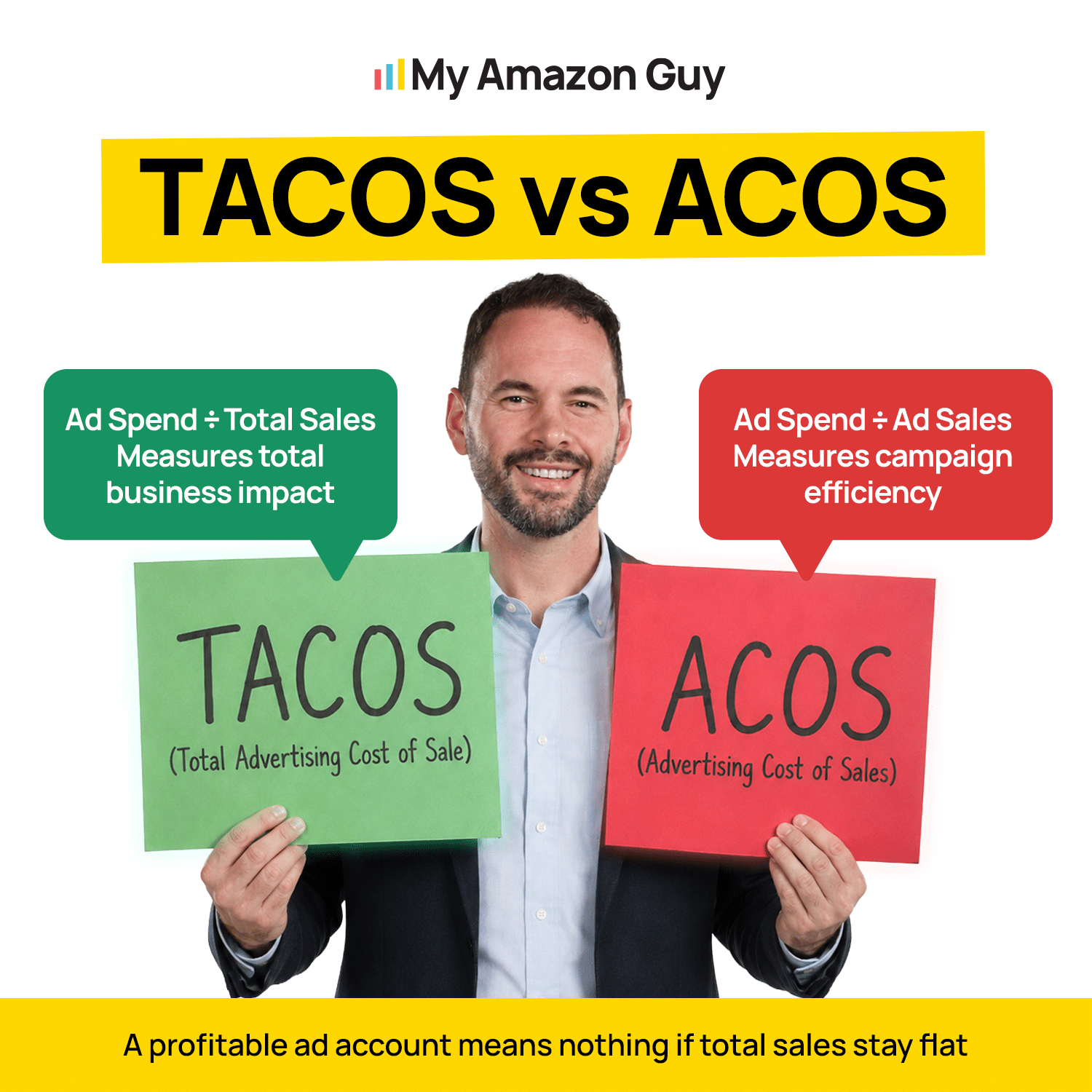
ACoS measures ad spend against ad-attributed sales, so it grades campaign efficiency, while TACoS measures ad spend against your total Amazon revenue, so it grades business health. You optimize with ACoS, but you steer with TACoS.
What Is the Difference Between ACoS and TACoS
Picture ACoS as your speedometer and TACoS as your fuel gauge. Speed tells you how one campaign is running right now, but the gauge tells you whether the whole trip is sustainable.
A 15% ACoS looks profitable on its own, yet if your TACoS sits near 15% too, almost nothing you sell is coming from organic. You have built a business that stops the second you stop paying Amazon.
| Metric | What it measures | Best used for |
|---|---|---|
|
ACoS |
Ad spend / ad-attributed sales |
Judging one keyword or campaign, daily |
|
TACoS |
Ad spend / total Amazon sales |
Steering the whole account, monthly |
|
True ACoS |
Ad spend against blended profit |
Sanity-checking against real margin |
What Is TACoS and Why Does It Matter More Than ACoS
TACoS is total ad spend divided by total Amazon revenue, organic sales included, so it shows whether advertising is building your business or just renting a month of revenue. It matters more than ACoS because it is the only number that reveals how dependent you are on paid traffic.
Read the two together, and the account tells the truth. A 50% ACoS with an 8% TACoS is not a problem because the ads are fueling profitable organic velocity, while a 15% ACoS with a 15% TACoS is the real emergency hiding behind a pretty number.
This is the mental shift the fastest-growing sellers make somewhere between $1M and $3M in revenue. ACoS becomes a tool, and TACoS becomes the goal.
What Good Looks Like: 2026 Amazon PPC Benchmarks
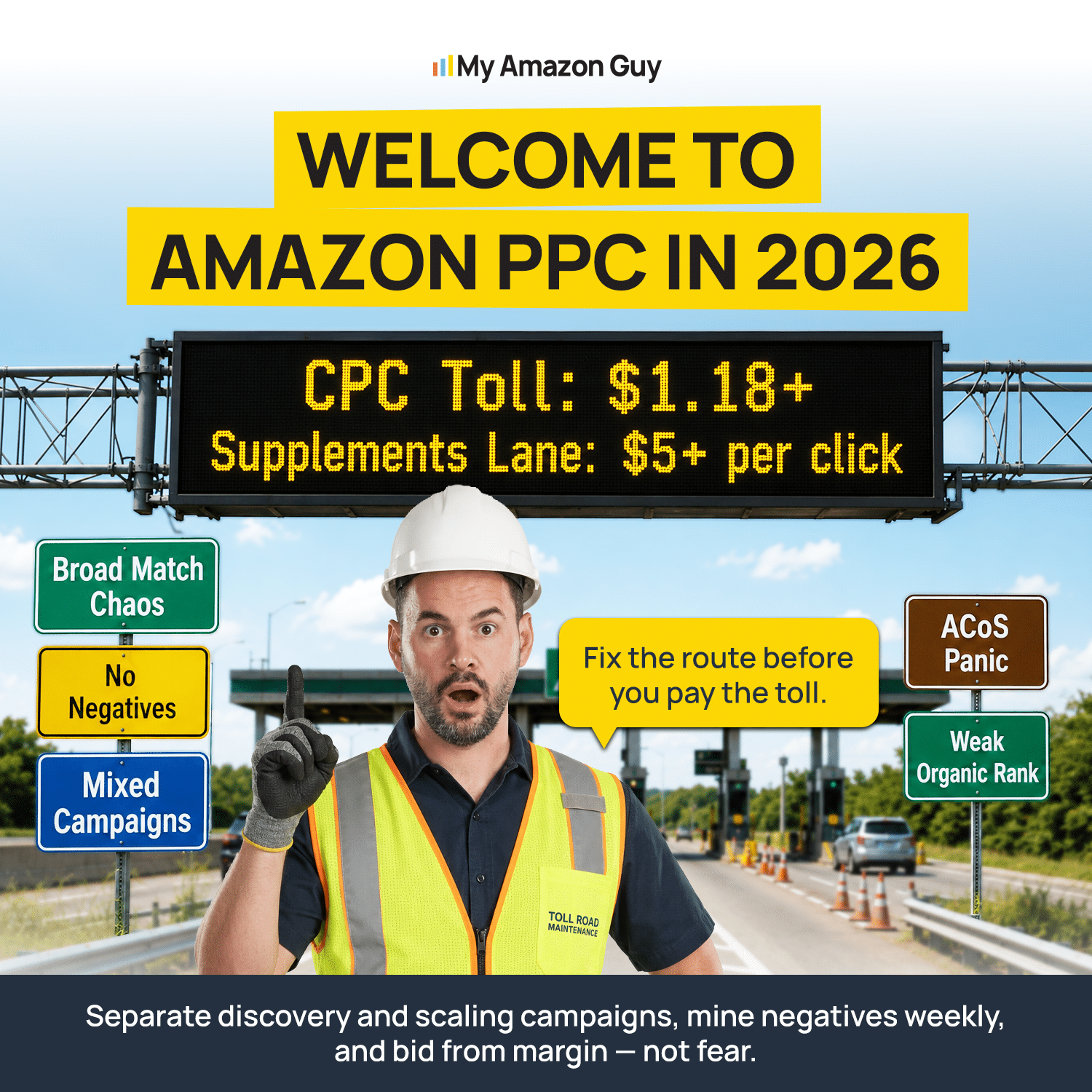
Healthy 2026 benchmarks sit near 28% to 32% ACoS, 10% to 15% TACoS, roughly $1.07 to $1.34 CPC, and a 10% to 13% conversion rate. These are reference points, not targets, because your margin and lifecycle stage decide what good means for you.
| Benchmark | 2026 healthy range | What pushes you outside it |
|---|---|---|
|
ACoS |
28% to 32% |
Weak conversion, thin margin, launch phase |
|
TACoS |
10% to 15% |
Flat organic, over-reliance on ads |
|
CPC (Sponsored Products) |
$1.07 to $1.34 |
Category competition, rising demand |
|
Conversion rate |
10% to 13% |
Listing quality, price, review count |
|
CTR |
0.3% to 0.6% |
Main image, title, targeting relevance |
What Is a Good TACoS on Amazon in 2026
For an established brand with a solid organic base, a healthy TACoS runs about 10% to 15%. Launch-phase brands sit at 25% to 40%, which is fine when margin supports it and the number trends down as rank builds.
Across one managed portfolio, the median account ran a 15% TACoS in the first half of 2026, with the middle half falling between 10% and 21%. Below 10% often signals a strong organic base or under-investment in growth, so a low TACoS is not automatically a win.
What Is a Good ACoS on Amazon in 2026
A good ACoS in 2026 generally lands between 25% and 32%, but the number only means something next to your gross margin. An ACoS below your margin makes ads directly profitable, while launches deliberately run higher to build rank.
Average ACoS sits around 30% to 32%, with top performers holding 23% to 26%. A brand-defense campaign should run a lean 5% to 10%, while a category-conquest campaign chasing new-to-brand buyers can justify 25% to 40% if those buyers repeat.
Why Is My Amazon ACoS Going Up
Rising ACoS usually traces to one of three causes: climbing CPCs, a listing that stopped converting, or budget leaking into search terms that never buy. Diagnose the cause before you touch a single bid.
Costs are the first culprit, and precision now matters more than budget. Sponsored Products CPC climbed roughly 34% year over year to about $1.34, with CPM rising even faster, so the waste you tolerated last year is the profit you lose this year.
Conversion is the second cause, and Amazon’s average ad conversion rate runs about 10.5% in 2026, far above the general e-commerce rate of 1% to 2%. A rate under roughly 7% almost always points to your main image, price, or reviews rather than your bids.
Category context is the third, since food and grocery convert near 13.7% while clothing sits around 7.3%, so a fair benchmark is your category median, not a sitewide average. Amazon’s conversion advantage holds near double the industry norm, which is exactly why waste hurts so much when you let it slide.
Stop Guessing, Start Compounding
Let our specialists rebuild your campaigns around the paid-to-organic flywheel.
The MAG Method: How to Structure PPC to Scale
We separate campaigns by shopper intent, bid by product maturity, prune waste weekly, and connect every ad decision to organic rank. The structure is boring on purpose because boring is what compounds.
How Do I Structure Amazon PPC Campaigns to Scale
Most sellers dump every keyword into one campaign and then wonder why they cannot optimize. You cannot bid aggressively on a term that wins and cautiously on a term that is still learning if they share a budget.
- Branded Exact
Defend your own name at a lean ACoS before competitors buy it out from under you. - Category Exact
Your proven winners with tightly controlled bids and the bulk of profitable volume. - Competitor Conquesting
Product targeting on rival detail pages to catch high-intent shoppers at the decision point. - Broad Discovery
A cheap testing ground that surfaces new exact-match winners to harvest each week.
How Do I Scale Amazon Ad Spend Profitably
Scale spend profitably by increasing budget only where TACoS holds or improves at the ASIN level, and by fixing conversion before you add impressions. Pouring traffic onto a page that does not close is how sellers set money on fire.
- Anchor to Break-Even First
Know your contribution margin per ASIN so you can tell a profitable ACoS from a vanity one. - Confirm the Listing Converts
If conversion trails your category median, the click is landing on a page that cannot close. - Scale Winners, Starve Losers
Move budget toward exact-match terms that hit the target, and negate terms that never convert. - Watch TACoS as You Add Spend
If TACoS climbs while total sales stay flat, you are outbidding yourself, not growing.
How Do I Lower TACoS Without Cutting Sales
Lower TACoS by improving keyword-to-listing relevance and conversion so organic sales grow faster than ad spend, not by slashing bids. TACoS is a keyword and listing problem more than a bid problem, so fixing the page usually moves it further than cutting the budget.
Cutting bids to chase a lower TACoS breaks the flywheel. Fewer clicks mean fewer conversions, velocity drops, and organic rank stalls.
The ratio actually worsens because your organic sales shrink faster than your spend. The durable way down is to make the listing convert and the targeting relevant.
In-House vs an Amazon PPC Agency: Which Scales Better
Run PPC in-house when you have a dedicated, trained specialist watching the account weekly. Hire an Amazon PPC agency when you need senior expertise, faster optimization cycles, and accountability without the headcount cost. The wrong answer is the one nobody owns.
Should I Manage Amazon PPC In-House or Hire an Agency
The reality is that PPC is not a set-it-and-forget-it task. It demands weekly negative keyword pulls, placement testing, bid schedules, and query-level diagnostics, and most in-house teams simply run out of hours.
| Factor | In-house | Amazon PPC agency |
|---|---|---|
|
Expertise depth |
One generalist, limited reps |
Specialists across many accounts |
|
Optimization cadence |
Often monthly at best |
Weekly, sometimes daily |
|
Cost structure |
Salary plus tools plus training |
Retainer aligned to results |
|
Cross-channel view |
Siloed from SEO and design |
PPC, SEO, and listing in one team |
|
Accountability |
Competing internal priorities |
Reporting is the deliverable |
MAG assigns seven to eight specialists per client rather than the two most competitors staff, so PPC, SEO, catalog, and design push in the same direction. That is the difference between a new PPC hire who nukes your old campaigns and a team that protects the rank you already built.
Is an Amazon PPC Agency Worth It
An Amazon PPC agency is worth it when it grows total revenue while holding TACoS, which most in-house teams cannot do consistently because PPC needs weekly senior attention. Judge worth by total profit and TACoS trend, not by a falling ACoS in isolation.
The retail media market now exceeds $101 billion and grows at nearly 28% a year, so brands still treating PPC as a keyword-bidding exercise are losing to brands who have turned it into a system. The winners are not the ones spending the most; they are the ones optimizing the fastest.
How Do I Know if My PPC Agency Is Doing a Good Job
A good agency reports TACoS and margin, not just a falling ACoS, and can show total revenue growing while efficiency holds. If the only number that improves is ACoS while total sales slide, you are being managed for the report, not the business.
- Total sales and TACoS trend appear before any campaign-level ACoS.
- Budget decisions reference contribution margin per ASIN, not gut feel.
- You see negative keywords added and waste recovered every week.
- Reports show organic rank moving, not just ad metrics in a vacuum.
What KPIs Should an Amazon PPC Agency Report
At minimum, total revenue, ad spend, ACoS, TACoS, True ACoS, conversion rate, and organic rank movement. If the report leads with a falling ACoS and hides total sales, treat that as a warning sign, not a win.
What Amazon PPC Services Cost, and How to Start
Most Amazon PPC services run on a monthly retainer, sometimes with a performance component tied to results. Pricing varies by catalog size and scope, so judge the fee against the profit the management protects, not the sticker alone.
How Much Does Amazon PPC Management Cost
Bottom line, the right question is not what management costs, but what mismanagement costs. With CPCs up 34% and roughly 71% of sellers advertising, a single month of wasted spend compounds fast.
How Do I Audit My Amazon PPC Account
Pull the last 90 days, check TACoS against margin, compare CTR and conversion to your category median, and flag any search term with 10-plus clicks and zero orders. That is the fast self-audit, and it tells you within an hour whether the problem is your bids or your listing.
A fixed-scope professional audit does the same work faster and hands you a prioritized roadmap. MAG runs a $500 advertising audit that finds wasted spend, weak campaigns, and coverage gaps before you commit to full management, so you learn exactly what is broken and then decide.
Frequently Asked Questions
Is an Amazon PPC agency worth it?
Yes, when it grows total revenue while holding TACoS, which most in-house teams cannot sustain because PPC needs weekly senior attention. Judge worth by total profit and TACoS trend.
How much does Amazon PPC management cost?
Usually a monthly retainer that scales with catalog size and scope. The better frame is what mismanagement costs, since with CPCs up 34% a month of waste compounds quickly.
How long does it take to see PPC results?
It depends. However, campaign efficiency can improve within 30 days, while the organic rank lift from the flywheel usually takes 60 to 90 days.
Stop Renting Revenue, Start Building It
Profitable Amazon PPC is not about spending less or chasing a prettier ACoS; it is about growing total revenue while TACoS holds or falls. Steer by TACoS, optimize with ACoS, and let the paid-to-organic flywheel turn every ad dollar into rank you keep.
The sellers who win in 2026 are not the ones with the biggest budgets; they are the ones with the sharpest systems. Fix the listing before the bid, prune the waste every week, and measure whether your ads are building a business or renting one month of revenue at a time.
Are you tired of watching CPCs climb while your agency reports a shrinking ACoS and flat sales? Contact our full-service Amazon agency and let our Amazon experts audit your account, rebuild your campaigns around TACoS, and scale your revenue profitably.
Find Out What's Breaking Your PPC
A fixed-scope audit finds wasted spend and weak campaigns in days, not months.