Last updated: August 28, 2026
AI Amazon product images are quickly becoming a go-to for Amazon sellers who want faster, lower-cost visuals. But professional product photos still dominate when it comes to trust, brand consistency, and conversions; so which should you choose?
As AI technology advances, it’s being used in nearly every aspect of e-commerce, from copywriting to ad design. While AI tools allow sellers to create product images quickly and affordably, professional photography still provides polished, high-quality visuals that establish credibility and showcase products accurately.
Because of these options, many sellers are tempted to rely solely on AI-generated visuals or invest heavily in professional photos. However, both approaches have strengths and limitations, and choosing the wrong strategy could impact conversions, brand perception, and overall sales.
We have managed $1.2B+ in ecommerce revenue across 400+ brands, and image decisions move the numbers faster than almost anything else on a listing. The right answer is usually a mix, and the mix depends on which image slot you are filling.
This article is about the differences between AI Amazon product images and professional product photos, including their benefits and limitations. We also share practical guidance to help sellers decide which option fits their budget, goals, and listing needs.
Table of Contents
Boost Conversions with Better Images
Let our Amazon experts help you create images that attract buyers and reduce returns.
TL;DR - AI Amazon Product Image vs Professional Photos
AI images and professional photos solve two different listing problems.
- AI Amazon product image tools draft fast.
- Human edits still fix logos, text.
- Professional photos carry trust, conversions.
- Main image rules suppress noncompliant uploads.
- AI-generated people require metadata disclosure.
Sellers waste budget applying one method to every image. This guide shows which slot each option fits, and where compliance quietly suppresses listings.
Why Product Images Matter on Amazon
Product images are often the first thing shoppers notice, and they play a huge role in influencing purchase decisions. Studies show that around 75% of online shoppers rely on product photos to decide whether to buy, making clear and high-quality images essential for capturing attention.
Beyond grabbing attention, great product images build trust and communicate important details like features, dimensions, and usage. High-quality visuals also enhance a product’s perceived value, reduce returns, and can even improve its ranking in Amazon search results, driving more sales.
What Are AI Amazon Product Images and How They Work
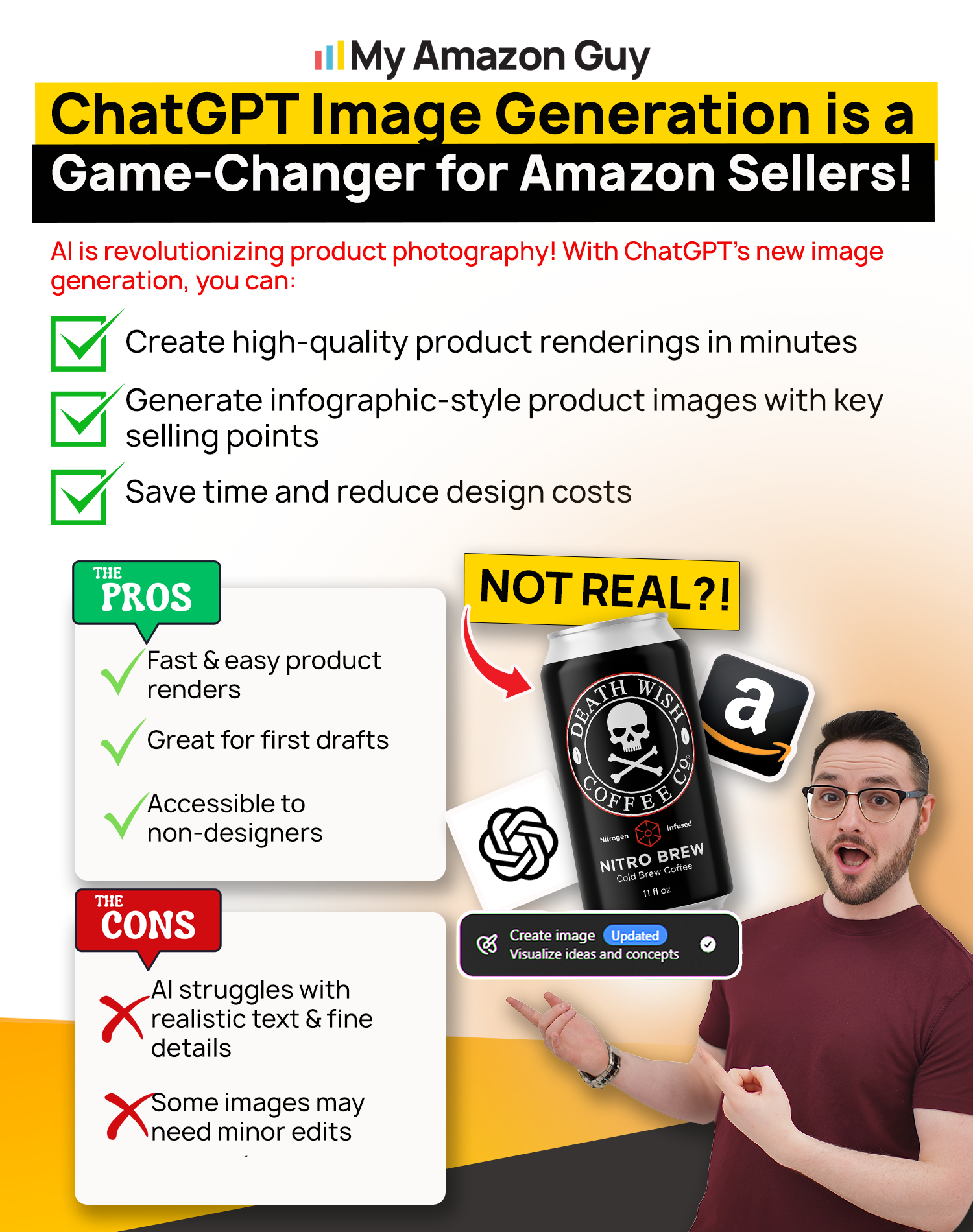
AI Amazon product images are visuals created using generative AI to produce high-quality product renderings, infographics, and lifestyle photos from an initial product photo. These tools allow sellers to quickly generate professional-looking images that can enhance listings and ads without needing a traditional photoshoot or design expertise.
The AI works by analyzing the product’s image, description, and even customer reviews to understand its context and features. It can then create new scenes, backgrounds, and themed variations, and sellers can refine the results using prompts to achieve the desired look for their Amazon listings.
The Benefits of Using AI Amazon Product Images
There are a bunch of advantages to using AI-generated images for Amazon product listings, which is why many sellers are adopting them now. These benefits make creating professional-looking visuals faster, easier, and more cost-effective than traditional methods.
- AI eliminates the need for expensive photographers, models, and studio rentals, making it more affordable.
- Images can be generated in minutes, allowing sellers to create multiple variations quickly for testing or seasonal updates.
- AI allows easy customization with different backgrounds, angles, and themes to create diverse and engaging visuals.
- It produces high-quality first drafts that are close to final-ready, even for sellers without design experience.
- Infographic-style images can be generated automatically to highlight key selling points and improve conversions.
The Limitations of Using AI Amazon Product Images
Despite all the advantages AI-generated Amazon product images bring, there are also some limitations that make many sellers hesitant to rely on them fully. Understanding these drawbacks is crucial to avoiding potential mistakes and maintaining high-quality listings.
- AI images may not be perfectly realistic and often require human edits to fix minor flaws.
- Text, logos, and branding can be rendered incorrectly, which reduces authenticity and trust.
- Lifestyle shots featuring people can look unnatural, potentially hurting customer perception.
- Product proportions and details may become distorted when placed in AI-generated scenes.
- AI struggles with creating complex multi-module A+ content, limiting its use for advanced listings.
Do You Need to Disclose AI-Generated Images on Amazon?
Yes, when the image or video shows a photorealistic person who was entirely generated by AI. Amazon announced the requirement in July 2026 for product images and A+ Content worldwide, which we broke down in our report on the Amazon AI image policy for AI-generated people.
Compliance runs through metadata rather than the visual itself. Sellers add the keyword contains-synthetic-performer to the dc:subject (XMP) field with an IPTC-compatible metadata editor, and Amazon then shows a disclosure indicator to shoppers when it applies.
- Images with no people fall outside the rule.
- Real people edited with AI tools need no tag.
- Non-photorealistic characters need no tag.
- Exports and asset systems can strip the metadata.
- Verify the tag at upload, not at design.
Understanding Professionally Designed Amazon Product Images
Professionally designed Amazon product images are high-quality visuals created to meet Amazon’s technical and stylistic standards while showcasing a product accurately and attractively. They are essential for building customer trust and encouraging purchases.
These images typically include a main product shot with a pure white background, high resolution, and proper framing, along with supporting images like lifestyle photos, infographics, and 360-degree views.
The main image is where the rules bite hardest. Amazon’s product photo requirements call for a pure white background at RGB 255, 255, 255, the product filling at least 85% of the frame, and no text, logos, badges, borders, or watermarks in that first slot.
Automated review does not wait for a human. Uploads that miss those marks get flagged quickly, and a suppressed hero image pulls the whole listing out of search until somebody fixes it.
The Benefits of Professionally Designed Amazon Product Images
High-quality product photos have been shown to significantly boost conversions by 94%, which is why many sellers invest in professionally designed images for their listings. Beyond that, they also build trust, improve visibility, and help customers fully understand the product.
- Professional images increase click-through rates by making your listing stand out in search results.
- They boost conversions by clearly showcasing the product’s features and quality.
- High-quality visuals build trust and credibility, reassuring customers about your brand.
- Accurate and detailed photos reduce returns by helping customers make informed decisions.
- Consistent, polished images strengthen brand identity and make listings more memorable.
Conversion is why brands buy this work, not aesthetics. A hero image is the only asset that gets judged before the shopper reads a single word, which is why our main image CTR upgrade is scoped around click-through and conversion rather than volume of files delivered.
The pattern holds across client accounts. Stronger hero images move click-through first, and conversion follows once the rest of the listing optimization work catches up.
The Limitations of Professionally Designed Amazon Product Images
Just like AI-generated images, there are also some drawbacks to using professionally designed Amazon product images. By knowing these limitations, you can better understand if they are the right choice for your listings.
- Professional photography can be expensive, requiring a significant upfront investment.
- The production process takes time, including scheduling, shooting, and post-production edits.
- Images may risk non-compliance if the designer is unfamiliar with Amazon’s strict guidelines.
- Over-editing or stylized images can misrepresent the product, leading to returns or negative reviews.
- Relying on external professionals can reduce control and flexibility over the creative process.
Need High-Converting Product Images?
Our team can craft professional or AI-enhanced visuals that boost clicks, conversions, and brand credibility.
Key Differences Between Professional vs AI Amazon Product Images
There are major differences between AI-generated and professionally designed Amazon product images that sellers should be aware of. By weighing these differences, sellers can decide which option is better suited for their products and goals.
1. Quality & Realism
AI-generated images are good for initial drafts and basic product renderings, but they often have noticeable flaws in logos, text, people, and fine product details. While they can create professional-looking visuals quickly, they are rarely perfect without human edits.
Professionally designed images achieve near-perfect accuracy in texture, color, branding, and human elements. These are considered final, publishable images that fully meet Amazon’s standards and customer expectations.
2. Speed & Cost
AI images can be generated in minutes with a simple prompt, eliminating the need for costly photoshoots and long editing sessions. This makes them highly accessible and budget-friendly, especially for sellers with large catalogs.
Professional photography requires planning, studio setup, props, models, and labor-intensive editing, which makes it slower and more expensive. However, this deliberate process ensures high-quality, polished images that are ready for use without further edits.
Time is the real cost for most sellers, and it is rarely the shoot. Keyword research, copy, image briefs, infographic text, and A+ modules all have to agree with each other, and one product change resets the entire set.
That is where catalogs stall. Sellers juggling cases, ads, inventory, and creative in the same week ship whatever asset is finished instead of the one that converts, which is the quiet mechanism behind fragmented Amazon management capping catalog growth.
3. Control & Accuracy
AI struggles with precise tasks like ensuring text, logos, or sizing are 100% accurate and cannot easily handle multi-module A+ content. Sellers have less control over the finer details and may need a designer to finalize the image.
Professional images give full control over every aspect, including lighting, composition, text placement, and color correction. This ensures brand consistency, compliance with Amazon’s guidelines, and accurate product representation.
4. Creative Flexibility
AI allows quick experimentation with different backgrounds, angles, and themes using simple prompts. Sellers can generate multiple variations for A/B testing or seasonal updates without additional cost.
Professional images can also be creative, but changing or testing new concepts requires additional time, coordination, and expense. Each variation usually needs a new photoshoot or extensive post-production.
5. Final Output & Complex Content
AI is excellent for creating single-product shots, lifestyle photos, and infographics, but it fails at complex multi-module content like A+ pages. This limitation requires manual intervention or a professional designer to produce final assets.
Professional designers can create high-fidelity images and complex content modules tailored for Amazon’s platform. These images are fully optimized, consistent, and compliant with technical requirements for multi-image layouts.
The gap in the last five comparisons is judgment, not tooling. This video covers why that judgment should sit with a creative and not an AI specialist.
AI Amazon Product Images vs Professional Photos: Which Is Better For You?
Knowing the benefits, limitations, and key differences between AI-generated and professionally designed Amazon product images can help sellers make an informed decision. But with so many factors to consider, it can still be confusing, so take the quick quiz below to find out which option fits your needs best.
Frequently Asked Questions About AI Amazon Product Images
Does Amazon accept AI-generated images?
Yes, and how the image was made is not what Amazon judges. The image has to show the actual product accurately and meet the standard requirements, and since July 2026 any photorealistic AI-generated person in an image or A+ Content module also needs a metadata tag before upload.
Is there an AI image generator inside Amazon?
Yes, both Seller Central and Amazon Ads include AI creative tools for product images and lifestyle visuals. Amazon reported that Sponsored Brands campaigns using AI-generated images delivered 10.3% higher return on ad spend, based on internal U.S. measurements from 2024 and 2025.
Do AI-generated images perform better than professional images?
AI images can boost engagement with quick variations, but professional images generally deliver higher trust and conversion rates, so the best choice depends on your product and goals.
Why do new sellers struggle to optimize Amazon product detail pages?
New sellers optimize one field at a time while Amazon scores the page as a whole. Images, title, bullets, backend terms, and A+ Content all feed the same conversion signal, so a great image on a weak page still underperforms.
Which Amazon listing optimization services specialize in improving conversion rates?
Look for services that name conversion rate and click-through as the deliverable instead of word count or file count. Our listing optimization and main image CTR work is scoped that way, with before and after measurement on every ASIN we touch.
What are the best Amazon listing optimization services for product launches?
A launch needs the full image set, a compliant hero image, keyword-mapped copy, and A+ Content live on day one. Work that ships in pieces wastes the launch window, which is why launches belong in a full listing optimization scope rather than a single asset order.
What makes writing Amazon product listings so time consuming?
The writing is fast and the coordination is slow. Keyword research, compliance checks, image briefs, infographic copy, and A+ modules all have to agree, and a single product change resets the whole set.
How do fragmented Amazon tasks overwhelm new sellers without management services?
Fragmented work forces sellers to switch between cases, ads, inventory, and creative in the same day. The tasks that get dropped are the compounding ones like image testing and listing refreshes, which is exactly what full-service Amazon management absorbs.
Why do brands invest in ongoing Amazon SEO services?
Listings decay because competitors, search terms, and Amazon's own rules keep moving. Ongoing Amazon SEO keeps keyword coverage and creative pointed at the same terms, so new image work does not sit on top of a page that stopped ranking six months ago.
Choosing the Right Amazon Product Images for Your Listings
Listing images can make or break your Amazon sales, which is why sellers place utmost importance on high-quality visuals that attract buyers and build trust. Deciding between AI-generated and professional images can be tricky, but understanding the benefits, limitations, and differences of each helps sellers make informed choices.
AI-generated images offer speed, flexibility, and cost savings, while professional images provide polished quality, brand consistency, and higher credibility. Knowing what each option brings to the table allows sellers to weigh their priorities and select the best approach for their products and budget.
Having trouble deciding which type of product image is right for your Amazon listings? Contact our full-service Amazon agency. We can help you create high-converting images that boost clicks, sales, and overall brand presence.
Upgrade Your Listing Images
We specialize in designing polished, high-quality images that make your products stand out.