
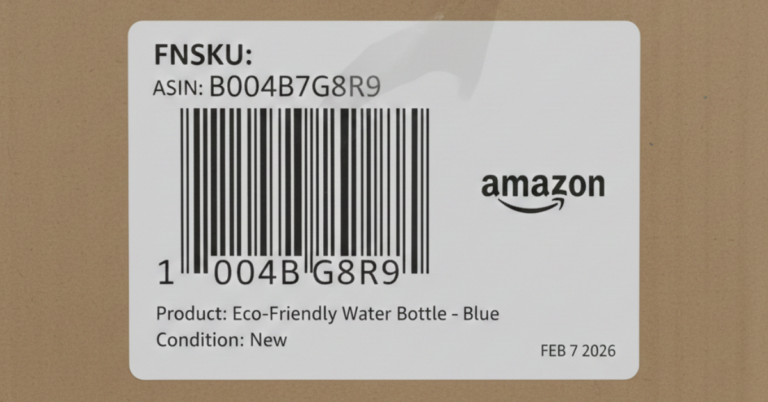
Amazon FNSKU barcodes will now be required for resellers who are not enrolled in Brand Registry, even when products already carry a UPC, and this shift can add real costs for sellers who rely on drop shipping or third-party labeling.
Last Updated: September 11, 2026
Amazon FNSKU barcodes will now be required for resellers who are not enrolled in Brand Registry, even when products already carry a UPC, and this shift can add real costs for sellers who rely on drop shipping or third-party labeling.
Amazon is splitting FBA labeling into two tracks, and the side a seller lands on depends entirely on whether they hold the Brand Representative role in Brand Registry. Brand owners keep the option to ship stickerless using the manufacturer barcode already printed on the package, while every other seller applies an Amazon barcode to each unit.
The change is more than a prep detail because it moves cost per unit before a product ever reaches a fulfillment center. Sellers who built their model around drop shipping or third-party labeling will feel it first.
Amazon FNSKU Barcodes Replace Manufacturer Barcodes for Most Resellers
The change takes effect for inventory shipped on or after March 31, 2026, and Amazon tied it directly to the end of commingling. In its Seller Central announcement on ending commingling practices, Amazon said brand owners holding the Brand Representative selling role will no longer need Amazon barcode stickers on products that already carry a manufacturer barcode such as a UPC or ISBN.
Amazon, Seller Central announcement"Commingling practices will end effective March 31, 2026."
Commingling is the practice of filling an order from the nearest identical unit in the network, no matter which seller sent it in. Amazon’s stated reasoning is that sellers now keep inventory close enough to customers that pooling is no longer needed to hit delivery speeds.
One detail catches brand owners off guard. If a product has no scannable manufacturer barcode at all, both brand owners and resellers still need Amazon barcodes, so Brand Registry enrollment alone does not make a seller exempt.
The requirements break down by seller type.
| Seller type | Barcode required on each unit | Stickerless eligible |
|---|---|---|
|
Brand representative in Brand Registry, product has a UPC or EAN
|
Manufacturer barcode
|
Yes |
|
Brand representative in Brand Registry, product has no manufacturer barcode
|
Amazon FNSKU
|
No |
|
Reseller not holding the Brand Representative role
|
Amazon FNSKU
|
No |
|
Authorized reseller without the Brand Representative role
|
Amazon FNSKU |
No |
The account-level setting is not the deciding factor, which is where sellers get tripped up. Eligibility is evaluated per offer, so a single account can hold SKUs on both sides of this line.
Sellers Are Told to Audit Their Supply Chain Before the Deadline
The seller community picked up on the cost side of this faster than the policy side. A widely shared post titled “New FBA Label Requirements For Non-Brand Owners” read the update plainly, arguing that non-brand owners will need an Amazon FNSKU on inventory even when a UPC is already printed on the package.
The same post framed the change as Amazon finally acting against the abuse of commingled FBA inventory. That reading matches what Amazon has signaled for some time, and it explains why the rule targets seller role rather than product type.
The most actionable advice in that post concerns timing. Sellers are urged to check their supply chain now for items that need new packaging or new labeling, and to get that work done at the factory with the supplier rather than after the goods land.
That advice carries extra weight because Amazon ended its own US FBA prep and labeling service, leaving no paid fallback at the fulfillment center. Paying a third party to label units, or shipping goods to a seller’s own address first and then forwarding them to Amazon, becomes expensive at any real volume.
Chris Turton Explains Why Amazon Is Making This Change
Chris Turton, an Amazon brand specialist at Chris Turton Ecommerce, broke the update down by seller role. His read is that from March 31, 2026, brand representatives in Brand Registry will be the only sellers able to use manufacturer GS1 barcodes on FBA shipments.
He traced the decision back to Accelerate 2025, where Amazon announced the end of commingled inventory, and noted that commingling was largely driven by manufacturer-specific barcodes in the first place. The result is seller-specific tracking for every non-brand owner.
Chris Turton, Chris Turton Ecommerce"FNSKUs directly link to the seller account, preventing commingled inventory."
That point matters most on crowded listings. When several sellers share a featured offer and all of them ship on the same UPC, a defective unit from any one of them can land against another seller’s account.
A 2026 Labeling Guide Breaks Down FNSKU vs UPC for Inbound Shipments
For the operational side, the FBA barcode requirements guide published by Aaron Yi walks through the identifier differences that cause most factory mistakes. A UPC or EAN identifies the product globally, an ASIN identifies the Amazon listing, and an Amazon FNSKU identifies how FBA units are tracked and scanned.
The guide recommends treating FNSKU as the safer default whenever eligibility is unclear, particularly for sellers consolidating from several factories. It also flags packaging surfaces that cause scan failures, including glossy film, curved bottles, and anything that scuffs in transit.
Labeling specs matter more than most sellers expect. Amazon barcodes print in black ink on white, non-reflective stock with removable adhesive, and a label that looks fine to the eye can still fail a scanner at check-in.
Sellers moving to FNSKU labeling for the first time should build one mapping file tying each SKU to its label file, then require a scan test before cartons are sealed. Wrong-label-on-wrong-unit errors do not fail at intake, which is what makes them costly.
What This Means for Sellers Heading Into Their Next Shipment
Brand owners selling their own products come out ahead, and the first step is confirming the Brand Representative role is active so the account can stop paying for stickers. Resellers face a higher cost per unit and a prep workflow that needs rebuilding before the next purchase order.
The middle group carries the most risk. Sellers who hold a brand in their brand portfolio but never completed Brand Registry enrollment often assume they are covered, and they are not.
Two moves are worth making before the next inbound plan. Audit the barcode setting on every offer so nothing carries a setting that contradicts the seller role, and move the trademark and Brand Registry enrollment forward if stickerless handling would save meaningful money.
Sellers running products on reseller UPCs who want them on their own GS1 codes can have an Amazon agency handle UPC to GS1 barcode changes as a standalone service. For shipments already stalled at check-in, this guide to fixing Amazon receiving delays helps isolate whether the problem is labeling or something else.
Amazon FNSKU barcodes are no longer a preference set once and forgotten. They are a function of seller role on the platform, and the accounts that audit their catalog early will be the ones shipping on time in Q4.