

Last Updated: August 17, 2026
Slow or inaccurate order fulfillment used to cost you a bad review and a refund. In 2026, it costs you the listing, the rank behind it, and the ad spend you already paid to build both.
Amazon order fulfillment speed and accuracy are an account health problem now, not a customer experience problem. Amazon holds seller-fulfilled listings to a 90% on-time delivery rate and switches off the specific listings dragging that number down.
Most brands learn this the same way, which is a page-one ASIN going dark in the middle of a strong month. We have managed $1.2B+ in ecommerce revenue across 400+ brands, and the operators who never lose that week are watching five numbers the rest of the market ignores.
In this guide, our Amazon agency will discuss which fulfillment metrics Amazon grades, where FBA and FBM each break down, and the targets to hold at your revenue level. We will also cover the Dual-Front System we use so a receiving delay never turns into a two-month rank rebuild.
Table of Contents
Our team pulls your fulfillment mix and account health in one pass and tells you which SKUs are the risk.
Amazon grades your delivery promise now, not just customer satisfaction.
- OTDR below 90% suppresses listings
- Handling time must be accurate
- FBA hides problems, not removes
- Backup FBM offer protects rank
- Split every metric by channel
Speed and accuracy are account health metrics in 2026, and the fix is operational rather than lucky.
Amazon Order Fulfillment Speed and Accuracy Metrics That Suppress Listings
Five numbers decide whether your listings stay live, and four of them only apply to orders you ship yourself. Learn them before your next capacity cut pushes part of the catalog onto FBM.
| Metric | Threshold | What happens when you miss |
|---|---|---|
|
On-Time Delivery Rate
|
90% minimum
|
Amazon deactivates the listings causing the misses
|
|
Late Shipment Rate
|
Under 4%
|
Amazon takes over your handling time settings
|
|
Valid Tracking Rate
|
Above 95%
|
Listing restrictions and suspension risk
|
|
Order Defect Rate
|
Under 1%
|
Account health warnings, then account review
|
|
Business Hour Delivery Rate
|
90% from Sept 30, 2026
|
Offers deactivated for Amazon Business buyers
|
What Is a Good On-Time Delivery Rate on Amazon?
Hold 95% or better, because 90% is Amazon’s hard minimum for keeping seller-fulfilled products listed. On 1,000 tracked units a month, the gap between those two numbers is fifty packages, which is one holiday Monday or one bad carrier weekend.
What Happens if My Amazon OTDR Drops Below 90%?
You lose the offending listings rather than the whole catalog, since Amazon began evaluating performance at the item level on February 28, 2026, and deactivates only the SKUs causing the misses. That is also why one listing gets suppressed for late delivery while the rest of the account looks healthy, though repeated or severe failures can still take down every seller-fulfilled offer you have.
What Is Amazon’s New Handling Time Rule for FBM Sellers?
Every seller-fulfilled SKU has needed an accurate handling time since June 29, 2026, and Amazon will manage the setting on your behalf when the number is wrong, with 180 days of late shipment rate protection when it does. Turn on Automated Handling Time unless someone reviews these settings every month, because Amazon uses a 4% late shipment ceiling to set the fastest time it thinks you can sustain.
What Is the Amazon Business Hour Delivery Rate Requirement?
B2B sellers need a 90% Business Hour Delivery Rate from September 30, 2026, over a rolling 14-day window, or seller-fulfilled offers can be deactivated for Amazon Business customers. The metric never touches FBA, so an FBA offer on the same ASIN keeps that B2B demand buyable even when the FBM side goes dark.
Amazon’s New and Tougher Compliance Standards: What It Means for You?
Importance of Speed and Accuracy in Order Fulfillment on Amazon
Speed and accuracy decide your conversion rate before they decide your account health. A slower delivery promise converts worse on the same listing, with the same images and the same price.
Late and wrong orders then compound into returns, negative feedback, and a rising order defect rate. That is the sequence that turns an operations problem into a marketing problem you pay for twice.
Does Faster Delivery Actually Increase Amazon Sales?
Yes, and the lift is large enough to fund the operational work. Amazon has reported that cutting one day off the estimated delivery date moves sales by roughly 5% on average, which is why 87% of US seller-fulfilled orders now ship within a single day.
How Long Does It Take To Recover Amazon Keyword Rank After a Stockout?
Plan on two to four weeks of rebuilt velocity for every few days you sit unbuyable. Keyword positions start sliding after roughly three to five days out of stock, and your ads keep spending against a listing nobody can purchase the entire time.
Is FBA More Accurate Than FBM for Order Fulfillment?
FBA is more consistent at scale, and FBM is more controllable. The real difference is not accuracy; it is who owns the failure when accuracy breaks.
| What breaks | Under FBA | Under FBM |
|---|---|---|
|
Picking and packing errors
|
Amazon owns the process, you own the metric
|
You own both
|
|
Damage in storage or transit
|
Claimable, but reimbursement takes weeks
|
Preventable with your own packaging standards
|
|
Delivery timing
|
Amazon absorbs the miss
|
Counts directly against your OTDR
|
|
Speed at peak
|
Constrained by receiving capacity
|
Constrained by your labor plan
|
Amazon’s fulfillment network runs goods-to-person robotics, barcode verification, and dynamic packing to hold picking accuracy at volume, which operations research on the process describes in detail. That system is better than most warehouses, and it is still not free of errors you cannot see or fix.
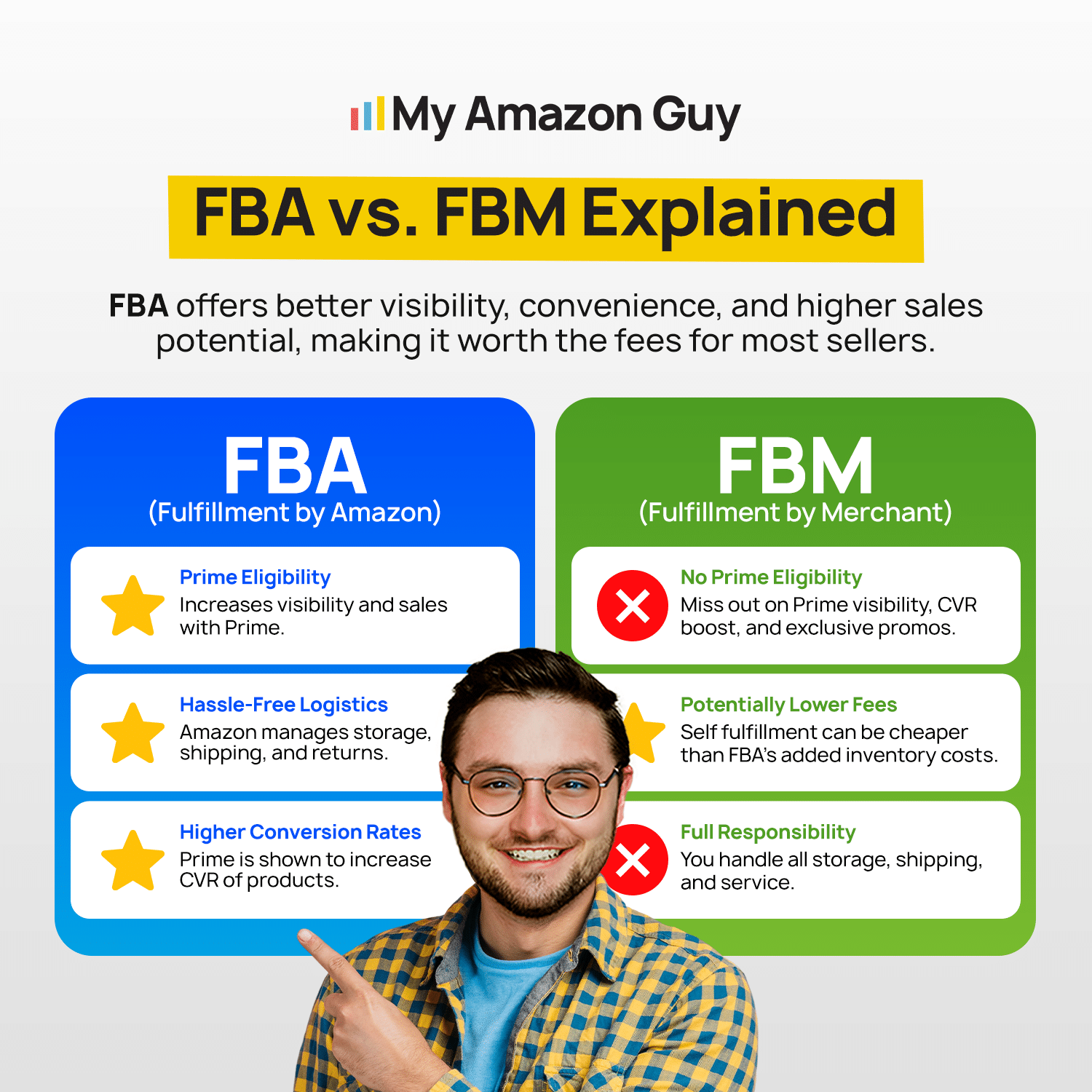
FBA vs FBM Explained
FBA Fulfillment Challenges: Overcoming Speed and Accuracy Hurdles
FBA moves your fulfillment problems out of sight rather than removing them. Around 82% of US sellers run FBA as their primary method, and almost none of them audit the six failure points below.
1. Peak Season Delays
Order surges overwhelm receiving before they overwhelm shipping, so your inventory sits in a trailer while the listing goes unbuyable. One seller in an Amazon forum thread reported shipments held in Amazon’s possession for 112 days, with back-ordered customers cancelling after 30 days of waiting.
- Send Q4 inventory well before the posted deadlines
- Run a combined FBA and FBM setup through peak
- Watch receiving status weekly, not monthly
- Reorder earlier rather than ordering more
2. Product Damage
Damage inside the network hits your return rate and your reviews before it hits your reimbursement. You are still responsible for the customer experience even when Amazon caused the problem.
- Follow Amazon packaging requirements exactly
- Review inventory health reports for damage patterns
- File claims promptly, since windows close
- Remove and reship rather than leaving damaged units live
3. Picking Errors
Mispicks arrive as wrong-item complaints and A-to-Z claims, which feed your order defect rate. You cannot fix Amazon’s pick process, so reduce the ambiguity that causes the error.
- Label units clearly with correct FNSKUs
- Keep product images accurate to the exact variation
- Avoid look-alike packaging across sizes
- Track defect rate by ASIN, not account-wide
4. Labeling Issues
Bad labels are the cheapest problem to prevent and one of the most expensive to ignore in 2026. Inbound defect fees have climbed to as much as $5.72 per unit on standard items and $8.25 on bulky ones, which can erase a full inventory cycle of margin.
- Match Amazon’s size and placement rules
- Use durable labels that scan on the first pass
- Audit a sample before every shipment leaves
- Use Amazon’s label service when volume justifies it
7 Tips to Fix Amazon FBA Mislabels – Tip 2 Takes 60 Seconds
5. Inventory Placement
Where your units sit decides how fast they reach the customer, and you only partly control it. Placement fees on a single-location split run from $0.14 to $6.50 per unit depending on size tier, so the cheap-looking option is often not cheap.
- Keep dimensions and weights accurate in the catalog
- Accept Amazon-optimized splits when freight math allows
- Watch which regions your sales actually come from
- Re-run the placement decision after every fee update
6. Carrier Performance Issues
Carrier problems inside FBA are invisible to you until the feedback arrives. Your leverage is monitoring and claims rather than control.
- Track delivery performance by ASIN and region
- File claims on lost and damaged shipments
- Set customer expectations before peak weeks
- Escalate patterns, not individual packages
We will show you which listings are dragging the number down and what to fix first.
FBM Fulfillment Challenges: Overcoming Speed and Accuracy Hurdles
FBM gives you the control that FBA takes away, and it hands you every metric to carry yourself. Roughly 34% of sellers now use FBM either on its own or alongside FBA, which means the following problems are mainstream rather than niche.
1. High Order Volume
Volume spikes create picking errors and processing delays at the same time, because rushed staff make different mistakes than slow staff. Build the workflow for your worst day rather than your average one.
- Set a defined pick, pack, and cutoff sequence
- Audit a percentage of orders daily
- Add order and warehouse management software before you need it
- Cross-train so one absence does not break the day
Here is a handy spreadsheet of Amazon’s sorting and fulfillment centers.
2. Manual Order Picking
Manual picking is where FBM accuracy quietly falls apart as the catalog grows. Every extra SKU adds a chance to grab the wrong box.
- Add pick-to-light or scan verification at volume
- Lay out the warehouse by velocity, not category
- Train on procedure and product knowledge together
- Review picker accuracy on a fixed cadence
3. Packaging and Order Accuracy
Packaging failures show up as damage claims and return costs you absorb personally. Standardization beats craftsmanship here.
- Standardize box sizes and fill materials
- Buy packaging that survives the carrier, not the shelf
- Document the packing method for every product type
- Audit packaging quarterly against your damage data
4. Shipping Delays
Delays are the single fastest way to lose your on-time delivery rate. Carrier choice and honest promises matter more than speed heroics.
- Choose carriers on delivery data, not list price
- Use Amazon Buy Shipping for protection and rates averaging over 31% below retail ground
- Set a handling time you can hit during a bad week
- Keep a backup carrier arrangement for surges
Want to learn more about shipping your Amazon products as an FBM seller? Check this video guide.
How To Set Up Seller Fulfilled Shipping Templates on Amazon 2026
5. Customer Service Issues
Customer service volume is the hidden cost of FBM, and slow responses convert into defects. Returns and refunds are where most of the time goes.
- Assign named ownership of the inbox
- Track interactions in a CRM rather than memory
- Publish a return process and follow it exactly
- Resolve proactively before claims are filed
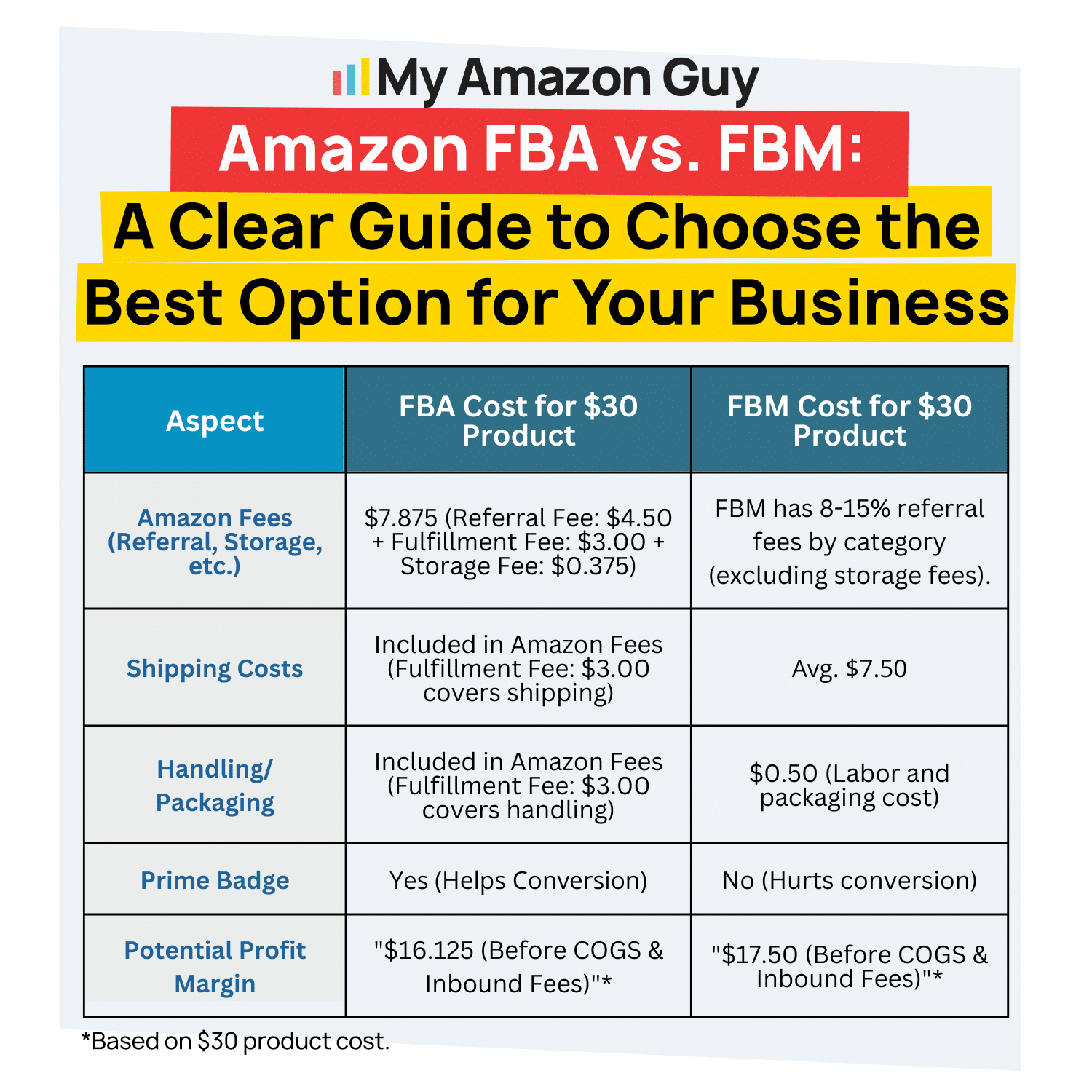
Amazon FBA vs FBM: A Clear Guide to Choose the Best Option for Your Business
6. Lack of Visibility and Control
FBM gives you control of the operation and often no visibility into it. That gap is what turns a small delay into a suppressed listing.
- Run an order management system, not spreadsheets
- Connect carrier tracking for real-time exceptions
- Keep inventory synced to prevent stockouts or overstocks
- Review fulfillment performance weekly
How the Dual-Front System Protects Amazon Speed and Accuracy
Running both channels on the same ASIN keeps a fulfillment failure from turning into a ranking failure. We call it the Dual-Front System, and its only job is holding your Buy Box, your keyword position, and your ad performance during the week something breaks.
Can I run FBA and FBM on the same ASIN to avoid stockouts?
Yes, with two separate SKUs on one ASIN and FBA winning the featured offer for as long as it has stock. An Amazon moderator recommends exactly that in a Seller Central forum post, telling sellers to keep FBM live as a backup that maintains Buy Box eligibility through FBA stockouts.
The backup offer is not there to be profitable while FBA is down. It exists so the gap never registers as a gap, and our guide on how to run Amazon FBA and FBM together covers the SKU naming, pricing, and allocation rules that make it work.
10 Reasons To Choose FBA over FBM (And When Not To)
What Amazon Fulfillment Metrics Should I Check Every Week?
Track five numbers every week and split every one of them by fulfillment channel. Blended reporting hides which side of the operation is failing, which is why most brands fix the wrong thing first.
| KPI | Good target | Cadence |
|---|---|---|
|
On-Time Delivery Rate, FBM offers
|
95% or better
|
Weekly
|
|
Late Shipment Rate
|
Under 2%
|
Weekly |
|
Days of supply, FBA
|
45 to 60 days
|
Weekly |
|
Order Defect Rate
|
Under 0.5%
|
Weekly |
|
Backup offer test orders
|
5 or more monthly
|
Monthly |
Pull the first four from Account Health and Business Reports, segmented by fulfillment channel, then load your own pick, pack, and outbound costs against the FBM SKU because Amazon never will. Push a handful of real orders through the backup SKU every month, since a backup offer first tested in November is a backup offer tested during the worst month of the year.
FAQs About Amazon Order Fulfillment
Does Amazon deactivate all my listings if OTDR falls?
Not usually, because enforcement now targets the specific listings responsible for the late deliveries. Sustained or severe failures can still take down every seller-fulfilled offer you have.
How do I fix a high late shipment rate on Amazon?
Fix the promise before the warehouse, since most late shipments are honest operations running against a handling time somebody padded years ago. Reset handling time to what your worst week supports, then confirm every order at the moment it actually ships.
How fast do I have to ship FBM orders on Amazon?
As fast as the handling time you published, which is the only speed Amazon grades you against. A padded two-day or three-day setting also costs you sales, because a slower delivery estimate converts worse on the same listing.
Who is responsible when Amazon damages my FBA inventory?
Amazon reimburses qualifying damage, and you still own the customer outcome and the defect it creates. File the claim, then remove the damaged units so they never reach a buyer.
What is Amazon's order defect rate limit?
Amazon requires an order defect rate below 1%, counting negative feedback, A-to-Z claims, and chargebacks. Run an internal target of 0.5% so one bad week never puts the account under review.
Should I move slow shipping SKUs from FBM to FBA?
Move them when the SKU keeps dragging your on-time delivery rate, and FBA fees still leave usable margin. Keep them on FBM when the item is oversized, slow moving, or fragile, since those units quietly eat your FBA capacity.
Amazon Order Fulfillment Speed and Accuracy Is a System
Order fulfillment stopped being a back-office function the moment Amazon started deactivating listings over it. Speed and accuracy are ranking inputs, ad efficiency inputs, and account health inputs all at once.
Whether you run FBA, FBM, or both, the win comes from knowing where each channel breaks and covering that gap before it opens. The brands that ride out a receiving delay built the backup offer months before they needed it, and they review five numbers every week instead of reacting to a suppression email.
Losing sales to a fulfillment problem you cannot pinpoint? Contact our full-service Amazon agency, and let our Amazon experts build the fulfillment mix that keeps your listings live through every delay.
We split your delivery and defect metrics by FBA and FBM so you fix the right side of the operation.