
Last Updated: September 14, 2026
FBA versus FBM was never the right question. The brands holding page one through a capacity cut run both on the same ASIN, and they set it up months before they needed it.
Roughly 82% of Amazon sellers run FBA, and most of them run nothing else alongside it. That single-channel setup works right up until restock limits, a receiving delay, or a capacity cut turns one operational hiccup into a two-month rank rebuild funded by your ad budget.
Knowing how to run Amazon FBA and FBM together is what separates the brands that ride out that week from the brands that spend the next quarter climbing back. We have managed over $1.4B in ecommerce revenue across 400+ brands, and the ones who never lose a quarter to a receiving delay all keep a second offer warm before they need it.
In this guide, our Amazon agency will discuss how to decide which ASINs belong on each channel, how to build and price an FBM backup offer that protects your margin, and what the fulfillment switch actually does to your PPC and your organic rank. We will also cover the offer limits Amazon enforces on a single ASIN, the KPIs worth splitting by fulfillment channel, and the advanced moves that make the whole system pay for itself.
Table of Contents
Our team will look at your catalog and tell you which ASINs actually need a backup offer.
TL;DR - How to Run Amazon FBA and FBM Together
Amazon FBA sells your units at Prime speed against Amazon’s warehouse capacity, while Amazon FBM ships from your own shelves against a promise you set yourself. Most sellers treat the two as a choice and route the whole catalog one way, which is the actual reason a single receiving delay turns into a two-month rank rebuild.
- One ASIN holds two offers
- FBA offer wins the Buy Box
- FBM offer catches the stockout
- Suffix the SKU, never duplicate
- Warm the backup before Q4
The backup offer is not there to make money while FBA is down. It is there to keep the gap from ever registering as a gap, which is what protects the rank and the ad performance you already paid for.
10 Reasons To Choose FBA over FBM (And When Not To)
The Dual-Front System, and Why FBA-Only Brands Keep Getting Squeezed
Running both channels comes down to one move, which is keeping a second offer live on the same ASIN and warming it up long before you need it. We call it the Dual-Front System, and its only job is to hold your Buy Box, your keyword position, and your ad performance during the week Amazon misplaces your inbound shipment.
Every operator between $1M and $20M knows the squeeze. Restock limits tighten, inbound sits in receiving for three weeks, storage fees climb, and one bad month erases the margin you spent a year building.
The usual fix is to send more inventory earlier, which works right up until Amazon caps your capacity. Then you are back to watching a page-one ASIN go dark while competitors split the traffic you just vacated.
What Does It Mean to Run Amazon FBA and FBM Together on One ASIN?
It means one ASIN carries two of your own offers, each with its own SKU and its own inventory pool. Amazon shows shoppers whichever offer wins the featured position, and the other one waits in reserve.
Yes, you can use FBA and FBM at the same time on Amazon, and yes, both offers can sit on the same ASIN. There is a ceiling, though, and a moderator answering a Seller Central forum thread described a maximum of two offers per ASIN, one per fulfillment channel, with anything past that treated as offer manipulation.
What Is the Difference Between Amazon Dual Fulfillment and Hybrid Fulfillment?
Dual fulfillment keeps both offers live at once, while hybrid fulfillment uses software to swap a single offer from FBA to FBM the moment FBA stock hits zero. The swap is not instant, and the integration platforms that run it document a changeover of roughly 15 minutes.
| Dual fulfillment | Hybrid fulfillment | |
|---|---|---|
|
Offers live
|
Two, always
|
One, swapped on demand
|
|
Gap risk
|
None
|
Roughly 15 minutes per swap
|
|
Best for
|
High-velocity ASINs and peak periods
|
Steady sellers with predictable demand
|
That gap is invisible on a slow Tuesday and expensive on Prime Day. For a $5M brand with any ASIN doing real daily volume, dual is the safer build, and hybrid is fine for the long tail.
Why Does an FBA Stockout Cost More Than the Sales You Miss?
Because the sales you miss are the cheapest part of the bill. Your keyword positions start sliding after roughly three to five days out of stock, and getting them back takes two to four weeks of rebuilt velocity.
Meanwhile, the ads keep spending against a listing nobody can buy. Across 240 sellers, the average stockout cost about $18K in lost revenue once rank decay and Buy Box loss were counted, and that is per event rather than per year.
What Do Sellers Get Wrong About Running Both Channels at Once?
Four beliefs cause most of the damage, and all four are wrong. Each one sounds reasonable right up until the week you actually need the backup offer.
- A second offer splits your Buy Box share
- You need a duplicate listing to do this
- FBM is only worth it for slow movers
- You can build the backup offer during the emergency
Does adding an FBM offer hurt your Buy Box percentage? No, because both offers are yours, so featured-offer share stays in the family either way, and the only thing that changes is which of the two earns it based on price and delivery promise.
How to Decide FBA or FBM for Each ASIN
Stop guessing and start with four inputs. Velocity, cube, margin after fulfillment, and replenishment risk decide the answer for every ASIN in your catalog.
Amazon allocates FBA storage by sales velocity and by physical space rather than by unit count, a rule the FBA storage limit guidance spells out plainly. That is why one oversized slow mover can quietly eat the capacity your best seller needed in October.
| Signal | Send to FBA | Send to FBM |
|---|---|---|
|
Velocity |
Top 20% of units sold
|
Bottom 40% of units sold
|
|
Cube |
Small and standard size
|
Oversized or awkward pack
|
|
Margin after fulfillment
|
Holds up under FBA fees
|
Improves by 5 points or more self-shipped
|
|
Replenishment risk
|
Reliable lead time
|
Long lead time or single supplier
|
Almost nobody runs this scoring, and that is the opportunity. Jungle Scout puts 9% of sellers on both channels, while other counts place hybrid setups near 19%, and both figures are dragged down by sub-$100K sellers who were never the audience for this.
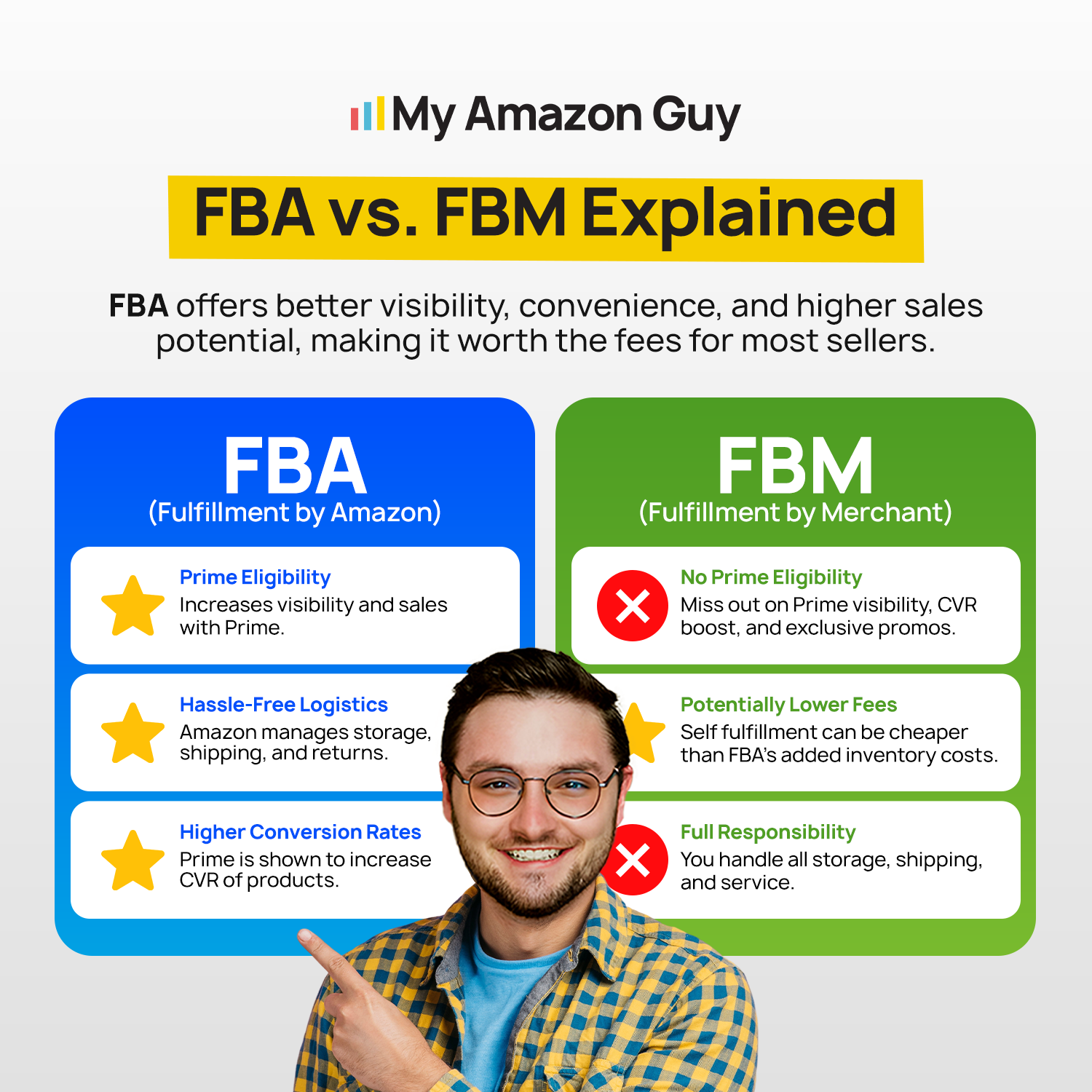
FBA vs FBM Explained
How to Run Amazon FBA and FBM Together on One ASIN: Step by Step
Setting it up means creating a second suffixed SKU on the same ASIN, loading a small live quantity, and pricing it to cover your own shipping. Maintaining it means pushing a few real orders through that SKU every month so it is never cold on the day you need it.
Every FBM offer needs its own SKU, and the cleanest convention is your existing FBA SKU with a clear suffix. That keeps inventory files, reports, and your 3PL from ever confusing the two inventory pools.
Get the naming right before you scale it across the catalog, because a mismatch between your FBA SKU and your fulfillment SKU breaks the routing outright. That one error is the most common reason a dual-front setup falls apart in week one.
Here is how to build and maintain the FBM backup offer, in order:
- Pick your top 20 ASINs by revenue and start there, not the whole catalog
- Create the FBM offer on the same ASIN using a suffixed SKU
- Set the handling time your warehouse actually hits, SKU by SKU
- Load a small live quantity, never zero
- Price the offer to cover your own shipping
- Push a handful of real orders through it every month
- Review handling time and price on a fixed quarterly date
Since June 29, 2026, Amazon reviews every seller-fulfilled SKU’s handling time against how it really ships, and a SKU that routinely beats its setting by a day gets flagged for a 30-day fix. The monthly test orders on your backup SKU are what feed Amazon that ship data, so the number you set has to be the number those orders prove.
We audit fulfillment mix, ad impact, and rank risk across your catalog in one pass.
What the Fulfillment Switch Does to Your PPC and Organic Rank
The switch keeps your campaigns eligible and your keyword position intact, which is where the whole system pays for itself. Ads keep serving because the ASIN still has a buyable offer, and that continuity is the difference between a stalled account and one that keeps feeding velocity to your top keywords.
Expect a measurable conversion dip while the FBM offer carries the listing, because a slower delivery promise converts worse than Prime speed does. A softer conversion rate on a live listing still beats a zero on a dead one.
Short interruptions where the offer stays buyable barely register with the algorithm, while longer gaps get read as a genuine collapse in conversion. The backup offer’s job is not to be profitable during the gap; it is to make sure the gap never registers as a gap.
Why Most Sellers Regret Moving Away from FBA
How to Measure a Dual-Front Fulfillment Mix
Track five numbers and split every one of them by fulfillment channel. Blended reporting hides the answer, and you will never know whether the backup offer is earning its keep if FBA and FBM sit in the same column.
| KPI | Good target | Cadence |
|---|---|---|
|
Buy Box share by offer
|
FBA above 95% while in stock
|
Weekly |
|
Days of supply, FBA
|
45 to 60 days
|
Weekly |
|
On-time delivery, FBM offer
|
95% or better
|
Weekly |
|
Contribution margin by channel
|
Within 5 points of each other
|
Monthly |
|
Backup offer test orders
|
5 or more per month
|
Monthly |
Reporting FBA and FBM profitability separately starts with Business Reports segmented by fulfillment channel, then loading your own outbound shipping and pick-pack costs against the FBM SKU. Amazon handles the first half and will never do the second, which is why most brands think their FBM offer is more profitable than it is.
One technical limit is worth knowing before you trust a blended export, since only one tracking number is stored per FBA fulfillment. Multi-box shipments will not reconcile cleanly, so reviewing channel performance side by side beats stacking it into a single view.
Advanced Amazon Hybrid Fulfillment Moves Worth Testing Next
Once both offers are live and stable, the next gains come from making the FBM node do more than sit in reserve. These four moves are where mid-market brands pull ahead of everyone still treating FBM as a fallback.
1. Skip Seller Fulfilled Prime Until Your Coverage Can Hold the Badge
Run SFP only if your warehouse coverage can clear the delivery thresholds, since our Seller Fulfilled Prime guide shows why losing the badge mid-quarter costs more than never carrying it. Amazon raised that bar on July 6, 2026, to 40% one-day and 75% two-day coverage for standard-size offers, which most single-node operations cannot hold through December, so SFP makes a weak Q4 backup.
2. Make One Warehouse Serve Amazon, Shopify, and Walmart
This is the strongest advanced move for most brands. The same warehouse shipping your Shopify orders can hold your Amazon backup, feed Walmart, and stage FBA replenishment from a single inventory pool.
3. Track FBM Ship+ for a Faster Backup Offer
Amazon’s FBM Ship+ program currently covers cross-border orders shipped from China, with domestic US routes on the roadmap but not live yet. Watch the program closely, because it changes the math on how hard a backup offer can compete while FBA is down.
4. Warm Your Backup Offers in September, Not November
Test them while nothing is at stake and volume is normal. A backup offer tested in November is a backup offer tested during the worst possible month of the year.
How to Choose Between Amazon FBA and FBM
Running the Dual-Front System Through Q4 Peak Season
Should you switch to FBM during Q4 peak season? No, because FBA and FBM play different roles, and peak is when FBM becomes the failover that keeps an ASIN sellable once inbound closes.
The Q4 2026 Inbound Calendar Your Backup Offer Has to Beat
The Amazon FBA inbound deadline for Black Friday 2026 is October 28, but only for sellers using Amazon-optimized splits. Amazon’s 2026 holiday calendar pulls that wall a week earlier for minimal splits and two weeks earlier for AWD.
| Date | What Amazon changes | Backup offer move |
|---|---|---|
|
Oct 14
|
AWD inventory must arrive
|
Raise the FBM reserve on any ASIN still waiting on AWD transfers
|
|
Oct 15
|
Holiday peak fulfillment fees begin
|
Rerun FBA vs FBM margin at peak rates
|
|
Oct 21
|
Minimal-split FBA shipments must arrive
|
Push test orders through every backup SKU
|
|
Oct 28
|
Amazon-optimized split shipments must arrive
|
Load the Cyber Week reserve into each FBM offer
|
|
Nov 27
|
Black Friday
|
Check FBA stock and FBM on-time delivery daily
|
|
Nov 30
|
Cyber Monday
|
Keep FBM live until the FBA restock checks in
|
|
Jan 14, 2027
|
Peak fulfillment fees end
|
Rerun your channel routing for Q1
|
Minimal and Amazon-optimized splits carry different deadlines because optimized shipments land already spread across Amazon’s network, which leaves less internal handling before the event. The minimal-split seller also pays a placement fee that optimized splits waive, so that seller spends more and hits the wall a week sooner.
What Happens to an FBA-Only ASIN After October 28?
Inventory that misses the October 28 cutoff still gets checked in, just without any promise it reaches shelves in time. Amazon stops guaranteeing Prime-badge placement for late arrivals, so an FBA-only ASIN can sit in receiving through Black Friday Week while shoppers buy elsewhere.
A tested FBM backup offer is how you stop the listing from going inactive when FBA runs out, and Amazon’s own forum team pitches that pairing for peak season. Build it on separate FBA and FBM SKUs now, because a dormant backup offer switched on in November starts posting defects the day real volume arrives.
How Much FBM Backup Inventory Should You Keep for Cyber Week?
Hold 15% to 20% of your peak 30-day forecast in the FBM offer, sized off the Cyber Week spike in your Q4 prep plan rather than a normal month. Smaller brands can start with the handful of ASINs that carry most of their Q4 revenue, while larger catalogs extend the reserve to the full top 20.
Price the FBM offer to cover your own postage, since Amazon’s 2026 holiday peak fulfillment fees add about $0.32 per FBA unit on average from October 15 to January 14. Keep its holiday handling time honest too, because Amazon ties each day of faster promise to roughly a 5% sales lift, and a padded setting gives that lift away.
FAQs About Running FBA and FBM Together
Can I have an FBA offer and an FBM offer on the same ASIN?
Yes, using two separate SKUs on the same ASIN. A Seller Central moderator described a two-offer ceiling per ASIN, so build one on each channel and stop there.
Does adding an FBM offer hurt my Buy Box percentage?
No, because both offers belong to you, so your featured-offer share is unaffected. The FBA offer will win it while it has stock.
Can I run more than one FBM offer on a single ASIN?
You should not. Stacking extra offers on one ASIN risks being read as offer manipulation rather than inventory management.
Does running FBM alongside FBA affect my IPI score?
Not directly, since IPI only measures FBA inventory. Shifting slow movers to FBM usually improves it by lifting sell-through.
Will FBM orders hurt my account health metrics?
Only if the offer runs untested. Use Buy Shipping, set honest handling times, and keep on-time delivery above 95%.
When should I pull slow-moving ASINs out of FBA?
When cover exceeds 60 days across two consecutive quarters. That inventory is charging you rent for capacity your fast movers need.
Is a 3PL required to run a backup offer?
No, though it helps at volume. Brands already shipping DTC orders from their own warehouse can back up Amazon from the same shelves.
How much backup inventory should I hold?
Roughly 15% to 20% of a rolling 30-day forecast on your top ASINs. Enough to survive a receiving delay, not enough to build a second warehouse.
What happens if my FBA inventory misses the October 28 cutoff?
The units still get received, but Amazon won't promise they reach shelves before Cyber Week, so they can miss the Prime badge window entirely. A tested FBM backup offer keeps the ASIN buyable and your ads serving while those late units clear receiving.
Stop Rebuilding Rank You Already Paid For
Running both channels is not about picking a side in the FBA vs FBM argument. It is about making sure a receiving delay never turns into a two-month rank rebuild funded by your ad budget.
FBA sells your units, and FBM protects your position, and the mechanics of setting that up take a single afternoon. The discipline of keeping that second offer warm is what separates brands that ride out a stockout from brands that spend Q1 climbing back to where they already were.
Don’t know how to build a backup offer without breaking your Buy Box, your ads, or your account health? Contact our full-service Amazon agency, and let our Amazon experts build the fulfillment mix that keeps your listings live through every receiving delay.
Setting up a backup offer wrong costs more than not having one, so let our team check the build before it goes live.