There is a cost line in your Seller Central account that moves faster than your duty rate ever will. Most importers never think to look at it.
Duty and advertising are both costs you pay per unit, but only one of them is still negotiable after the fact. You can offset Amazon import duties with organic rank, because every unit that sells without a click fee hands back the margin the tariff took.
Most brands spend the quarter arguing with the cost that was settled the day their container cleared customs. We have managed $1.2B+ in ecommerce revenue across 400+ brands, and the ones that keep their margin through a tariff shock are the ones that go after acquisition cost instead.
This guide talks about the math that turns a duty rate into a TACoS target your team can actually hit. Our Amazon agency will also walk through the 90-day playbook, the metrics that prove the offset landed, and why a careful price increase can strengthen your organic rank rather than break it.
Table of Contents
We plug your COGS ratio, duty rate, and current TACoS into the same model and hand you the target.
Duty is fixed the moment your container clears customs, but acquisition cost is not. Every unit that sells through organic rank instead of a paid click hands back the margin the tariff took.
- Duty raises COGS per unit
- Organic clicks cost you nothing
- Convert duty points to TACoS
- Fund rank, then harvest bids
- Falling TACoS proves it worked
Your duty rate is set by people you will never meet, and your cost per unit sold is not. Run the math on your own COGS ratio before you touch price.
Import Duties Are an Acquisition Cost Problem, Not a Pricing Problem
A duty is charged against the customs value of your goods, so it lands inside COGS before a shopper ever loads your listing. Any offset has to come from a different line measured against that same retail price.
Do the Supreme Court Tariff Refunds Change My Amazon Pricing Strategy?
Not yet, and not the way most sellers hope. The Supreme Court ruled in February 2026 that IEEPA gives the president no authority to impose tariffs, which wiped out the reciprocal and fentanyl duties importers paid through last year.
The money is real, and the calendar is not. CBP had accepted roughly $128.68 billion in potential and certified refunds for processing as of July 31, 2026, so build your pricing around what you are paying this week rather than a credit with no settlement date.
The 2026 Amazon Duty Stack You Are Actually Paying
Sellers still quote rates that stopped applying months ago, which is how a margin plan goes stale without anyone noticing. Here is what the stack looks like heading into September 2026.
| Duty layer | Status in August 2026 | What it hits |
|---|---|---|
|
IEEPA reciprocal and fentanyl
|
Struck down February 20, 2026
|
Refunds moving through CBP
|
|
Section 122 surcharge
|
Expired July 24, 2026
|
No longer in the stack
|
|
Section 301 forced labor
|
Active since July 24, 2026
|
Roughly 60 economies, 10% or 12.5%
|
|
Section 301 China and Brazil
|
Active
|
Stacks with other layers
|
|
Section 232 metals
|
Active at 25% to 50%
|
Steel, aluminum, copper, derivatives
|
|
Section 338
|
Active since August 22, 2026
|
Certain Canadian goods at 50%
|
One layer vanished in February, and two others took its place before August, with the Section 122 surcharge expiring in July and a Section 301 forced-labor tariff replacing it. Any plan to protect Amazon margins from tariffs that rests on a single rate has a shelf life, which is the argument for anchoring the offset to something you own outright.
What Happens to My Organic Rank if I Pause PPC To Save Money?
It slides, and it takes next quarter’s margin with it. Ad spend drives sales velocity, velocity drives rank, and rank is what eventually lets you stop paying for the click at all.
The cut reads as savings for about six weeks and then charges you twice. You come back into the auction with less rank and a costlier click, because the average Amazon CPC reached roughly $1.22 in 2026.
Three Misconceptions That Cost Importers Margin
Every seller who calls us during a duty shock brings at least one of these. They are expensive because each one sounds like discipline.
- Price is the only lever that moves fast
- Cutting ad spend is the same as saving money
- Organic ranking is a slow project unrelated to the P&L
The third belief does the most damage. Rank is not a branding exercise; it is the mechanism that sets what a unit costs you to sell.
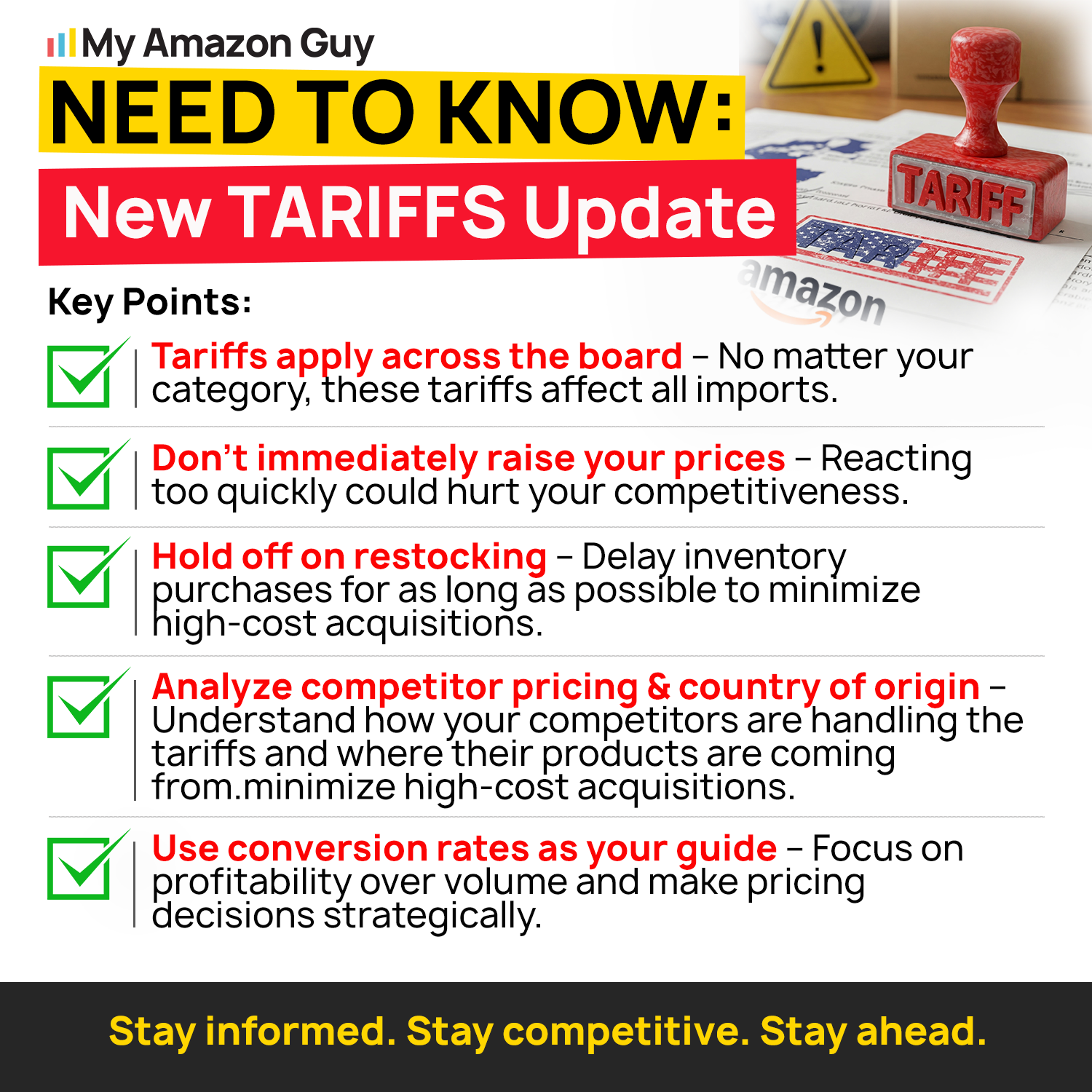
Need to Know: New Tariffs Update
The Math to Offset Amazon Import Duties With Organic Rank
This is the section your finance lead has been waiting for. A duty converts into a fixed number of margin points, and organic rank is how you take those points back without touching your price.
How Do I Calculate How Much Tariffs Cost Me per Unit on Amazon?
Multiply your duty rate by your COGS as a share of retail price. A 15% duty on a product where COGS runs 25% of retail takes 3.75 points of margin out of every unit you sell.
That single step is the whole calculation, and the result is the target your offset has to match. Work it per SKU instead of across the catalog, since duty exposure varies by origin and classification, and our US tariff price calculator handles the batch view when you want every line at once.
How Much TACoS Reduction Do I Need To Offset a 15% Duty?
Most sellers know their duty rate and their TACoS, but never put the two numbers in the same sentence. This table does it for you, starting from a 14% TACoS baseline.
| COGS as a share of retail | Margin points lost to a 15% duty | TACoS target to hold margin, from 14% |
|---|---|---|
|
20%
|
3.00
|
11.00%
|
|
25%
|
3.75
|
10.25%
|
|
30%
|
4.50 |
9.50%
|
|
40%
|
6.00
|
8.00%
|
Find your COGS row, and you have a target your team can be measured against. A brand at 25% COGS needs TACoS to travel from 14% to 10.25%, which is a concrete assignment rather than a vague push to spend less.
What Is a Good TACoS for a Brand With Thin Margins?
We run most mature listings toward 10% to 15%, and we read anything above 20% on an established SKU as unfunded rank rather than real growth. Thin margins do not need a lower target so much as a steady one you can forecast against.
The number that matters is the direction, not any single week’s reading. A TACoS that declines over time signals that organic sales are carrying more of your revenue base, and that shift is what a working duty offset looks like on a report.
How Does Raising My Price Affect My Amazon Conversion Rate and ACoS?
Conversion falls first, and ACoS follows it up, which explains why your ACoS climbed right after a tariff price increase. You pay the same cost per click for fewer sales, so the ad line deteriorates at the exact moment the margin line already did.
There is an upside here that almost nobody prices in. Amazon weights keyword rank by the revenue a listing generates rather than the units it moves, so a measured increase that holds conversion sends a stronger revenue signal per sale, not a weaker one.
Every catalog has a different number, and yours depends on origin, classification, and category norms.
The 90-Day Playbook to Lower Amazon TACoS and Recover Margin
Ninety days is the window because that is roughly how long a funded keyword needs before it holds an organic position on its own. It is also the only cost line you can move meaningfully before your next container lands.
Five Steps to Lower Amazon TACoS and Offset Import Duties
Run these in order, because each step pays for the one after it. Skipping step two is the single most common reason the offset never reaches the P&L.
- Model the exposure per SKU. Calculate duty points per unit for every ASIN, then rank your catalog by exposure rather than by revenue.
- Fix conversion before funding anything. Rank bought on a listing that converts poorly is rented, so repair the main image, A+ content, and review position first.
- Pick the rank-eligible shortlist. Choose eight to fifteen keywords where you already sit on page two or the bottom of page one.
- Fund rank on that shortlist only. Accept a deliberately bad ACoS window on those terms, and our guide on boosting Amazon organic ranking with Amazon Ads covers how ad-driven sales feed the ranking signals.
- Harvest by pulling bids back. Once organic position holds for two weeks, step bids down in increments and watch whether the rank stays put.
Step five is the one almost nobody runs. Without the harvest, you have bought traffic instead of margin, and your TACoS never moves at all.
Which Amazon Keywords Should I Rank Organically To Reduce PPC Dependence?
Start with terms where you already sit on page two or the bottom of page one, since those need a push rather than a launch. Head terms are the expensive trap, because head terms run three to five times the cost of long-tail keywords in the same category.
Long-tail terms also arrive closer to purchase intent and cost less to defend once you hold them. That pairing is where cost per acquisition genuinely collapses, which makes it the fastest route to lowering acquisition cost on Amazon.
Four Mistakes That Break an Amazon Duty Offset
Four failure patterns account for most of the accounts we inherit mid-attempt. Each one looks like sound judgment in isolation.
- Funding the whole account instead of a shortlist
- Harvesting bids before rank has stabilized
- Skipping the conversion fix and buying rank anyway
- Going out of stock in the middle of the climb
The stockout is the cruelest of the four. You lose the position you just paid for, then pay a second time to win it back.
Amazon Will Never Succeed in Philippines For this One Reason
How to Measure Whether the Amazon Duty Offset Is Actually Working
A duty offset shows up in your rank data weeks before it reaches the P&L. Report on both cadences, or you will kill a working plan because the monthly numbers had not caught up yet.
Five Metrics That Prove Your Amazon Duty Offset Is Working
Track all five together, because any one of them read on its own will point you the wrong way. Rank can climb while margin still sags, and TACoS can dip for reasons that have nothing to do with organic strength.
- TACoS, weekly, as the headline
- Organic rank on the shortlist terms
- Organic share of total revenue
- Top of search share of voice
- Contribution margin per unit after duty
Pull rank and share of voice weekly, then read margin monthly once the unit economics have settled. Search Query Performance and your Business Reports in Seller Central carry every number on this list at no extra cost.
How Long Does It Take To Improve Amazon Organic Rank Enough To Cut Ad Spend?
Expect movement on shortlist terms within four to six weeks and a defensible harvest somewhere around week eight to twelve. Categories with heavy review moats run longer, and listings with weak conversion never arrive at all.
The timeline is a function of velocity, not patience. If your conversion rate sits below the category norm, you are funding a leak rather than buying an asset.
Advanced Tactics to Protect Amazon Margins From Tariffs
Brands with a working offset have two levers left that most importers never touch. Both stack on top of organic rank rather than replacing it.
Claim the Amazon Brand Referral Bonus as a Second Duty Offset
This is a direct fee rebate sitting unclaimed in most importer accounts. Amazon credits the Brand Referral Bonus against your referral fees on sales you drive from outside Amazon, with rates set by category and averaging near 10%.
Do the per-unit math exactly the way you did the duty math. On a $35 order, a 10% bonus returns $3.50 per unit, which lands on the same line the duty took it from.
Can Amazon SEO Replace PPC for a Tariff-Hit Product?
No, and any agency telling you otherwise is selling you a stockout. Ads hold placements that organic listings cannot reach, and external traffic has become a heavily weighted input into Amazon’s ranking, which means the two systems feed each other.
The goal is not replacement; it is proportion. You are shifting the share of units acquired at zero incremental ad cost, and an organic click costs you nothing while a paid click can run from a dollar to five dollars or more.
I Can Be Your Guy – MAG (Official Lyric Video)
FAQs About Offsetting Amazon Import Duties
How do I offset Amazon import duties without raising prices?
Convert the duty into margin points, then take the same number of points back from TACoS by growing the share of units that sell organically. A 15% duty at 25% COGS costs 3.75 points, which a TACoS move from 14% to 10.25% covers exactly.
Does improving organic rank actually lower my Amazon acquisition cost?
Yes, because organic units carry no incremental ad cost while every paid unit carries a click fee. More than 60% of Amazon clicks land on the top three organic results, so position decides how many units you acquire for free.
Is it better to raise my Amazon price or reduce my ad spend after a tariff increase?
Neither on its own, because a blunt price rise costs conversion and a blunt ad cut costs rank. Run a small tested increase alongside a funded rank push on a keyword shortlist, then let the harvest pay for the rest.
Should importers cut PPC or improve listings first when margins compress?
Improve listings first, every time. Conversion is what turns ad spend into rank, so cutting spend on a weak listing removes the only thing keeping it visible while fixing nothing.
The Line You Control Is Not the One You Are Staring At
Duty is fixed the moment your goods clear customs, and no repricing tool changes that. Acquisition cost is the line that still moves, and the conversion math tells you exactly how far it has to travel.
The importers who come through a duty cycle with margin intact are not the ones who repriced fastest. They are the ones who knew their number, funded a keyword shortlist, and harvested the bids once organic position held.
Are you watching tariffs eat a margin you cannot reprice your way out of? Reach out to our full-service Amazon agency and let our Amazon experts build the organic rank that lowers what every unit costs you to sell.
Our specialists build the organic rank that lowers what every unit costs you to sell.