
Your rankings rarely disappear overnight, but your margins can slowly bleed until you wonder why every sale costs more to earn. If your Amazon business depends on yesterday’s SEO work, you’re already paying for it whether you realize it or not.
Treating your listing like a static billboard is one of the fastest ways to lose profitability because Amazon’s marketplace changes every day. Skipping regular SEO Amazon updates lets competitors capture new search demand while your brand relies more heavily on advertising just to hold its position.
We have managed $1.2B+ in ecommerce revenue across 400+ brands. That experience has consistently shown us that listings left on autopilot lose organic visibility, face rising advertising costs, and eventually give ground to brands that improve their listings month after month.
This guide explains why a “set it and forget it” approach quietly reduces profits, what causes Amazon SEO performance to fade, and how continuous optimization protects long-term growth. Our Amazon agency also shares practical strategies for maintaining strong organic rankings, using PPC data to improve SEO, and building a sustainable optimization process that supports long-term profitability.
Table of Contents
Scale Organic Sales
Deploy our proven four-phase optimization framework to keep your catalog visible through every algorithm update.
TL;DR - Amazon Is Never a One-Time Project
Treating Amazon SEO as a one-time task can slowly reduce your organic visibility and increase your reliance on paid advertising. Here are the key takeaways from this guide:
- Continuously optimize your listings to maintain organic rankings.
- Monitor changing customer search behavior and keyword trends.
- Use PPC and SEO together to improve long-term profitability.
- Track Search Query Performance to identify optimization opportunities.
- Regularly update your listings to stay ahead of competitors.
Successful Amazon SEO depends on consistent optimization, not a one-time setup. This guide explains why listings lose momentum over time, what drives ranking changes, and how ongoing Amazon SEO maintenance helps protect your traffic, profit margins, and long-term growth.
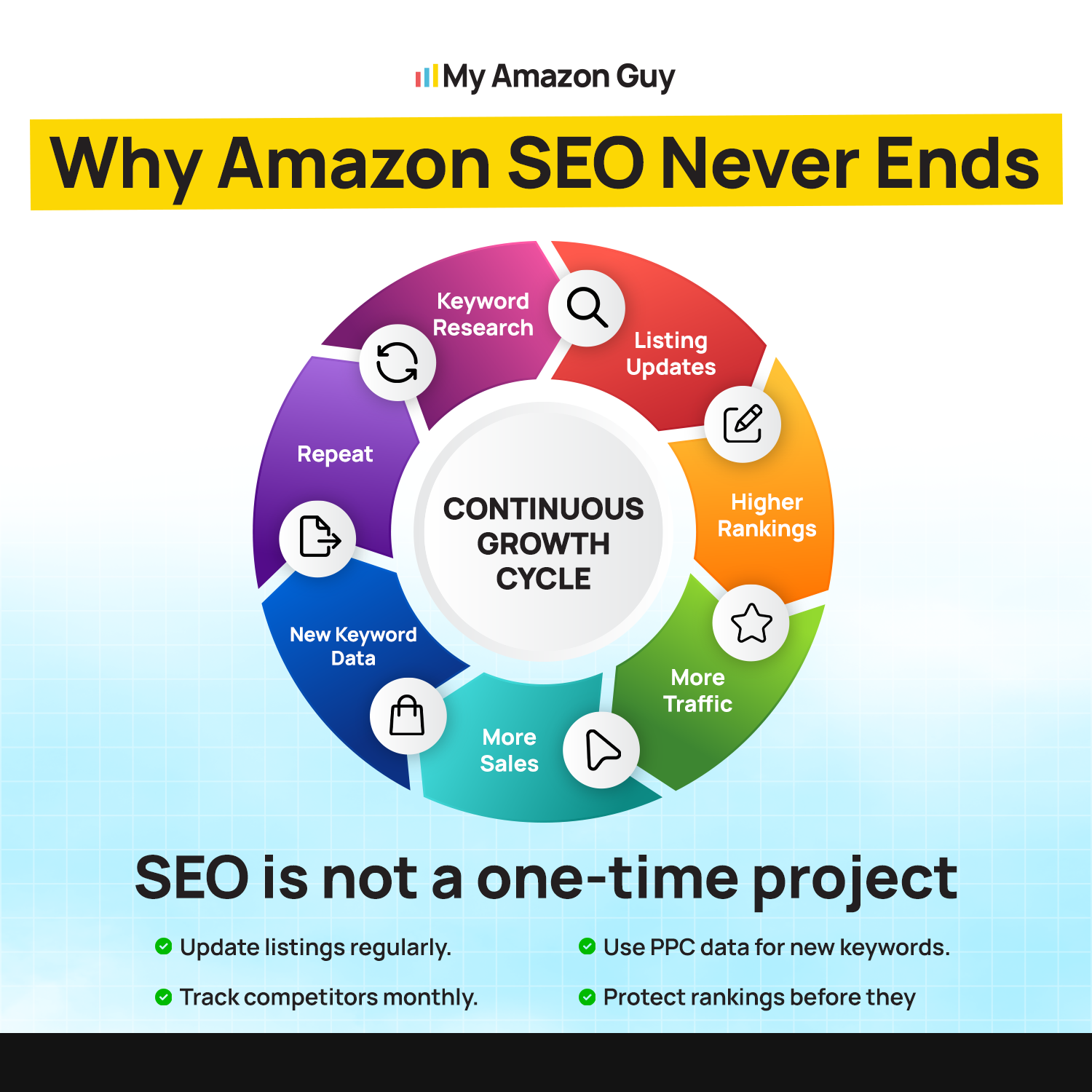
Why One-Time Amazon SEO Eventually Stops Working
Treating your catalog text as a finished task causes a slow slide into platform obscurity. Many brands believe their initial keyword configurations will remain effective forever.
This static mentality ignores how the marketplace operates as a moving river of consumer traffic. Failing to update your copy means you are actively handing your market share over to hungrier brands.
What Does “Set It and Forget It” Amazon SEO Mean?
This practice refers to writing a product description once during setup and never altering the text again. Brand owners often launch an item and assume that initial keyword research handles traffic permanently.
This passive approach treats a digital marketplace like a traditional physical retail shelf. It assumes that consumer demand patterns and search algorithms remain completely frozen.
Why Do Sellers Believe Amazon SEO Only Needs to Be Done Once?
Many operators confuse marketplace listings with traditional website blogs that require less frequent structural updates. They view product copywriting as a launch hurdle rather than an ongoing operational routine.
This misconception leads to stagnant listings that slowly drop out of the search index. Sellers realize a problem exists only after their organic sales baseline drops off a cliff.
Why Does Amazon Reward Continuous Optimization?
The A10 search algorithm prioritizes listings that consistently convert highly relevant customer traffic. Refreshing your text signals to the database that your product matches active market demand.
The platform ranks active listings higher because they provide a superior shopping experience for searchers. Regular content iteration keeps your conversion speed ahead of the category average.
How Do Amazon Policy Changes Affect Amazon SEO?
Amazon regularly updates listing requirements, search standards, and product detail page policies that can directly affect your organic visibility. Sellers who ignore these changes risk losing search performance simply because their listings no longer align with Amazon’s current requirements.
A recent example is Amazon’s shift toward shorter product titles, with many categories now enforcing a 75-character limit. Keeping your most important keywords at the beginning of your title and moving secondary information into bullet points helps maintain compliance while preserving your Amazon SEO performance.
How Stale Amazon SEO Quietly Shrinks Your Profit Margins
Organic search placement rarely disappears overnight, but profitability slowly erodes when listings sit abandoned. This invisible decay forces sellers to spend more on marketing just to keep their total sales flat.
The resulting margin squeeze catches internal management teams completely by surprise. They watch their revenue remain stable while their actual take-home profit drops to zero.
Why Does Organic Traffic Decline Over Time on Amazon?
Your natural marketplace visibility drops because older keywords slowly lose their relative search volume. Consumer language changes over time and leaves static product text behind.
Rivals who update their listings capture the new search terms that you are missing. This displacement pulls your product down the organic results pages.
Why Does Stale Amazon SEO Increase PPC Costs?
Losing your free search rankings forces you to buy sponsored placements to maintain your historical unit volume. This structural shift causes your average cost per click to swallow your net profits.
Sponsored Products average cost per click reached 1.34 dollars, making unoptimized accounts incredibly expensive to run. You end up paying for customers who previously found your brand for free.
Why Do Competitors Eventually Outrank Optimized Listings on Amazon?
Aggressive rival brands continuously harvest fresh search phrases to pull buyers away from your catalog listings. Standing completely still in a moving category guarantees that your product loses its page placement.
Competitors use programmatic analysis to discover the keyword vulnerabilities inside your stagnant copy. They deploy targeted advertising campaigns against your weaknesses to permanently take your position.
How Does Lower Conversion Hurt Amazon Ranking and Profitability?
Fewer purchases per thousand impressions signal to the search engine that your listing is irrelevant to shoppers. The platform responds by lowering your organic positions and increasing your ad bidding costs.
This penalty destroys your profitability by trapping your brand in an expensive ad auction loop. Breaking this cycle requires a complete structural refresh of your user-facing content.
The Amazon SEO Signals That Change Constantly
Marketplace search indicators fluctuate based on customer behavior and backend system updates. Operators must monitor these variables to prevent sudden traffic drops across their catalog.
Ignoring these shifting signals is like driving a vehicle with a broken dashboard. You will remain unaware of engine damage until the car stops moving entirely.
| Amazon SEO Signal | Why It Requires Ongoing Optimization |
|---|---|
|
Customer search terms |
New search phrases emerge over time |
|
Keyword demand |
High-value keywords gain or lose traffic |
|
Customer reviews |
Customer language and expectations evolve |
|
Competitor listings |
Competitors continuously improve their listings |
|
Amazon’s ranking system |
Ranking signals are regularly refined |
How Often Do Keywords Change on Amazon?
High-volume terms shift positions constantly as new search habits emerge each month. A phrase that dominated your category last quarter might carry zero commercial value today.
Sellers must track these keyword volume adjustments to keep their text aligned with real demand. Relying on old data guarantees that you are optimizing for obsolete search queries.
Why Do Amazon Customer Search Terms Evolve?
Shoppers alter their vocabulary based on seasonal changes and trending media influences. Failing to integrate these fresh descriptive terms leaves your listing invisible to active buyers.
External cultural shifts create completely new search phrases that did not exist last year. Capitalizing on these trends requires a flexible copy management process.
Why Do Amazon Reviews Change Listing Performance?
New buyer text highlights unique product benefits that you can add directly to your backend search fields. These real-world customer statements provide excellent keyword insights for your listing.
Negative ratings lower your conversion score and reduce your organic rank ceiling. Monitoring review content helps you adjust your messaging before sales drop.
How Do Competitor Listings Affect Your Amazon Rankings?
When a rival updates their listing images or drops their price, they steal clicks from your detail page. This external movement forces the algorithm to re-evaluate your position on the search results grid.
You cannot protect your visibility without analyzing what your direct competition does. Your organic rank is completely relative to the performance of other products in your category.
Why Do Amazon Algorithm Updates Matter?
The platform frequently changes how it weights backend data fields and customer conversion history. Staying current ensures your listing complies with the latest code changes.
An algorithm shift can strip your indexing for vital keywords overnight if your copy layout is fragile. Regular updates protect your catalog from these sudden structural system changes.
What Continuous Amazon SEO Actually Looks Like
Moving from theory into execution requires a structured operational routine. Successful brands use clean checklists to split their optimization tasks into daily, weekly, and monthly workflows.
This consistent operational rhythm removes the guesswork from managing large product catalogs. It ensures your listings adapt to data changes before your competitors can react.
How Often Should Amazon Listings Be Optimized?
Brands should implement a systematic catalog review every two weeks to stay ahead of market trends. Regular adjustments keep your product indexed for the most profitable seasonal keywords.
This frequency keeps your data fresh without confusing the indexing system with daily textual shifts. It provides the perfect balance between listing stability and market responsiveness.
What Should Be Reviewed Every Week?
Sellers must track immediate performance metrics to catch ranking drops before they ruin monthly sales. Monitoring these rapid changes allows you to adjust your keyword targets instantly.
| Weekly Review | Purpose |
|---|---|
|
Search Query Performance |
Monitor changes in search visibility and click share. |
|
PPC Search Terms |
Identify new keywords with strong buying intent. |
|
Keyword Rankings |
Track gains and losses for important search terms. |
|
Conversion Rate |
Detect listing issues that may affect sales. |
|
Click-Through Rate (CTR) |
Evaluate title, main image, and pricing performance. |
What Should Be Reviewed Every Month?
Monthly reviews focus on structural changes and deep copy improvements across your catalog. This broader look allows you to test creative assets against your direct category rivals.
| Monthly Review | Purpose |
|---|---|
|
Title Optimization |
Refresh keywords and improve readability. |
|
Image Testing
|
Improve click-through and conversion rates. |
|
Backend Keywords |
Remove outdated terms and add new opportunities. |
|
A+ Content |
Update messaging and strengthen product storytelling. |
|
Competitor Analysis |
Monitor changes in competitor listings and positioning. |
|
Catalog Cleanup |
Fix indexing issues, suppressions, and inconsistent content. |
Amazon SEO Strategy by Business Growth Stage
Different revenue milestones require unique approaches to keyword management and capital allocation. Tailoring your Amazon listing optimization routines to your current size protects your cash flow.
A strategy that works perfectly for a small startup can bankrupt an enterprise brand with extensive catalog overhead. Segmenting your operational priorities keeps your business profitable through every expansion stage.
New Brands Under $500K
Early-stage businesses should focus completely on establishing core indexing for their primary descriptive keywords. Paid advertising acts as the main driver to build up historical conversion data.
Sellers at this stage must avoid targeting highly competitive broad terms that drain limited capital. Focus your energy on winning niche long-tail keywords to establish your initial sales baseline.
Growing Brands Between $500K and $5M
Mid-tier accounts must focus on expanding into the organic strike zone where terms rank between positions eleven and twenty. This systematic expansion reduces your total dependence on expensive broad-match ad campaigns.
Pushing these strike zone phrases onto the first page yields the fastest possible revenue growth. This tactical move protects your profit margins as your infrastructure overhead expands.
Established Brands Above $5M
Enterprise catalogs require deep programmatic catalog cleanup and advanced cross-platform tracking routines. Protecting your category dominance requires continuous defensive updates across your entire catalog portfolio.
Large brands must monitor competitive movements daily to block rivals from stealing their historical placement. At this scale, even a minor drop in organic traffic creates massive financial losses.
| Growth Stage | Main Goal | SEO Priority | PPC Role | Review Frequency |
|---|---|---|---|---|
|
Under $500K |
Establish indexing |
Core keywords |
Drive launch data |
Weekly monitoring |
|
$500K to $5M |
Expand traffic |
Strike zone focus |
Fill keyword gaps |
Biweekly optimization |
|
Above $5M |
Defend dominance |
Catalog cleanup |
Protect brand terms |
Continuous auditing |
Stop Ranking Decay
Our team will analyze your backend fields to locate hidden keyword gaps that are costing your brand.
How to Measure Whether Your SEO Is Improving
Sellers cannot improve traffic metrics that they fail to track accurately through native dashboards. Monitoring specific performance trends keeps your business ahead of sudden market movements.
Relying on overall revenue numbers can hide dangerous underlying traffic slides across your account. You need a granular view of your metrics to verify your true catalog health.
Which Amazon SEO KPIs Matter Most?
Operators must monitor a clear set of metrics to judge whether their listing updates deliver real results. Focusing on these core indicators prevents you from chasing vanity numbers that do not impact profit.
| KPI | Why It Matters |
|---|---|
|
Organic Sales |
Measures how much revenue comes from unpaid search traffic. |
|
Organic Sessions |
Shows whether more shoppers are finding your listings organically. |
|
Click Share |
Indicates how often shoppers click your listing after searching. |
|
Conversion Share |
Measures how well your listing converts compared to competing products. |
|
TACoS |
Shows how dependent your overall revenue is on advertising. |
|
Keyword Rankings |
Tracks changes in your organic visibility for target keywords. |
|
Unit Session Percentage |
Measures how effectively your listing converts visitors into buyers. |
How Often Should Sellers Report Amazon SEO Performance?
Performance tracking should occur on a strict biweekly schedule to match platform indexing behavior. This regular cadence allows you to spot negative traffic trends before they hurt your monthly distributions.
Monthly summaries help identify larger structural shifts across your entire product line. Weekly reports should focus strictly on immediate tracking updates and emergency ranking alerts.
Which Amazon Reports Should You Monitor?
Sellers need to gather clean data from multiple native dashboards to guide their copywriting choices. Relying on outside software estimates can cause you to miss sudden algorithmic shifts.
| Amazon Report | Primary Purpose |
|---|---|
|
Search Query Performance |
Measure keyword visibility, click share, and conversion share. |
|
Brand Analytics |
Analyze customer search behavior and competitor trends. |
|
Business Reports |
Monitor sessions, sales, and conversion performance. |
|
Advertising Reports |
Discover new keywords and measure PPC performance. |
Common Amazon SEO Mistakes That Hurt Margins
Many Amazon sellers lose organic traffic and profitability because they repeat the same avoidable SEO mistakes without realizing the long-term impact. Following outdated advice or treating SEO as a one-time task can slowly weaken your rankings, increase advertising costs, and make it harder to stay competitive.
Mistake 1: Treating SEO as a One-Time Project
Leaving your listings unchanged allows competitors to capture new keywords and improve their visibility while your content becomes less relevant. Regular updates help your listings keep pace with changing shopper behavior and Amazon’s evolving ranking signals.
Mistake 2: Relying on PPC Instead of SEO
Paid advertising can increase visibility, but it cannot replace strong organic rankings or improve a poorly optimized listing. The most profitable brands use Amazon PPC to discover keyword opportunities while continuously strengthening their organic presence.
Mistake 3: Stopping Optimization After Reaching Page One
Ranking on the first page is not permanent because competitors are constantly improving their listings and targeting the same keywords. Ongoing optimization helps protect your rankings and reduces the risk of slowly losing organic traffic over time.
Mistake 4: Depending Entirely on Automation
SEO tools can speed up research and identify opportunities, but they cannot fully understand customer intent or write persuasive product copy. Combining data-driven tools with human judgment produces stronger listings that improve both rankings and conversions.
Mistake 5: Keyword Stuffing Your Listing
Adding too many keywords at the expense of readability creates a poor shopping experience and can reduce conversion rates. Write naturally while placing your most important keywords where they make sense for both shoppers and Amazon’s search algorithm.
Advanced Amazon SEO Strategies
Once your listings have strong fundamentals, the next step is using data to make smarter optimization decisions instead of simply adding more keywords. These advanced strategies help established brands strengthen organic visibility, improve efficiency, and stay ahead in competitive categories.
1. Use PPC Data to Strengthen SEO
Your search term reports show which keywords generate clicks, conversions, and sales, making them a valuable source for SEO improvements. Incorporating proven search terms into your listing helps prioritize keywords with real buying intent instead of relying on assumptions.
2. Adjust Your Keyword Strategy for Seasonal Demand
Customer search behavior changes throughout the year, especially during holidays, major shopping events, and seasonal trends. Refreshing your keywords and listing content to reflect current demand helps capture more organic traffic when shoppers are actively searching.
3. Optimize With Search Query Performance Data
The Search Query Performance report shows how shoppers find, click, and purchase your products across important search terms. Reviewing this first-party data regularly helps identify where you’re losing visibility so you can focus your optimization efforts where they matter most.
4. Continuously Test and Refine Your Listings
High-performing brands regularly improve titles, images, A+ Content, and backend keywords based on performance data instead of leaving successful listings untouched. Small, consistent updates often produce stronger long-term results than waiting to make large changes all at once.
5. Use AI as a Research Assistant, Not a Replacement
AI tools can speed up keyword research, content analysis, and idea generation, but they should not replace strategic decision-making. Human expertise is still needed to write persuasive copy, prioritize keywords, and create listings that convert shoppers into customers.
Amazon SEO Tools Our Amazon Agency Recommends
Choosing the right tools helps you monitor performance, identify new opportunities, and make informed optimization decisions without wasting time. Each tool serves a different purpose, so using them together provides a more complete view of your Amazon SEO performance.
| Tool | Best For | Strength | Limitation |
|---|---|---|---|
|
Search Query Performance |
Keyword performance |
First-party Amazon data |
Brand Registry required |
|
Brand Analytics |
Market and competitor research |
Amazon first-party insights |
Limited historical data |
|
Jungle Scout |
Keyword research |
Extensive keyword and product database |
Relies on estimated data |
|
DataDive |
Listing optimization |
Keyword clustering and prioritization |
Paid subscription |
|
Amazon Ads Console |
PPC insights |
Real customer search term data |
Requires active advertising campaigns |
Frequently Asked Questions About Amazon SEO
Can SEO Amazon be completed once?
No, Amazon SEO is an ongoing process because customer search behavior, competition, and ranking signals constantly change. Regular optimization helps maintain organic visibility and reduces your reliance on paid advertising over time.
What is the Amazon Search Query Performance report?
The Amazon Search Query Performance report is a first-party tool that shows how shoppers find, click, and purchase your products for specific search terms. It helps you identify opportunities to improve your listings using real customer search data instead of estimates.
Should I optimize my listings myself or hire an Amazon agency?
If you have the time, expertise, and resources, you can manage Amazon SEO yourself by consistently monitoring performance and making data-driven updates. Many growing brands choose to work with an agency to gain access to proven processes, specialized tools, and experienced strategists.
How long does Amazon SEO take to show results?
Small changes, such as keyword indexing updates, can appear within days, but meaningful ranking improvements usually take several weeks of consistent optimization. The timeline depends on factors like competition, conversion rate, and sales performance.
Is Amazon SEO different from Google SEO?
Yes, Amazon SEO is designed to help shoppers find products they are most likely to purchase, while Google SEO focuses on delivering the most relevant information. Success on Amazon depends heavily on relevance, conversion rate, and sales performance rather than backlinks or domain authority.
Your Listings Should Grow With the Marketplace
Amazon SEO is never finished because the marketplace keeps changing, and your competitors are constantly looking for ways to win more visibility. Ignoring your listings for months at a time allows them to capture valuable keywords, organic traffic, and customers that could have been yours.
The brands that consistently protect their profit margins are the ones that treat SEO as an ongoing process instead of a one-time project. Regular optimization helps you adapt to changing search trends, strengthen organic rankings, and reduce your dependence on paid advertising to maintain sales.
Are your organic rankings slipping? It may be time to take a closer look at your SEO strategy. Reach out to our full-service Amazon agency, and let our Amazon experts develop a data-driven optimization plan for your brand.
Maximize Your Profit
Speak directly with our marketplace strategists to eliminate wasteful ad spend and reclaim your organic search rankings.