Nobody scrolls to page two unless they regret a life choice, so let’s talk about how to rank products higher on Amazon.
TL;DR
Here is what drives higher Amazon product rankings.
- Relevance and conversion drive rankings
- Keyword sales velocity matters most
- Optimize every listing field fully
- Reviews and stock protect rank
- Track keyword positions every week
Stuck on page two despite strong sales? This guide shows the full system and when an Amazon agency should run it for you.
Table of Contents
Rank Higher on Amazon Faster
Let our Amazon SEO experts optimize your listings to improve visibility, rankings, and organic sales.
If you sell more than $1 million a year on Amazon and your best products are still stuck on page two, this guide is for you. We wrote it to show you exactly how to rank products higher on Amazon using the same system our team runs every day across hundreds of brands.
We are My Amazon Guy, and we have managed more than $1.2B+ in ecommerce revenue for the brands we serve. That experience is the foundation for everything below, from the algorithm breakdown to the listing checklist you can act on today.
Ranking is not luck, and it is not a secret. It is a repeatable process built on relevance, conversion, and sales velocity, and you can learn the whole system on this page.
- 00:00 - Why Sales Drive More Sales on Amazon
- 01:08 - How to Structure Your Product Title
- 05:04 - Bullet Points SEO Strategy Explained
- 07:23 - A+ Content and Description Indexing
- 09:13 - Keyword Research Using Competitors
- 11:02 - Filtering High Relevancy Keywords
- 15:23 - Aligning SEO with Ad Campaigns
- 17:36 - Why Main Image Impacts Clicks and Sales
What Is Amazon SEO?
You have a product that sells, real reviews, and a price that works, yet it sits on page two while thinner competitors outrank you. The frustrating part is that you are not sure whether the problem is your keywords, your listing, or something in the algorithm you cannot see.
Amazon SEO helps remove the guesswork from improving your visibility. Once you understand what influences rankings, it becomes much easier to identify what needs attention and where to focus your efforts.
Amazon SEO is the process of improving your product listings to increase their visibility in Amazon’s search results for relevant customer searches. It works by improving keyword relevance and sales performance, so Amazon shows your product to more shoppers who are ready to buy.
Amazon SEO is how you earn organic placement on the search results page without paying for every click. The higher you rank for a keyword, the more impressions, clicks, and sales you get from that keyword for free.
The goal is simple. You want your product near the top of page one for the searches your buyers actually type, because most shoppers never scroll past the first page.
The stakes are higher than most sellers realize. Ranking in the top three spots for a high-volume keyword can mean several times the daily sales of a page-two position.
On Amazon, every search carries buying intent. A shopper who types a query is not browsing for information; they are looking to purchase, which makes search visibility the single biggest driver of organic sales.
How Does Amazon SEO Work?
Amazon SEO works by matching your listing to a shopper’s search and then proving your product is the one most likely to sell. Amazon evaluates information across your listing, including your title, bullet points, product description, and backend search terms, to determine which searches your product should appear for.
After that, it watches how shoppers respond. Clicks, purchases, and review quality tell Amazon whether to push you up or let you slide down.
How Is Amazon SEO Different from Google SEO?
Google ranks pages on authority and backlinks because it is trying to answer a question. Amazon ranks products on conversion and sales because it is trying to close a sale.
That difference changes your whole strategy. On Amazon, you do not build links; you build sales velocity and a listing that turns browsers into buyers.
It also changes your timeline. Google rankings can take months to build trust, while Amazon listings can move in days because the algorithm reacts quickly to sales.
Does Amazon SEO Matter for Established Brands?
Yes, and it matters most once you already have traction. A brand doing $1M+ has the sales history to rank fast, but a weak listing leaves that potential on the table.
Fixing relevance and conversion on a proven product is often the quickest win in your account. That is exactly the gap we see on most mid-market listings we audit.
How Amazon's Ranking Algorithm Works
You have read a dozen conflicting blog posts and watched as many videos, and each one names a different magic factor. The result is that you are optimizing in the dark, guessing at what Amazon actually rewards.
The fix is to understand the engine itself. Once you know what the algorithm measures, you stop guessing and start working the levers that matter.
Amazon’s search engine decides which products appear first for every keyword a shopper types. Learning how the ranking system works is the foundation of an effective Amazon SEO strategy.
What Is the Amazon A10 Algorithm?
The Amazon A10 algorithm is the search system that ranks products based on relevance and sales performance. It is the community name for the major ranking changes that are built on the older A9 system.
One honest note matters here. Amazon never officially launched a product called A10, so the term is shorthand sellers use for how ranking has shifted in recent years.
The older A9 system leaned heavily on keyword matching and ad-driven sales. The newer approach puts far more weight on organic sales, conversion, and customer behavior.
What this means for you is practical. You cannot buy your way to the top with ads alone anymore, because the algorithm rewards genuine demand and a listing that satisfies the shopper.
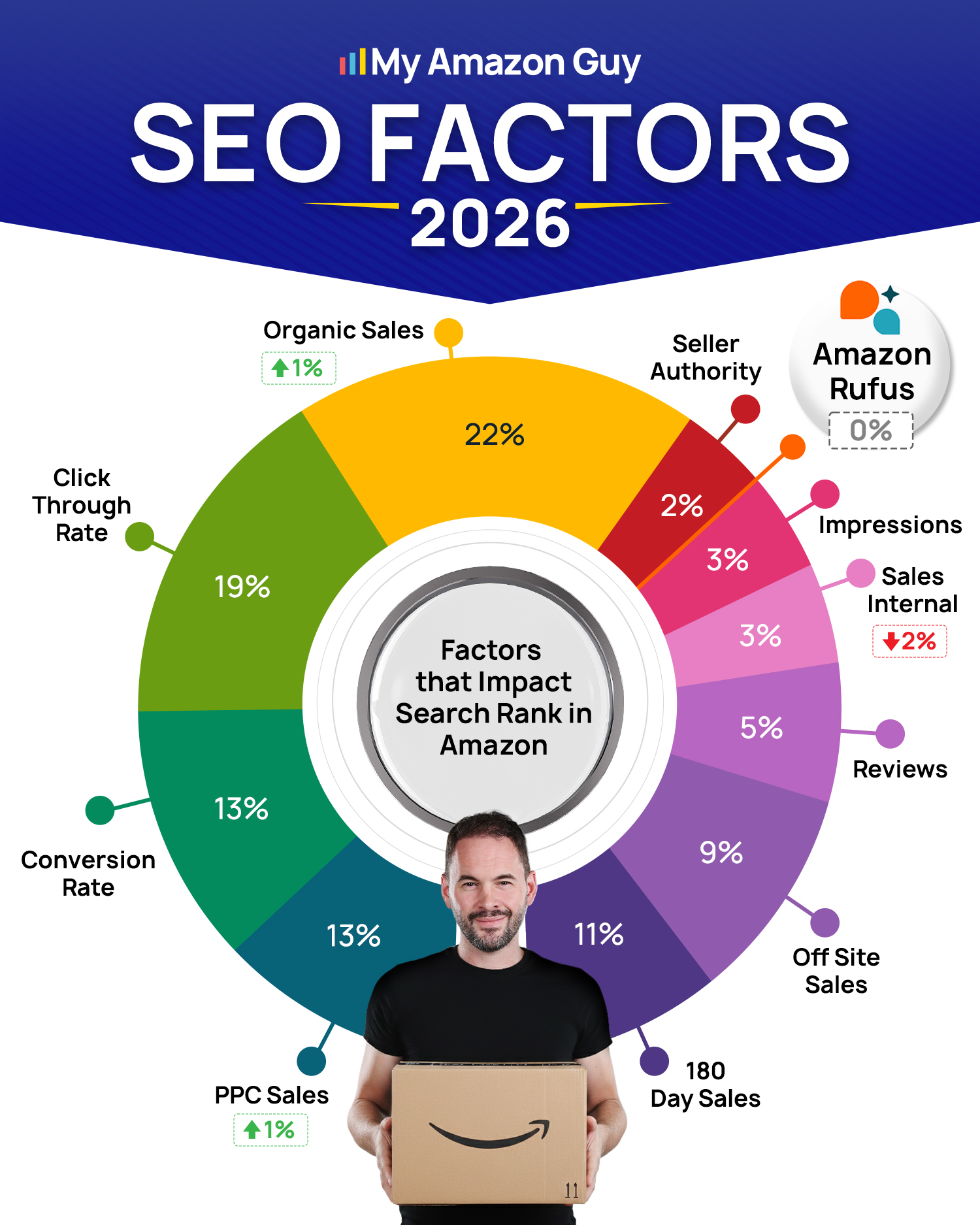
What Factors Determine Amazon Search Rankings?
Amazon rankings are influenced by several signals that work together. The strongest results usually come from improving relevance, performance, and customer trust at the same time.
- Relevance: Keywords in the title, bullets, description, and backend terms.
- Performance: CTR, CVR, and keyword-level sales velocity.
- Trust: Customer ratings, product reviews, return rates, and reliable fulfillment.
What Is the Difference Between Indexing and Ranking?
Indexing means Amazon recognizes your listing as relevant for a particular keyword and allows it to appear in search results. Ranking refers to the position your product earns within those results.
Your product must be indexed before it has any chance of ranking for a keyword. Think of indexing as qualifying for the search results, while ranking determines how visible your listing is once it qualifies.
How Is AI Changing Amazon Search in 2026?
Two AI systems are reshaping results right now. COSMO is Amazon’s knowledge framework that connects products to real use cases, not just exact keywords.
Rufus is Amazon’s shopping assistant that already handles a large share of searches and reads your full listing to decide what to recommend. The takeaway is to write listings that clearly explain what your product does and who it is for.
These AI systems reward clarity over keyword tricks. They read your reviews, bullets, and description to understand real use cases, so plain language about benefits now beats clever stuffing.
How Long Does It Take to Rank on the First Page of Amazon?
Amazon indexes most listing edits within 24 to 48 hours, but ranking takes longer to move. Real position change usually appears across two to four weeks as clicks and conversions accumulate.
Competitive head terms can take a few months of steady sales velocity. The honeymoon period at launch gives new products a short boost, so a strong start matters.
What Role Do Conversion Signals Play in the Algorithm?
Once Amazon shows your product, it watches what shoppers do next. A click followed by a purchase is the clearest signal that your listing matches the search.
This is why two listings with identical keywords can rank worlds apart. The one that converts better proves it deserves the spot, and Amazon moves it up.
Amazon SEO Ranking Factors That Actually Move the Needle
You have tweaked your title, added bullets, and refreshed your images, but the needle barely moved. The problem is rarely effort; it is spending that effort on factors that carry little weight while ignoring the ones that carry the most.
This section fixes the priority order. Below are the factors that actually create movement, ranked by how much pull each one has.
Not every ranking factor carries equal weight. Below are the ones we prioritize first, in the order they tend to create movement.
Why Is Keyword Sales Velocity the Top Ranking Factor?
Keyword sales velocity is how many sales your product makes after a shopper searches for a specific term. Amazon treats this as the strongest proof that you deserve to rank for that term.
Ranking is always per keyword, never global. You can sit at position one for one phrase and position fifty for another at the same time.
This is why keyword selection drives everything. A few sales on a low-competition term move you fast, while the same sales on a saturated term barely register.
Most sellers cannot see sales by keyword, so they guess at which terms are working. A keyword tool that estimates demand and competition removes that guesswork and shows where your velocity is actually landing.
How Does Click-Through Rate Affect Ranking?
A strong click-through rate signals that shoppers find your listing appealing when it appears in search results. CTR is often easier to improve than conversion, and the main image is your biggest lever.
Contrasting colors, clear product framing, and readable packaging all lift clicks. More clicks feed more sales, and more sales feed your rank.
How to Improve Conversion Rates on Amazon?
Conversion rate is the share of visitors who buy after landing on your listing. Strong images, competitive price, solid reviews, and clear bullets all push it higher.
Conversion matters because it confirms your listing matches search intent. When you convert better than rivals for the same keyword, Amazon rewards you with a stronger position.
Small changes compound here. A sharper main image, a clearer first bullet, and a few more reviews can each lift conversion a point or two, and together they move your rank.
Do Reviews and Ratings Change Where You Rank?
Reviews build the trust signal Amazon uses to protect the shopper experience. High ratings, steady review velocity, and low returns all support a higher rank.
Never buy or incentivize reviews, since that can trigger suspension. Earn them with a compliant follow-up using Amazon’s Request a Review button instead.
Does Inventory Health Impact Amazon Organic Search?
Yes, running out of stock can quietly sink your rank. Stockouts reset your sales momentum and can suppress your listing for weeks after you restock.
Steady availability signals reliability to the algorithm. Forecast demand and keep a buffer stock so a supply gap never costs you a ranking you worked to earn.
Does Amazon Prime Eligibility Affect Search Ranking?
Prime eligible products through FBA tend to get extra ranking consideration. Fast, reliable fulfillment improves conversion, which feeds back into rank.
Prime also lifts buyer confidence at the click stage. Shoppers trust the badge, so your listing earns more clicks and more sales.
Do Behavioral Signals Like Add-to-Cart Affect Ranking?
Yes, Amazon watches how shoppers behave beyond the final purchase. Time on the page, add-to-cart rate, and brand searches all hint at whether a product is genuinely interesting.
These signals sit underneath the bigger ones like velocity and conversion. You influence them with the same work, a sharper listing that holds attention and earns the click.
The table below ranks the core signals by how much pull they carry and what you control to influence each one.
| Ranking Signal | Impact on Rank | What You Control |
|---|---|---|
|
Keyword sales velocity |
Highest |
Pricing, traffic, promotions |
|
Conversion rate |
Very high |
Images, reviews, bullets |
|
Keyword relevance |
High |
Title, backend terms |
|
Reviews and ratings |
High |
Product quality, follow-up |
|
Inventory health |
Moderate |
Forecasting, restock timing |
|
External traffic |
Moderate |
Social, email, influencers |
Fix Your Amazon SEO Today
Get a complete SEO strategy built to help your products rank higher and convert more shoppers.
Keyword Research for Amazon SEO
You have a keyword list, but you suspect half of it is wrong. Some terms get no traffic, others are impossible to win, and you cannot tell which ones are quietly costing you sales.
Better keyword research solves that doubt. When you pick the right terms, every other optimization finally pays off.
Keyword research is the foundation of ranking because picking the wrong terms wastes every other effort. The real question is not how to rank; it is which keywords are worth ranking for.
How to Find Keywords for Amazon SEO?
Start with Amazon’s own autocomplete, since the suggestions reflect real shopper demand. Then reverse-engineer the top competitors to see which terms drive their sales.
Tools like Jungle Scout‘s Keyword Scout add hard search volume data on top. Cross-reference a few sources so you trust the numbers before you build around them.
Competitor analysis is the fastest shortcut to a strong keyword list. Pull the terms your top three rivals rank for, then target the ones where your product can realistically compete.
How to Find Long-Tail Keywords for Amazon?
Long-tail keywords are longer, more specific phrases with lower volume but higher intent. A shopper searching with a three- or four-word phrase usually knows exactly what they want.
These terms convert well and cost less to win. Use them in your bullets and backend fields to capture buyers your competitors miss.
How to Use Amazon Brand Analytics for Keyword Research?
Brand Analytics is free with Brand Registry and shows the search terms driving your category. The Search Query Performance dashboard reveals which queries lead to impressions, clicks, and purchases.
Search frequency rank tells you how popular each query is against all Amazon searches. Use it to prioritize the terms with real revenue behind them, not just big volume.
Should You Chase High Search Volume Keywords?
Big volume looks tempting, but it is often the hardest and least profitable to win. Some high-volume terms barely convert, while smaller terms quietly drive steady sales.
Balance a few ambitious head terms with a deep set of mid- and long-tail phrases. That mix builds momentum you can actually sustain.
Amazon Listing Optimization, Field by Field
You know your listing could be tighter, but you are not sure which field deserves the most attention. So you rewrite the title for the third time while the backend terms sit half empty and the description goes unread.
This section gives each field a clear job. Work through them in order, and nothing important gets left on the table.
Amazon listing optimization is where keyword research becomes real ranking. Every field on your detail page sends a signal, so each one deserves attention.
Think of your listing in two layers. Text targets the algorithm for relevance, while images and design target the shopper for conversion.
Here are the four text fields that carry the most SEO weight and how much room you have in each.
| Listing Field | Character Limit | SEO Job |
|---|---|---|
|
Product title |
75 characters |
Front-load primary keywords |
|
Bullet points |
255 each, five total |
Secondary keywords and benefits |
|
Description or A+ |
2,000 characters |
Story, objections, extra terms |
|
Backend search terms |
249 characters |
Synonyms and misspellings |
Limits vary slightly by category, so confirm yours in Seller Central before you write.
How to Write an SEO Friendly Amazon Product Title?
Lead with your highest volume primary keyword, then add brand, product type, and a key feature. The title carries the most keyword weight of any field.
Front-load the most important terms because mobile truncates titles after about 80 characters. Write it to read naturally, since stuffed titles now hurt you with shoppers and the algorithm.
Mobile is where most of your shoppers live, so test the title on a phone before you publish. If the key benefit gets cut off, rewrite until the first 30 characters carry the message.
How Many Keywords Should I Put in an Amazon Title?
There is no magic number, but clarity beats cramming. Fit your primary term plus two or three strong supporting keywords without breaking readability.
A clean title that a human wants to click outperforms a keyword pile every time. Save the extra terms for your bullets and backend fields.
Do Amazon Bullet Points Affect Search Rankings?
Yes, bullets carry secondary keywords and do heavy lifting on conversion. Lead each bullet with a benefit, then back it with the feature that delivers it.
Keep them scannable, since only the first few show on mobile before a shopper taps to expand. Answer the questions a buyer has before they reach the reviews.
What Are Amazon Backend Search Terms?
Backend search terms are hidden keywords you enter in Seller Central that shoppers never see. Amazon indexes them, giving you room for synonyms, misspellings, and alternate names.
Use the full character allowance and skip commas to save space. Do not repeat words already in your title, since that wastes the field.
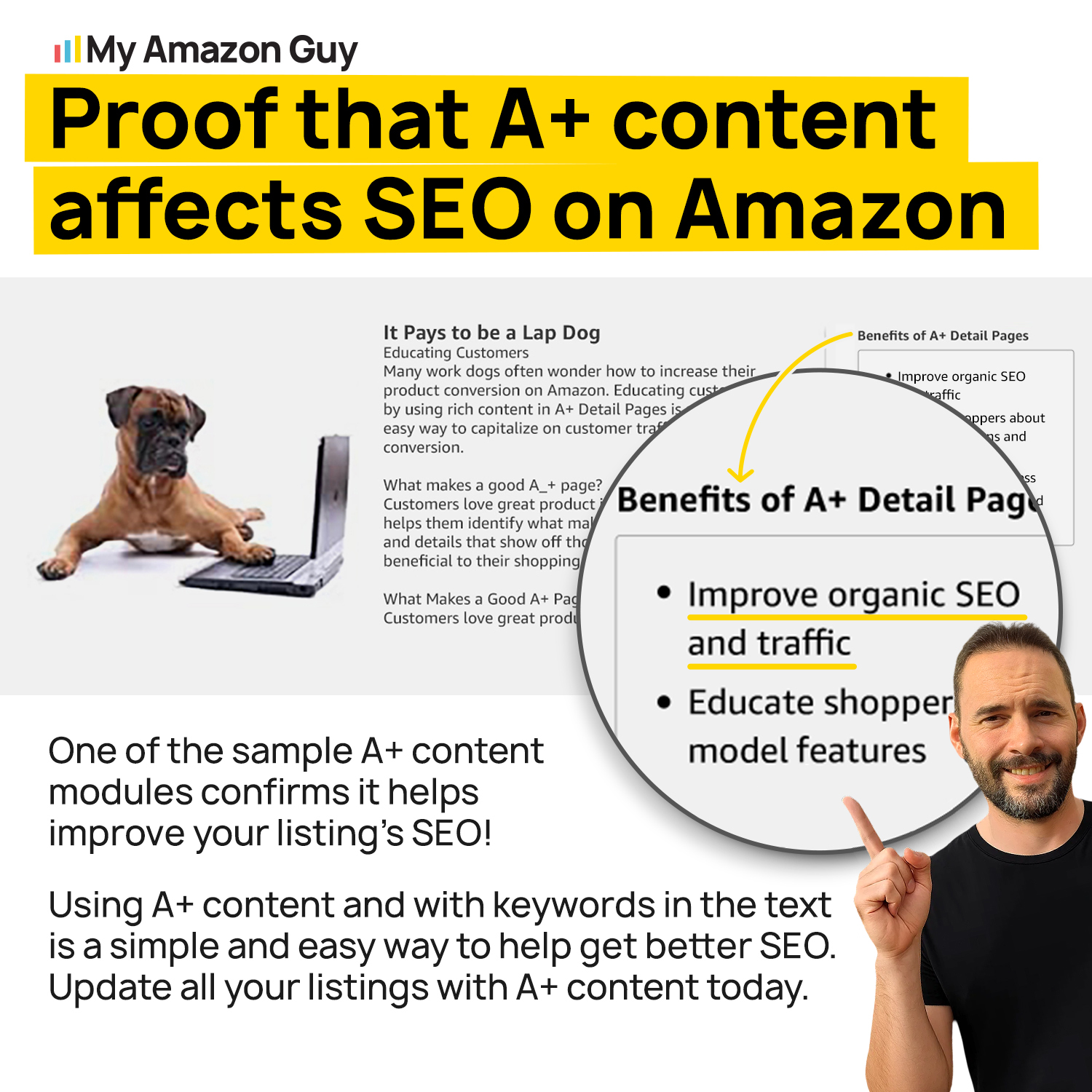
Does A+ Content Improve Amazon SEO?
A+ Content does not get indexed for keywords directly, but it lifts conversion in a big way. Higher conversion feeds the performance signals that improve your rank.
Use comparison charts and lifestyle imagery to answer objections on the page. A compelling brand story adds prime detail-page space that keeps shoppers engaged.
What Makes an Amazon Image Stack Convert?
Your main image wins or loses the click before any text is read. Use a pure white background, fill most of the frame, and keep it sharp at small mobile sizes.
Fill every secondary slot with lifestyle shots, infographics, and feature callouts. Showing the product in use helps shoppers picture owning it, which lifts conversion.
Is Your Listing Ad-Ready Before You Scale PPC?
Pouring ad spend onto a weak listing burns money. Before you scale, confirm the listing is retail ready with strong images, reviews, a competitive price, and the Buy Box.
An ad-ready listing converts the traffic ads send, which feeds sales velocity. A listing that is not ready just leaks your budget at the click stage.
Advanced Amazon SEO Strategy
You have covered the fundamentals and still cannot crack the top of a competitive keyword. The brands above you are not doing one secret thing; they are stacking several advanced tactics you have not layered in yet.
This section is the next layer. These are the moves that separate a page-two listing from a page-one leader.
The basics get you onto page one for easier terms. To win competitive keywords and hold them, you layer in the tactics below.
How Does Pricing Strategy Affect Ranking?
Price is not a direct ranking factor, but it shapes conversion and velocity, which are. Too high and conversion drops, too low and your margin disappears.
At launch, pricing well below your target can spark early sales during the honeymoon window. A short, deliberate price drop on an established product can also lift velocity and rank before you raise it again.
Does Amazon Advertising Improve Organic Rank?
Amazon PPC does not move organic rank directly, but it drives the sales velocity that does. Ad sales build keyword history and conversion data, which the algorithm rewards.
A healthy listing balances roughly one sponsored keyword for every two organic keywords. Use ads to spark momentum, not to prop up a listing forever.
How Does External Traffic Affect Amazon SEO?
Outside traffic from social, email, and influencers signals real demand to Amazon. Quality now matters more than raw volume, so targeted traffic that converts beats a flood of random clicks.
External traffic is especially powerful during a launch or a ranking plateau. A focused email push that converts can leapfrog a stuck listing.
Amazon also offers a Brand Referral Bonus that rebates part of the sales you drive from outside the platform. That turns your own marketing into a ranking input and a cost saver at the same time.
How to Increase Organic Sales on Amazon?
Organic sales grow when relevance, conversion, and trust all improve at once. Tighten your keywords, sharpen your listing images, fix your price, and keep reviews flowing.
Then protect the gains with steady stock and consistent service. The flywheel builds on itself once each piece is working.
The order matters as much as the work. Fix relevance and conversion first so the traffic you drive actually converts, then pour on velocity through ads and external traffic.
How Does Catalog and Variation Strategy Help Ranking?
Smart variation listings concentrate reviews and sales history onto one strong family. That combined strength helps every child ASIN rank better than it would alone.
A clean catalog also prevents keyword cannibalization between your own listings. When two pages chase the same term, they split the equity that should sit on one.
We see this constantly during audits. Two near-duplicate listings each rank on page two, when a single consolidated page would have reached page one.
How Do You Maintain a Ranking Once You Earn It?
Ranking is not set and forget, since competitors and the algorithm keep moving. Hold your position by keeping stock steady, reviews flowing, and your price competitive.
Revisit your keywords each quarter and after any major Amazon change. The sellers who stay on top are the ones who monitor weekly and adjust before small slips become big ones.
How to Track Amazon Keyword Rankings Accurately?
Track organic positions for your target keywords weekly, not once. Watch session percentage by source, conversion rate, and sales velocity trends alongside rank.
A keyword tracker shows movement before it shows up in revenue. Catching a slip early lets you fix it before it compounds.
Common Amazon SEO Mistakes to Avoid
You may be doing everything right and still losing ground because of one quiet mistake working against you. A single de-indexing trigger or a recurring stockout can undo months of careful optimization.
Knowing the traps is half the battle. Here are the errors that sink rankings most often, so you can check your account against them today.
Most ranking problems trace back to a short list of avoidable errors. Steer clear of these, and you stay ahead of most of your category.
- Keyword stuffing titles and bullets, which now hurts both readability and rank
- Using rebates, two-step URLs, or other schemes that can get you de-indexed
- Buying or incentivizing reviews, which risks account suspension
- Letting products go out of stock and resetting your sales momentum
- Optimizing for keywords your listing is not even indexed for
- Ignoring mobile, where most shoppers see a truncated title and top bullets
- Running two near-identical listings that cannibalize the same keyword
Why Did My Amazon Product Ranking Drop?
A sudden drop usually points to a lost Buy Box, a stockout, a price change, or a wave of negative reviews. Each one hits the conversion or trust signals that hold your rank.
Check those four first before you touch your keywords. The fix is often operational, not a rewrite of your listing.
Amazon SEO Checklist
You have absorbed a lot of moving parts, and it is easy to lose track of which ones you have actually handled. Without a single list to work from, something always slips.
This checklist turns the whole guide into a repeatable pass. Run it on any listing, and you cover every signal we have discussed.
Use this checklist as your repeatable pass on any listing you want to rank. Work from top to bottom, and cover every signal in this guide.
- Researched keywords from autocomplete, competitors, and a volume tool
- Confirmed the listing is indexed for every target keyword
- Front-loaded the primary keyword in a readable title
- Wrote five benefit-led bullets with secondary keywords
- Filled the full backend search term field with synonyms and misspellings
- Completed the image stack with a scroll-stopping main image
- Published A+ Content and a brand story to lift conversion
- Set a competitive price and confirmed Buy Box ownership
- Built a compliant review request flow
- Set inventory buffers so you never run out of stock
- Connected PPC and external traffic to drive keyword sales velocity
- Set up weekly keyword rank tracking
How to Rank Products Higher on Amazon Without Doing It All Yourself
By now, you can see the truth. Ranking higher on Amazon is not one trick; it is a system of relevance, conversion, velocity, and trust that all have to move together.
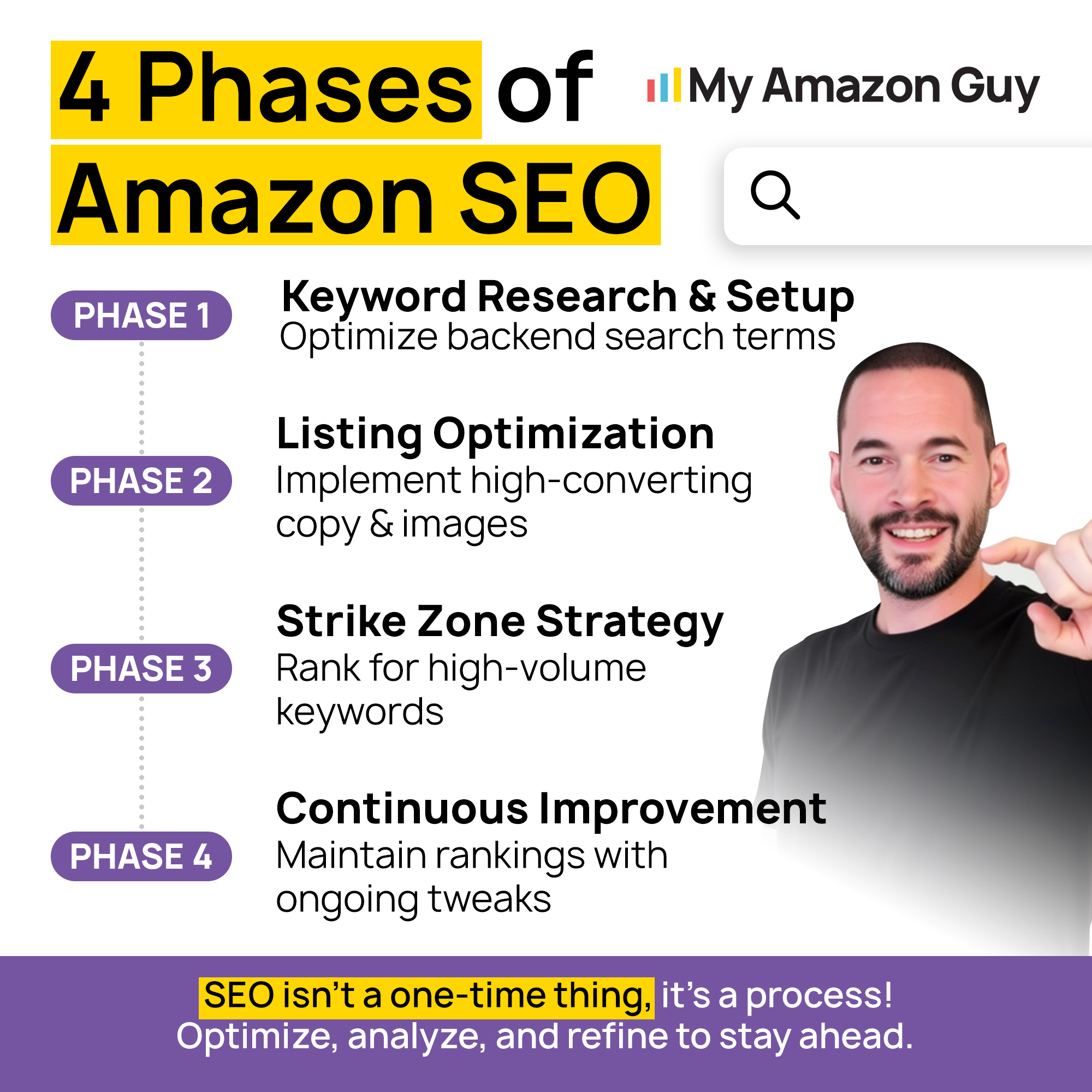
That system is learnable, and most of this guide is built so you can run it in-house. We follow a four-phase Amazon SEO method that takes a listing from initial keyword optimization through backend rotation, strike-zone keywords, and finally market share expansion.
The honest part is that doing all of it well, across a full catalog, every week, is a real job. Keyword research, listing optimization, design, reviews, inventory, and ad-fed velocity each demand ongoing attention.
Most mid-market brands have the product and the demand, but not the hours. That is the exact moment ranking stalls, not because the seller lacks skill, but because the work outgrows the day.
If you would rather hand the execution to a team that does this at scale, that is exactly what we do. Our experts run the entire four-phase system on your account so you can focus on the parts of the business only you can run.
We bring seven to eight specialists to a single brand, covering SEO, design, advertising, and catalog together. That is how a stuck page-two listing becomes a page-one earner, with every signal moving in the same direction at once.
Amazon SEO FAQs
A few questions come up on almost every call we have with a mid-market seller. Here are the direct answers to the ones you are probably weighing right now.
What Is Amazon SEO?
Amazon SEO is the practice of optimizing your product listings to rank higher in Amazon search results. It improves keyword relevance and sales performance, so more ready-to-buy shoppers see your product.
How Long Does It Take to Rank on the First Page of Amazon?
Amazon usually indexes listing changes within 24 to 48 hours, but ranking movement takes longer. Most listings show meaningful position change in two to four weeks as the algorithm gathers click and conversion data.
Does Amazon SEO Matter If I Already Run a Lot of PPC?
Yes, because PPC drives visibility while SEO drives durable organic rank. Ads spark the sales velocity that lifts organic position, but a weak listing wastes that spend.
How Long Does Amazon SEO Take to Show Results?
Expect early signals within a couple of weeks and stronger gains over one to three months. Ranking compounds, so consistent optimization beats a single one-time pass.
What Is the Single Most Important Amazon Ranking Factor?
Keyword-level sales velocity carries the most weight. Amazon ranks the product that sells best for a specific search, so everything you do should drive sales on your target terms.
Can I Do Amazon SEO Myself?
Yes, the full system is learnable, and this guide lays it out. Many brands run it in-house, while others hand execution to an agency once they see how much ongoing work it takes.
Turn Your Rankings Into Long-Term Revenue
Amazon SEO is not about finding one hidden trick or chasing the latest algorithm update. It is about building a listing that is relevant, converts shoppers into buyers, and consistently earns the sales signals Amazon rewards to increase ranking on Amazon over time.
The sellers who win organic rankings are the ones who treat SEO as an ongoing process instead of a one-time task. Keep refining your keywords, improving your listings, monitoring performance, and protecting your inventory, and your page-two products will have a much better chance of reaching page one.
Ready to climb from page two to page one? Get our team on your listings with full-service Amazon SEO Services from the Amazon SEO agency that has managed more than $1.2B+ in ecommerce revenue, and let us build a strategy that helps your products rank higher, convert better, and grow faster.
Build Better Amazon Listings
Access proven Amazon SEO templates, SOPs, and resources to optimize your listings with confidence.