
Having trouble deciding which fulfillment method actually costs you less? Most sellers compare Amazon FBA vs FBM shipping costs the wrong way, and it quietly drains margin on every order they ship.
Amazon FBA vs FBM shipping costs are not two versions of the same bill, and treating them that way is why so many mid-market catalogs get routed badly. FBA charges you per unit against a published rate card, while FBM charges you per shipment against a carrier rate you negotiate yourself.
We have managed $1.2B+ in ecommerce revenue across 400+ brands, and the same mistake shows up constantly. Sellers set their fulfillment mix once and never revisit it, then 2026 arrived with a January fee increase, an April fuel surcharge, and the end of Amazon’s prep service.
In this guide, our Amazon agency will break down what FBA shipping really costs, what FBM costs once you add labor and returns, and how the two compare at real volume. You will also get the four cases where we tell clients to stay on FBM, and the dual-front system we use so a SKU never runs out of stock.
Table of Contents
Know Your Numbers?
Most brands we audit find two to four points of margin sitting in the wrong fulfillment channel.
TL;DR - Amazon FBA vs FBM Shipping Costs
Amazon FBA charges you per unit against a published rate card, while Amazon FBM charges you per shipment against a carrier rate you negotiate yourself. Most sellers compare the two on the fulfillment fee alone and route the entire catalog one way, which is the actual reason margin compresses as volume grows.
- FBA bills you per unit
- FBM bills you per shipment
- FBA runs $3 to $5
- Self-shipping runs $4.50 to $8
- Oversized and slow stay FBM
The cheaper channel on paper is not always the cheaper channel for your product. Add both legs on both sides, match each SKU to the channel its weight and velocity actually favor, and re-run the math before the next fee update lands.
What Are Amazon FBA Shipping Costs?
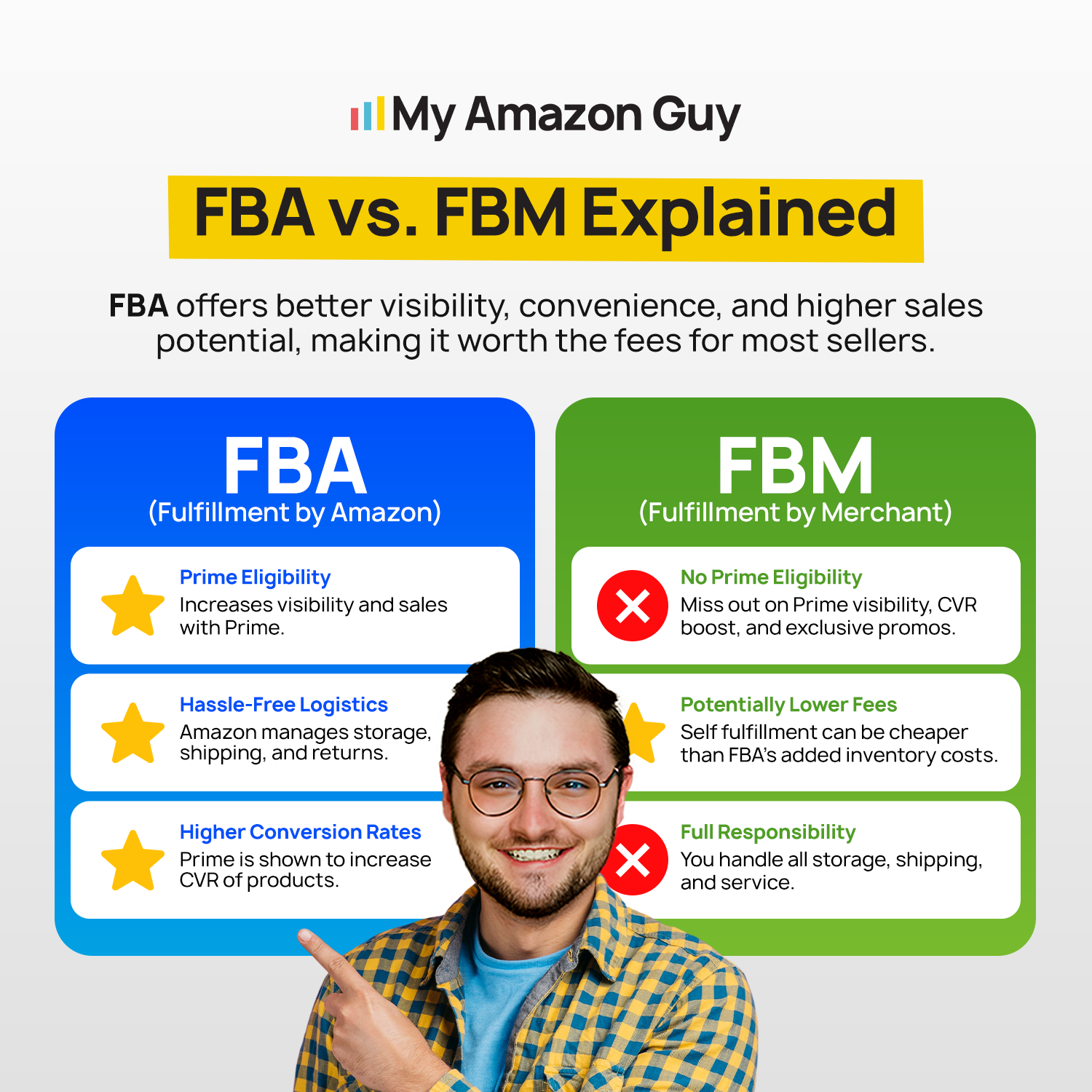
Amazon FBA shipping costs are not a single line item. You pay to move inventory into the network, and you pay again every time a unit goes out to a customer.
Most sellers quote the fulfillment fee and stop, but that fee only covers the outbound leg of picking, packing, postage, and customer service. Inbound freight arrives on a separate bill, and that is where the surprise costs live.
Amazon FBA Shipping Costs at a Glance
| Cost | When it applies | Typical range |
|---|---|---|
|
Typical range
|
Moving units from your supplier or warehouse into a fulfillment center
|
$0.40 to $0.70 per pound
|
|
Inbound placement, optimized splits
|
Inventory sent to the multiple locations Amazon assigns
|
$0
|
|
Inbound placement, minimal splits
|
Standard-size inventory sent to a single location instead
|
$0.21 to $1.58 per unit
|
|
Fulfillment fee, standard size
|
Every unit shipped to a customer, priced by weight and price tier
|
Roughly $3 to $5 per unit
|
|
Fulfillment fee, large and bulky
|
Weight brackets and dimensions replace the standard tiers
|
Varies by bracket
|
|
Overmax handling
|
Items over 96 inches on the longest side or 130 inches length plus girth
|
$17 to $25 per unit
|
|
Fuel and logistics surcharge
|
Added to all FBA fulfillment fees since April 17, 2026
|
3.5%
|
Two of those lines deserve extra attention. The overmax handling charge runs $17 to $25 per unit on genuinely oversized products, while the fuel and logistics surcharge is a 3.5% multiplier on your fulfillment fee rather than a flat add.
Placement is the only line you control outright, since accepting Amazon’s assigned splits drops that charge to zero. Everything else scales with the physical product, which is why size tier engineering pays off before any other tactic you try.
How Much Did FBA Fulfillment Fees Go Up in 2026?
Base fulfillment fees rose an average of $0.08 per unit on January 15, 2026, though that average hides wide variation. Price now sets your fee tier, and standard-size products over $50 absorbed roughly $0.31 per unit, a 15.4% non-peak increase.
Not every product moved the wrong way, and the new Small Bulky tier is the proof. It pulled items with a longest side of 18 to 37 inches or weighing 20 to 50 pounds out of Large Standard and cut fees between 21.4% and 23.3%, dropping a 10-pound product from $9.61 to $7.55.
How Do Inbound Placement Fees Change My Landed Cost?
Placement fees add anywhere from nothing to $1.58 per unit to your landed cost, and which end you land on is your decision. Amazon-optimized shipment splits carry no placement fee at all, while minimal splits push the full charge onto you.
The 2026 restructure hit mid-weight goods hardest. The upper limit for Large Standard climbed about $0.40 per unit, and items over five pounds rose an average of $0.72.
What Are Amazon FBM Shipping Costs?
Amazon FBM shipping costs are the same two legs, unbundled and paid to different vendors. You pay freight into your own warehouse or 3PL, then labor, packaging, and postage on every single order that leaves it.
The trap is that only postage feels like a shipping cost. Labor, materials, return postage, and the customer service time Amazon would have absorbed are all real money, and they rarely show up when a seller runs the comparison.
Amazon FBM Shipping Costs at a Glance
| Cost | When it applies | Typical range |
|---|---|---|
|
Inbound freight to your warehouse
|
Moving units from your supplier to one location instead of many
|
Usually below FBA inbound
|
|
Carrier postage
|
The outbound label through UPS or USPS, priced by weight and zone
|
$4.50 to $8 per unit
|
|
Pick and pack labor
|
Every order pulled, boxed, and labeled
|
Per order, in-house or 3PL rate
|
|
Packaging materials
|
Boxes, dunnage, and labels on each shipment
|
Per shipment
|
|
Return postage
|
Every unit a customer sends back
|
Paid by you, not Amazon
|
Postage is the only line that moves with distance. FBA charges the same whether the customer sits five miles from the fulfillment center or two thousand, while an FBM order out of one warehouse pays a zone-based rate that climbs across the country.
That single fact decides most cases. A one-warehouse operation shipping nationwide pays high zones on a large share of orders, and no carrier discount fully closes that gap.
What Does FBM Actually Cost Once I Add Labor and Returns?
Build the number from five inputs rather than one. Carrier postage, pick and pack labor, packaging materials, return postage, and the customer service time FBA would otherwise absorb.
Returns are where FBA holds a structural edge that rarely gets modeled. Amazon absorbs return postage on FBA orders, so a product returning at 20% under FBM pays postage in both directions on one in five orders while the same product on FBA pays outbound only.
How Much Does Losing the Prime Badge Cost Me in Conversion?
Products carrying the Prime badge convert 5 to 10% better than those without it, and that badge only comes with FBA unless you qualify for Seller Fulfilled Prime (SFP). Amazon also turns the Prime filter on automatically for mobile shoppers, which is over 70% of Amazon buyers.
That makes it an impression problem before it becomes a conversion problem. If your FBM impression share looks weak with no obvious ranking cause, mobile shoppers filtering you out is usually why.
Cut The Guesswork
We will model your top SKUs across both channels and show you exactly where margin is leaking.
Comparing Amazon FBA vs FBM Shipping Costs
Compare cost per order, not cost per unit. FBA charges its fulfillment fee on every unit in the box, while FBM charges one label for the whole box, so a catalog averaging two units per order is quietly paying FBA twice.
How Do I Calculate True Cost Per Unit for FBA vs FBM?
Add both legs on both sides, then divide by the units you shipped in the same period. Skipping the inbound leg is the single most common modeling error we see.
Before you analyze fulfillment costs, you must know your true landed COGS, and a failure to claim available tariff refunds or accurately calculate container rates can quietly drain your margins. Check the video below to understand this better.
| Line | Amazon FBA | Amazon FBM |
|---|---|---|
|
Outbound shipping, standard size |
$3 to $5 per unit |
$4.50 to $8 per unit |
|
Customer service |
Included |
Your headcount or Amazon’s fee
|
|
Return postage
|
Absorbed by Amazon
|
Paid by you
|
|
Prime badge
|
Included |
SFP only
|
Is FBA or FBM Cheaper at 10,000 Units a Month?
FBA, and the gap widens the more you ship. Self-shipping runs $4.50 to $8 per unit against $3 to $5 through FBA, so the difference that felt trivial at two orders a day compounds hard at volume.
Run it at a thousand units a month with a two-dollar spread, and you are handing over $2,000 in monthly profit. Multiply that across a catalog and fulfillment routing becomes one of the fastest margin wins available to you.
At What Unit Volume Does FBM Beat FBA on Cost?
Below roughly a hundred orders a month, shipping cost barely moves your P&L either way, so stay wherever your operations already work. Above that, FBA’s rate advantage starts compounding, and the case for self-shipping gets narrow.
If you are in that early band and want to close the gap, Amazon Shipping or a rate-shopping tool like Veeqo will get you closer to FBA pricing. Neither one beats FBA at scale, and both add a workflow you have to maintain.
When Should I Stay on FBM Instead?
Four situations, and they are specific rather than general. Weight, velocity, fragility, and existing infrastructure.
- Oversized and bulky products, where inbound freight and storage costs outrun the conversion benefit even with Amazon Warehousing and Distribution (AWD)
- Slow-moving inventory, where long-term storage charges accumulate and eventually hurt your account health
- Brands already running a large 3PL or multi-node network, where the fulfillment problem is already solved
- High-value fragile goods, where Amazon’s handling and return policy create loss and damage you cannot control
Bulky and slow-moving usually arrive together, which is why oversized SKUs are the first place we look when margin compresses. This video walks through the full decision framework and both sides of the tradeoff below.
Can I Run FBA and FBM on the Same ASIN?
Yes, and we recommend it as a dual-front system rather than a fallback. Put the majority of inventory into FBA to hold the Prime badge and the ranking benefits, then keep a reserve on FBM behind it.
The reserve exists for one reason. Running out of stock is the most expensive mistake on Amazon, and an FBM offer keeps the listing live and ranking while your FBA replenishment lands.
Best Practices to Lessen Shipping Costs
The biggest lever is not a tactic. It is putting each SKU in the correct channel first, then optimizing inside that channel.
How Do I Lower My Amazon FBA Shipping Costs?
- Right-size packaging to drop into a lower size tier
- Accept Amazon-optimized shipment splits to zero out placement fees
- Enroll bulky products in Ships in Product Packaging (SIPP) to avoid packaging fees of $1.51 to $4.04
- Consolidate inbound freight to cut your per-pound rate
- Check your size tier after every fee update, since reclassification can cut costs
How Do I Lower My Amazon FBM Shipping Costs?
- Rate shop across carriers with Amazon Shipping or a tool like Veeqo
- Shorten shipping zones by adding a second regional node
- Cut dimensional weight before you cut anything else
- Consolidate multi-unit orders into a single box
- Buy packaging in volume rather than per replenishment
How Do I Keep Margin When Amazon Raises Fees Mid-Year?
Treat fee changes as a scheduled event rather than a surprise. Amazon announces most changes in late fall for a mid-January effective date, which gives you roughly 90 days to re-price and re-route.
Build the re-run into your quarterly cadence. Pull the Fee Preview report, recalculate contribution margin by SKU, and move anything that flipped, which is exactly the discipline our Amazon FBA vs FBM guide walks through.
FAQs About Amazon FBA and FBM Shipping Costs
What Is the 3.5% Amazon Fuel Surcharge and Who Pays It?
The 3.5% Amazon fuel surcharge applies to every FBA unit shipped in the US and Canada, so all FBA sellers pay it through higher fulfillment fees. It also applies to Multi-Channel Fulfillment and Buy with Prime orders, while FBM sellers are not affected because they purchase their own shipping.
What Happened to Amazon FBA Prep Services in 2026?
Amazon stopped prepping and labeling inventory in US fulfillment centers on January 1, 2026, so every unit must now arrive fully compliant. Non-compliant shipments face a consolidated inbound defect fee averaging around $0.60 per unit.
Can I Use FBA Inventory to Ship My Shopify and Walmart Orders?
Yes, through Multi-Channel Fulfillment. Amazon will fulfill orders from your other sales channels out of the same FBA inventory, which keeps everything in one location instead of splitting stock across a 3PL and your own warehouse.
Should I Move Oversized SKUs From FBA to FBM?
Start there, because oversized and slow-moving inventory is where FBA charges compound hardest. Overmax handling alone adds $17 to $25 per unit on genuinely large products, and storage costs stack on top of that.
Does the New Small Bulky Size Tier Lower My FBA Fees?
If your product has a longest side between 18 and 37 inches or weighs 20 to 50 pounds, yes, by 21.4% to 23.3%. Check your size tier in Seller Central before you assume 2026 raised your costs.
Stop Paying the Wrong Channel
Amazon FBA vs FBM shipping costs come down to two legs, and the winner changes by product rather than by brand. FBA runs $3 to $5 per unit against $4.50 to $8 for self-shipping, so most catalogs belong on FBA once your order volume gets real.
The exceptions are narrow, but they matter. Oversized, slow-moving, and fragile products still earn their place on FBM, and keeping a reserve there means a listing never goes dark while your FBA replenishment lands.
Are you watching margin compress while your fulfillment mix sits exactly where you set it two years ago? Contact our full-service Amazon agency and let our experts model your top SKUs across both channels and show you where the money is leaking.
Stop Guessing Today
No obligation and no contract, just a clear model of where your fulfillment costs are leaking.