You are paying twice for a good share of your Amazon sales. The first payment is the click, and the second is the organic rank you already earned and then bid against.
Most teams go looking for the answer in their campaigns, and the audit comes back clean. Spend climbs because paid and organic sit on two separate budget lines while Amazon reads them as one system.
We have managed $1.2B+ in ecommerce revenue across 400+ brands, and the pattern repeats at every revenue level. Learning how to combine Amazon PPC and SEO to lower ad costs is a budgeting decision, not a campaign tactic.
Our Amazon agency will discuss how to allocate budget by organic rank tier, when to cut bids without losing placement, and what your TACoS is actually telling you. We will also talk about the numbers to report to finance, how to forecast next quarter’s ad spend, and the mistakes that turn a reallocation into a rank collapse.
Table of Contents
Our audit shows which keywords you are paying for twice and what that spend is actually worth.
Amazon treats paid and organic sales as one signal, but most brands budget them as two separate lines. That gap is why ad spend climbs faster than revenue and why campaign audits keep coming back clean.
- Fund one keyword strategy from one budget
- Report TACoS upward, leave ACoS in the weekly review
- Allocate by organic rank tier, not a fixed percentage
- Find your overlap in Search Query Performance organic click share
- Cut bids only after page one, four weeks, and 40% click share
- Move in 10% steps and measure total units, never ad units
The brands that lower Amazon advertising costs rarely spend less overall. They move the same money onto keywords that still need buying and off the ones their listing already wins.
Why Amazon PPC and SEO Belong in One Budget
Your paid and organic spend answer to the same algorithm, so managing them apart is what makes Amazon advertising cost so hard to control. This section covers why the two lines belong together and how to find the overlap quietly draining your margin.
What Does It Mean To Combine Amazon PPC and SEO?
It means funding one keyword strategy from one pool of money instead of running two teams against two budgets. Amazon does not care whether a sale came from an ad or an organic click, and neither should your forecast.
The algorithm rewards relevance, conversion, and sales velocity. A paid sale and an organic sale send the same ranking signal, which is why ad spend that buys rank is an investment and ad spend on terms you already own is a tax.
Why Is My TACoS Going up Even Though ACoS Looks Fine?
Because ACoS grades a campaign and TACoS grades the business, a distinction our breakdown of ACoS versus TACoS covers in full. ACoS ignores organic revenue completely, so your campaigns can look efficient while advertising eats a growing share of every dollar you sell.
A healthy TACoS for a mid-market Amazon brand lands between 8% and 12%, a band we cover in our Amazon PPC optimization guide. Above it for two straight quarters, you are usually renting rank you already earned instead of buying rank you do not have.
Am I Paying for Keywords I Already Rank for Organically?
Almost certainly, and that overlap is where the margin goes. The waste hides in the gap between what you bid on and what your listing already wins for free.
Two things get called cannibalization, and only one of them costs money, since running a keyword across several campaigns is harmless under Amazon’s second-price auction. The expensive kind is sales cannibalization, where you pay for a click your listing would have won without the ad.
Three Misconceptions That Cost Margin on Amazon
Each of these sounds reasonable in a budget meeting, which is exactly why they survive year after year. All three push money toward ads and away from the listing work that would lower your Amazon advertising cost.
- SEO is free, when it costs copy, images, and A+ content
- A lower ACoS means better performance, when it often means less volume
- Cutting bids lowers TACoS, when it usually raises it
That third one does the most damage. Bids drop, clicks and conversions fall, velocity slows, and organic rank slips until organic sales shrink faster than the spend you saved.
PPC, SEO, and Scaling: Your Amazon Questions Answered
How to Combine Amazon PPC and SEO to Lower Ad Costs by Rank Tier
Allocate against organic rank, not against a fixed percentage. The right split for a keyword you do not rank for is the wrong split for a keyword sitting at position two.
| Organic rank for the keyword | PPC posture | Where the next dollar goes |
|---|---|---|
|
Not indexed, or page 3 and beyond
|
Fund discovery and exact match aggressively
|
PPC
|
|
Page 2 through position 15 |
Hold bids steady, harvest search terms
|
Split evenly
|
|
Page 1, positions 4 to 14
|
Trim bids in 10% steps, watch weekly
|
SEO and conversion work
|
|
Page 1, positions 1 to 3
|
Defensive spend only, protect the placement
|
SEO upkeep and new terms
|
Read the table as a portfolio, not as one ASIN. A catalog of 300 SKUs sits in all four rows at once, and the budget question is how much of your revenue lives in each row.
How Much of My Budget Should Go to Amazon PPC vs SEO?
Start near 10% of sales for PPC and 3% for SEO, then move off that number as fast as your rank data lets you. Our own guide to combining PPC and SEO has used that split for years, and it works as a starting position rather than a destination.
Published benchmarks across the industry cluster in a similar range, and every one of them flattens the differences that actually decide your number. Treat any published figure as an opening bid, because a brand ranking on page one for its top terms and a brand ranking nowhere should spend alike.
Where the 10% and 3% Rule Breaks
It breaks in three places, and all three are common at mid-market scale. A brand with strong rank and weak listings overspends on PPC, a brand launching a new category overspends on SEO, and a brand in a high-CPC category finds 10% cannot buy enough clicks to gather usable data.
The fix is the same in every case, which is to check your rank distribution before you argue about the percentage. If most of your revenue sits in the bottom two rows of the table above, a 10% PPC line is a floor rather than a ceiling.
What Is the Right Ratio of SEO Keywords to PPC Keywords on Amazon?
Aim for roughly twice as many indexed keywords as advertised ones. That 2:1 target is a common benchmark in Amazon advertising education, and the logic holds up because indexing costs nothing per click while bidding does.
If your ratio runs closer to 1:1, you are advertising your way around a listing problem. Fix the indexing first, and the same ad budget stretches further without a single bid change.
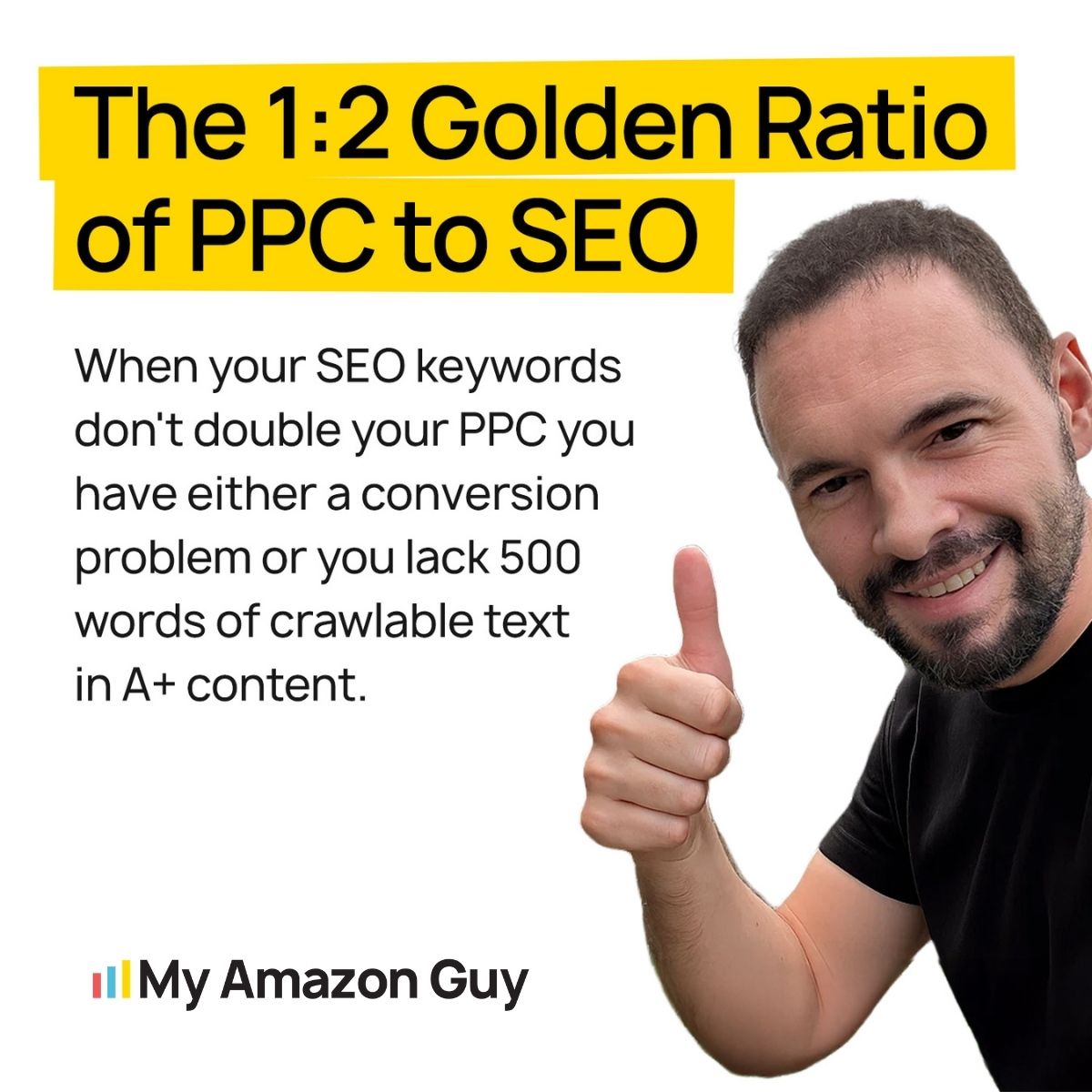
The 1:2 Golden Ratio of PPC to SEO
How Much Does Amazon SEO Cost Compared to PPC?
SEO costs are fixed and front-loaded while PPC costs are variable and permanent. You pay once to rewrite a listing and rebuild A+ content, then you pay for every click forever.
That difference is the whole argument for shifting the mix as rank improves. A listing built to convert both paid and organic traffic lowers your cost per click through better relevance, which means the same budget buys more volume before you reduce a single bid.
How to Reallocate Amazon Ad Spend Without Losing Rank
Moving money between paid and organic is where most brands lose the rank they spent two years buying. This section covers how to find the overlap, what has to be true before you cut, and how to test a reduction without betting the placement on it.
Step 1: Find Your Overlap in Amazon Search Query Performance
It tells you your organic click share for every query, which is the single number this whole exercise runs on. Pull it from Brand Analytics and compare it against your ad spend for the same term.
High organic click share plus high ad spend is your overlap. That combination is the shortlist of keywords worth testing, and it is usually shorter than directors expect.
Step 2: Confirm Three Conditions Before Lowering Amazon PPC Bids
Wait for three conditions together, not one. Page-one placement, four consecutive weeks holding it, and organic click share above roughly 40% for that query.
One condition on its own is noise. Rank moves week to week, and cutting spend on a placement you held for six days is how brands hand rank back to a competitor.
Step 3: Test the Reduction and Watch Your Organic Ranking on Amazon
A bid cut can cost you rank, which is why the reduction is a test and not a decision. Drop bids by 10%, hold for two weeks, and watch total units rather than ad units.
If total units hold, run the same 10% cut again. If organic rank slips or total units fall, restore the bid and wait another month, because gradual reductions after reaching page one are the only way to find your floor without paying to rediscover it.
Five Mistakes That Turn an Amazon Reallocation Into a Rank Collapse
Every one of these shows up in accounts we inherit, usually after a quarter of trying to hit a TACoS number by cutting spend. The damage takes far longer to undo than it took to create.
- Cutting more than 10% in one move
- Acting on a single week of data
- Pulling spend off defensive and branded terms
- Reallocating during Q4 or a launch window
- Treating every keyword in the catalog the same way
The Dangerous Amazon PPC Mistake You’re Probably Making
We treat TACoS as a listing problem first, so your ad line comes down without your organic sales going with it.
The Amazon Advertising Cost Numbers to Report to Finance
Most reporting failures at this level are not accuracy problems; they are audience problems. This section covers which numbers belong in front of finance, how to build a defensible forecast, and how long to tell your CFO the payoff will take.
What Your CFO Needs Instead of ACoS
Stop reporting ACoS upward. Report TACoS, organic click share, and contribution margin after ad spend, because those three answer the question finance is actually asking.
ACoS belongs in the weekly operator review where campaign decisions happen. A CFO needs to know whether advertising is buying growth or subsidizing sales you would have made anyway.
| Cadence | Owner | The question it answers |
|---|---|---|
|
Weekly |
PPC manager
|
Which campaigns need bid or negative changes
|
|
Monthly |
Ecommerce director
|
Is organic click share rising on our top 50 terms
|
|
Quarterly |
CFO or finance lead
|
Is TACoS trending toward our margin target
|
How to Forecast Amazon Ad Spend for Next Quarter
Forecast from your rank distribution, not from last quarter’s spend plus a percentage. Count the revenue sitting in each row of the rank tier table above, then apply the posture that row calls for.
That method produces a number you can defend line by line. It also makes the SEO investment legible to finance, because every dollar of listing work maps to a tier a keyword is expected to move into.
How Long Amazon SEO Takes to Reduce Your Ad Spend
Plan on one to two quarters before the ad line moves. Listing changes need indexing, then traffic, then conversion history before Amazon trusts the page enough to rank it.
Anyone promising faster is selling you a bid cut dressed as a strategy. Our Amazon PPC management team treats TACoS as a listing and relevance problem first, because cutting bids to hit a number breaks the flywheel that earned the rank.
Advanced Amazon PPC and SEO Tactics for Mature Catalogs
The three questions below come up once the allocation model is running and the easy waste is gone. Each one addresses a cost pattern that looks like a problem on a report but is usually a portfolio effect.
Why You Should Rarely Cut PPC on Your Best-Ranking ASINs
Almost never cut to zero, even at position one. Holding a sponsored slot above your organic slot takes two placements off the page for competitors and defends the term you spent two years earning.
Reduce instead of removing. Defensive spend on a top-three keyword is cheap insurance compared with the cost of winning that position back.
Why Your Amazon Ad Spend Rises as Sales Grow
Because catalog growth adds new keywords in the bottom tier faster than mature keywords graduate out of it. Every new ASIN starts unranked, which means it starts expensive.
That is normal, and it is also forecastable. Model launch spend separately from maintenance spend, or your blended TACoS will look broken when it is simply carrying new products.
How to Budget for AI-Driven Shopping on Amazon
Shift a slice of the SEO line toward answering questions rather than matching keywords. Amazon introduced Alexa for Shopping in May 2026, combining Rufus and Alexa+ so shoppers can ask, compare, and get guidance inside search.
Keywords still matter, and bids still work the same way. What changes is that complete attribute data, clear compatibility details, and specific use cases now feed the surfaces that recommend your product, and none of that carries a cost per click.
Amazon SEO For AI Agents Full Walkthrough Guide
FAQs About Combining Amazon PPC and SEO
Can Amazon SEO reduce my advertising spend?
Yes, once your organic rank is strong enough to carry the clicks, you stop buying. A better listing also raises conversion rate, which lowers your cost per click before you touch a single bid.
How do I know if my ads are cannibalizing organic sales?
Compare organic click share against ad spend for the same query in Search Query Performance. Any term high on both is a candidate for a bid test.
What is a healthy TACoS for a mid-market Amazon brand?
Most categories settle between 8% and 12%. Set your own ceiling from contribution margin, because a 45% margin brand and a 20% margin brand cannot carry the same number.
What organic rank do I need before cutting ad spend?
Page one, held for four straight weeks, with organic click share above roughly 40%. Anything short of all three is too early.
How do I budget Amazon PPC and SEO together?
Build one budget, then split it by organic rank tier rather than by channel. Count the revenue sitting in each tier and fund the posture that tier calls for.
Should I stop PPC once I hit page one?
No, reduce it instead. Defensive spend protects the placement and costs far less than winning back a position you lost to a competitor.
Stop Paying Twice for the Same Amazon Sale
Amazon reads a paid sale and an organic sale as the same signal, so budgeting them as two separate lines is what lets ad spend outrun revenue. Allocate against organic rank instead of a fixed percentage, and the money follows the keywords that still need buying rather than the ones you already own.
The discipline is in the sequence, since rank comes first and the bid cut comes second. Wait for page one, four straight weeks, and organic click share above 40%, then move in 10% steps and measure total units rather than ad units.
Are you watching your Amazon ad spend climb while nobody can explain where the money is going? Contact our full-service Amazon agency and let our Amazon experts show you exactly which keywords you are paying for twice and what that spend is worth.
We segment 60 days of spend and show you where the money goes before you commit to anything.