
Are you still trying to figure out how to find the ideal true ACoS on Amazon PPC while your dashboard keeps calling a 30% ACoS good? That number only grades your ads, so it can look healthy while your bank balance shrinks every month.
The fix is to stop borrowing benchmarks and build your target from your own margin, growth stage, and ad share. Once you know how much profit each sale carries, the right ad budget becomes simple math instead of a guess.
We’ve managed $1.2B+ in ecommerce revenue, and brands that set ad targets from profit keep growing while the rest cut bids and lose rank. That same approach shapes every formula, worked example, and reporting habit you will find below.
Our Amazon agency talks about what true ACoS is, why it beats campaign ACoS, and how to calculate your ideal target in this guide. We also discuss how to turn that number into campaign targets, track it monthly, and adjust it for Q4 and new ad placements.
Table of Contents
Send us your margin and ad data, and we will map your break-even ACoS, ideal true ACoS, and campaign targets in one review.
TL;DR - Finding Your Ideal True ACoS on Amazon PPC
True ACoS compares total ad spend to total sales, so it shows what your ads really cost the business. Our Amazon agency builds every Amazon PPC target from that number in five moves.
- Calculate your margin before ads
- Subtract the net margin you need
- Adjust the result by growth stage
- Divide by ad share for campaign ACoS
- Recalculate monthly and after Q4
A good campaign ACoS means little when ads drive most of your sales, and your margin is thin. Work through this list before your next bid change so every ad dollar has a clear profit job.
True ACoS Fundamentals Every Amazon Seller Should Know
Before you set any target, you need to know which number actually connects ad spend to profit. ACoS, true ACoS, and break-even ACoS each answer a different question, and mixing them up is where most budgets go wrong.
What Is True ACoS on Amazon?
True ACoS shows how much of every sales dollar your business spends on advertising. To calculate it, divide your total ad spend by your total sales, including organic orders, then multiply by 100.
For example, $5,000 in ad spend against $50,000 in total sales gives you a true ACoS of 10%. It uses the same math as TACoS, and the original true ACoS formula and this ACoS vs TACoS comparison explain the overlap in more detail.
Why Does True ACoS Matter More Than Campaign ACoS?
Campaign ACoS only compares ad spend to the sales those ads directly produced. It leaves out the organic orders your ads helped create, which is why Amazon advises in its ACoS guide for advertisers against judging campaigns on ACoS alone.
True ACoS uses total sales, the same revenue figure your business reports every month. Your profit after ads equals your margin before ads minus your true ACoS, so it is the one ad metric that connects straight to your bottom line.
What Is the Difference Between ACoS, True ACoS, and Break-Even ACoS?
ACoS tells you how efficient a single campaign or keyword is, while true ACoS tells you how much the whole business spends on ads. One is a tool for your PPC manager, and the other is a number for the owner or CFO.
Break-even ACoS is the point where an ad sale earns zero profit, and it equals your margin before ad costs. Your ideal true ACoS should always sit below that line, because the business still needs to keep some profit.
What Do Most Sellers Get Wrong About True ACoS?
The most common mistake is copying a benchmark from a forum or a podcast instead of working one out from your own numbers. A 10% target means something very different to a brand with an 18% margin than to a brand with a 45% margin.
Other mistakes include using gross margin instead of contribution margin, leaving Sponsored Brands or Sponsored Display spend out of the total, and using one target for the whole catalog. Some sellers also celebrate a very low true ACoS, even though break-even ad sales often pay off later through organic rank.

TACoS vs ACoS
How to Set Your Ideal True ACoS Target
Your target comes from three numbers you already have or can pull from Seller Central in an afternoon. Once you have them, the right ad budget stops being a debate and becomes a quick calculation.
What Formulas Set Your True ACoS Target?
Three simple formulas do all the work, and each one feeds the next. Run them in this order so every number builds on the one before it.
- Break-even ACoS = margin before ads ÷ price
- Ideal true ACoS = margin before ads % − target net margin %
- Campaign ACoS target = ideal true ACoS ÷ share of sales from ads
The first two formulas tell you how much the business can spend on ads overall. The third turns that into a campaign target, which explains why a brand that depends on ads needs a tighter campaign ACoS than one with strong organic rank.
What True ACoS Should You Aim for at Each Growth Stage?
Your growth stage decides how much margin you are willing to put back into ads. Newer products need more ad support to build rank, while mature products should return more of their margin as profit.
| Stage | Starting True ACoS | Main Focus |
|---|---|---|
|
Launch |
15% to 25%
|
Build rank
|
|
Scaling
|
10% to 15%
|
Grow organic share
|
|
Mature |
7% to 10%
|
Protect margin
|
|
Harvest |
Under 7%
|
Keep sales moving
|
Treat these ranges as starting points, not rules, and let your own margin math have the final say. Launch is the only stage where going above your ideal true ACoS makes sense, since new campaigns tend to post a high ACoS before they gather data.
Should Every ASIN Have the Same Target?
No, because each product in your catalog carries a different margin and plays a different role. A hero product, a new launch, and a slow long-tail SKU should not share one ACoS target.
Set a target for each ASIN based on its own margin and stage, then combine them into one brand number weighted by sales. Your PPC manager bids against the ASIN targets, while the brand number is what you report to owners or investors.
Our PPC team will check your margin, ad share, and true ACoS against your growth goals.
How to Find the Ideal True ACoS on Amazon PPC With a Simple 4-Step Calculation
This section walks through the full calculation using one example product, a $29.99 item sold through FBA. Swap in your own costs at each step, and the same math works for any ASIN in your catalog.
Step 1: Calculate Your Margin Before Ads and Break-Even ACoS
Start with your selling price, then subtract your landed product cost, the referral fee, the FBA fee, and an allowance for returns and storage. Leave ad spend out of this step, because ad spend is the number you are trying to find.
What is left is your margin before ads, which is $11.49 on our $29.99 example. As a percentage of price, that is 38.3%, and that figure is also your break-even ACoS.
Step 2: Choose the Net Margin You Want to Keep
Next, decide how much profit the business needs to keep after paying for ads. A net margin of 15% to 30% is a typical range for Amazon FBA sellers, though it shifts by category.
Aim toward the low end when you are scaling and investing in growth, and toward the high end when a product is mature. Our example brand wants to keep 28% of every sale as profit.
Step 3: Subtract Your Target Margin to Find Your Ideal True ACoS
Subtract your target net margin from your margin before ads. In the example, 38.3% minus 28% leaves an ideal true ACoS of about 10.3%.
That number tells you how much to spend on ads as a percent of total sales. At $100,000 in monthly sales, it works out to a total ad budget of roughly $10,300.
Step 4: Turn Your True ACoS Into a Target ACoS for Amazon PPC Campaigns
Divide your ideal true ACoS by the share of total sales that comes from ads. The table below pulls the whole example together, from price down to the campaign ACoS your PPC team should bid toward.
| Item | Amount |
|---|---|
|
Price |
$29.99
|
|
Product and shipping cost
|
-$7.50
|
|
Referral fee
|
-$4.50
|
|
FBA fee
|
-$5.20
|
|
Returns and storage
|
-$1.30
|
|
Margin before ads (break-even ACoS)
|
$11.49 (38.3%)
|
|
Target net margin
|
28%
|
|
Ideal true ACoS
|
10.3%
|
|
Campaign ACoS when ads drive 35% of sales
|
29.5%
|
|
Campaign ACoS when ads drive 60% of sales
|
17.2%
|
The same product supports a 29.5% campaign ACoS when ads drive 35% of sales, but only 17.2% when ads drive 60%. That gap is why a 30% ACoS can be profitable for one brand and quietly bleed another.
What Calculation Mistakes Can Throw Off Your True ACoS?
Small data errors can move your target by several points, so check your inputs before you trust the result. These are the slip-ups we see most often.
- Pulling sales and ad spend from different date ranges
- Forgetting returns and storage in your cost stack
- Leaving Sponsored Brands, Display, or DSP spend out
- Cutting bids right after a stockout spikes true ACoS
- Changing bids before two weeks of new data
ACOS vs. TACOS: What Every Amazon Seller Should Know
How to Measure and Report True ACoS
A target only helps if someone checks it on a set schedule. Pairing true ACoS with a few supporting metrics also shows you why the number moved, not just that it moved.
Which KPIs Should You Track Alongside True ACoS?
True ACoS is your headline number, but it needs context to be useful. Track campaign ACoS by ASIN and your ad share of total sales, since those two numbers tell you whether ads or organic sales are driving the business.
Add your organic sales trend, your margin after ads, and your conversion rate and CPC trend to complete the picture. Our guide to monitoring Amazon PPC campaigns explains how to read each of these metrics.
How Often Should You Report True ACoS?
Check campaign ACoS and spend pacing every week, and review true ACoS with your margin after ads every month. Reset your targets each quarter and rebuild your full cost list once a year.
Rising click costs are the main reason to stick to that schedule. Amazon’s ad revenue grew 26% to $19.8 billion in Q2 2026, and an analysis of the same quarter estimated ad revenue per paid unit rose about 8% while seller fees per unit barely moved.
Is My True ACoS Too High or Too Low?
Your true ACoS is too high when ad spend eats into your target net margin without growing organic sales. In that case, cut spend on keywords that are not converting before you touch your best performers.
It is too low when you sit well under target and sessions or organic rank start to slip. An Amazon PPC audit can show which side you are on and where the extra budget should go.
How Did a Supplement Brand Add $1M in Sales While Holding True ACoS at 12%?
A health supplement brand selling $1M to $10M a year came to us with wasted ad spend, suppressed listings, and no clear launch plan. We fixed the catalog first, then rebuilt the PPC strategy around profit instead of a generic ACoS goal.
The brand added more than $1M in sales while holding TACoS at 12% in a category where 20% to 25% is common. Ad revenue also grew 295%, which shows ads can scale without eating margin when the target comes from real numbers.
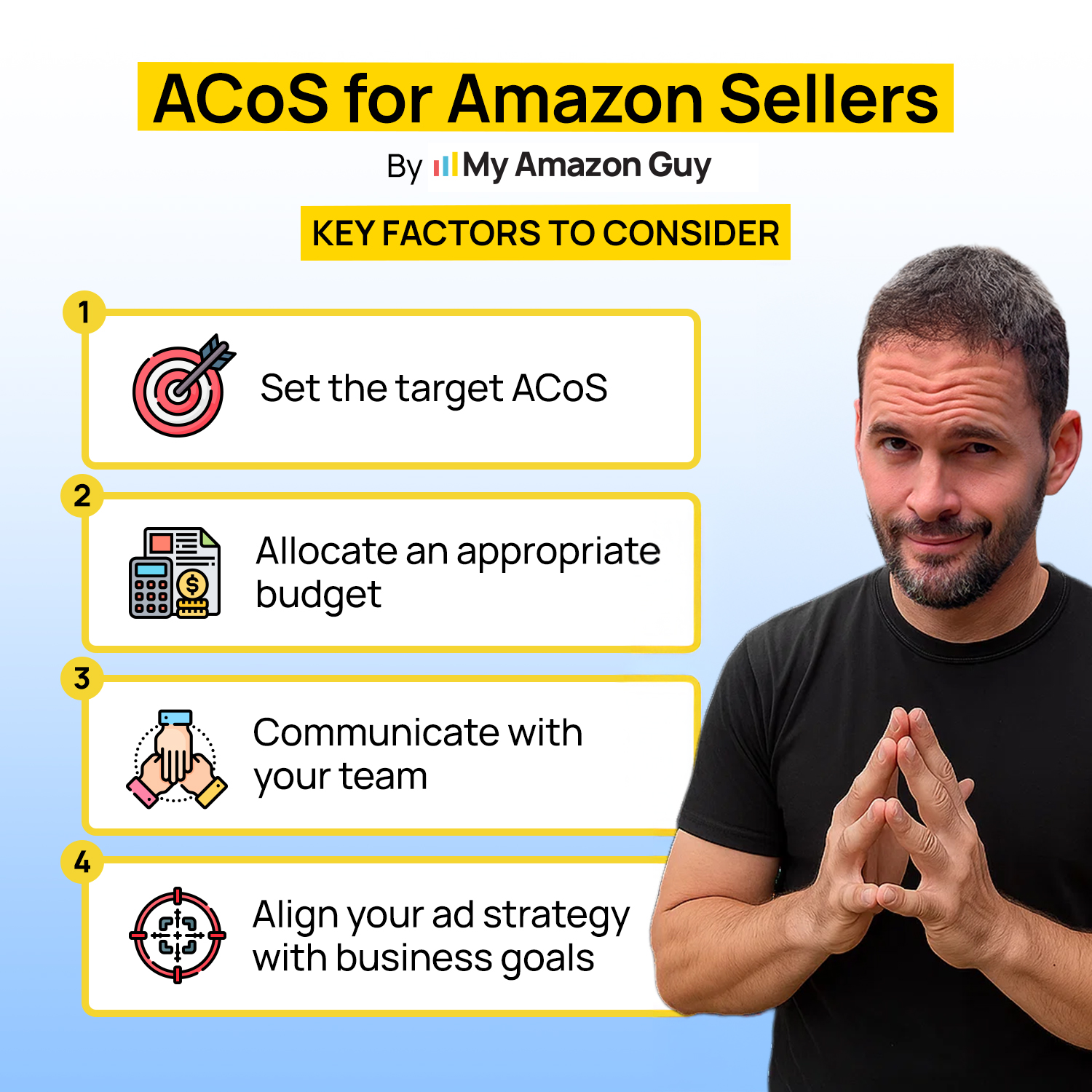
ACoS for Amazon Sellers
Advanced True ACoS Strategies for Established Brands
Once your targets hold steady for a few months, you can fine-tune them for organic growth, seasonal swings, and new ad placements. These strategies work best for brands that already have clean data and a target they trust.
1. Raise Campaign Targets When Organic Sales Lift
When organic orders rise on the keywords you advertise, you can run a higher campaign ACoS without pushing true ACoS past your target. One trampoline brand we manage ran a 10.5% ACoS alongside a 4% TACoS because organic sales carried most of the volume.
2. Recalculate Your Targets Before Q4 and Prime Events
Peak events raise both click costs and storage fees, so rerun your break-even ACoS with those higher numbers before you increase budgets. Once the rush ends, reset your targets in January, a step Steven covers in this Q1 Amazon strategy video.
3. Count Rufus Sponsored Prompts and DSP Spend in True ACoS
Rufus Sponsored Prompts became billable under existing CPC bids on March 25, 2026, so that spend already belongs in your true ACoS total. Add Amazon DSP spend at the brand level too, since it rarely shows up in campaign ACoS and can quietly inflate your real ad costs.
Frequently Asked Questions About True ACoS on Amazon
Is true ACoS the same as TACoS?
Yes, both divide total ad spend by total sales, so they produce the same number. We use the term true ACoS to stress that it reflects the whole business, as covered in our TACoS vs ACoS breakdown.
What is a good true ACoS for a $1M brand?
A scaling brand usually starts in the 10% to 15% range from the growth stage table, but your margin decides the real answer. Subtract your target net margin from your margin before ads, and that result is your ideal true ACoS.
How often should I recalculate my target?
Review your true ACoS every month, and reset your targets each quarter or before any major sales event. Rebuild the full cost list at least once a year, or sooner when Amazon changes fees.
Can a true ACoS be too low?
Yes, a true ACoS far below target usually means you are underspending and handing rank to competitors. Watch sessions and organic share, and raise budgets on proven keywords when both start to slide.
Set Your Ideal True ACoS From Margin and Stop Guessing Your Ad Budget
Knowing how to find the ideal true ACoS on Amazon PPC starts with your own margin before ads. Subtract the profit you need to keep, and the result tells you how much the business can spend on advertising.
From there, divide by your ad share to set campaign targets and adjust for your growth stage. Review the number monthly so rising click costs never catch you off guard.
Are you unsure whether your ad spend is building profit or just buying sales? Contact our full-service Amazon agency and let our Amazon experts set true ACoS targets your margin can actually support.
Let our Amazon PPC specialists set true ACoS and campaign targets your margin can actually support.