Your Brand Story shows up on every product page you own, so if it misses, it misses everywhere at once. Shoppers scroll right past founder photos and mission statements because they’re still asking one thing, which is whether your product fixes their problem.
These Amazon brand story tips to match buyer intent show you how to rebuild your story from data you already have in Seller Central. You’ll learn how to read shopper intent in Search Query Performance, pull buyer language from your reviews, and turn both into copy for every card.
We’ll also give you a copy-ready template, a before-and-after rewrite, and the KPIs that prove your new story is working. For bigger brands, we go further into Alexa for Shopping, separate stories for separate buyers, and Q4 gift swaps.
Our Amazon agency has managed $1.4B+ in ecommerce revenue, and the Brand Stories that convert all start with the shopper’s words, not the brand’s. Find the intent, give each card one job, keep one promise across your listing, and measure the lift.
Table of Contents
Find the suppressed ASINs, keyword gaps, and vendor silos holding your catalog back, with zero obligation.
TL;DR - Matching Your Amazon Brand Story to Buyer Intent
Short on time? Here’s the playbook our Amazon agency uses to rebuild Brand Stories, boiled down to five moves.
- Pull purchase queries from Search Query Performance
- Copy buyer phrases from your reviews
- Give each Brand Story card one job
- Keep one promise across images, ads, and Store
- Compare conversion 30 days before and after
Most Brand Stories stall because they talk about the brand while shoppers are still deciding if the product solves their problem. The rest of this guide shows you how to fix that, card by card, with data you already own.
Amazon Brand Story Tips to Match Buyer Intent at a Glance
A Brand Story is built from a handful of card types, and each one shows up at a different moment in the shopper’s decision. The fastest way to align your Brand Story with customer intent is to give every card one question to answer and pull the words from real shopper data.
| Card | Shopper question | Data source |
|---|---|---|
|
Background
|
Is this for me?
|
Search Query Performance
|
|
Brand Focus
|
Will it fix my problem?
|
Your 5 star reviews
|
|
Logo and Description
|
Why you?
|
Competitors’ 1 star reviews
|
|
Brand Q&A
|
What’s stopping me?
|
Customer questions
|
|
ASIN Showcase
|
What else do I need?
|
Repeat purchase data
|
Start with the Background card, because it’s the first thing shoppers see and should carry your highest-revenue intent. Every data source here is free in Seller Central or on Amazon itself, so you don’t need new tools to start.
Fundamentals of an Intent-Aligned Amazon Brand Story
An intent-aligned Brand Story answers the shopper’s question before it says a word about your brand. Getting this right matters more than any design choice, because your Brand Story repeats on every ASIN you apply it to, good or bad.
What Does “Consumer Intent” Mean for an Amazon Brand Story?
Consumer intent is the job a shopper wants done when they type a search. Someone searching “back stretcher for desk workers” wants relief between meetings, not a story about how your company started.
Amazon keeps getting better at reading that job instead of just matching words. Its COSMO system connects products to the real needs behind a search, so copy that names the need lines up with how Amazon already understands your product.
Why Does Disjointed Brand Messaging Cost You Sales?
When your main image says gentle, and your Brand Story says adventure, shoppers see two brands and trust neither. Amazon’s own research shows why that hurts, with 79% of shoppers favoring brands that share their values and 64% willing to pay more for authentic ones.
That trust gap turns into lost revenue fast. Amazon says A+ Content can lift sales by up to 8%, or up to 20% with Premium A+, which is as much as $200,000 a year on a $1M ASIN.
What Do Most Sellers Get Wrong About Brand Stories?
The biggest mistake we see is treating the Brand Story like an About Us page while shoppers are still deciding whether to buy. These other myths show up on almost every audit we run.
- One story fits every product line
- You can publish once and forget it
- Keywords alone make it relevant
- Pretty design makes up for weak copy
How to Upgrade Your Brand Story A+ Content to Rank Better on Amazon
Strategy for Aligning Your Brand Story With Shopper Intent
Strategy comes before copy, because you can’t write a great card until you know which shopper it’s for. The goal is to find the intents that drive your revenue and give each one its own card.
What Are the Four Types of Shopper Intent Your Brand Story Must Serve?
Almost every purchase we see on Amazon starts from one of four intents, and each one needs a different card. Here’s what each card has to do for the shopper.
- Problem intent names the pain in the shopper’s words
- Comparison intent shows the one difference that matters
- Trust intent proves claims with numbers or tests
- Expansion intent points to the next product they need
How Should Your Brand Story Strategy Change as Your Brand Grows?
Under $1M, you’re still learning who your buyer is, so focus on a strong problem card and one proof card. Between $1M and $5M, you finally have enough Search Query Performance and review data to map all four intents, and that’s where we see the biggest gap.
Above $5M, the play shifts to separate Brand Stories for separate buyers and seasonal card swaps. A brand selling both puppy pads and senior dog joint chews is talking to two very different people, so one story can’t serve both.
What Does a Good Brand Story Look Like Compared to an Average One?
An average Brand Story looks polished but could belong to any brand in the category. Most Amazon brand story best practices come down to research, and a good story reads like someone studied every review.
- Headline names the buyer’s problem
- Proof uses numbers, not adjectives
- Q&A card answers real objections
- Tone matches main image and ads
What Does an Intent-Aligned Brand Story Look Like in a Real Account?
One back-pain wheel brand came to us with a strong product and a listing that didn’t speak to the pain its buyers felt. As our case study on this back-pain brand shows, we built a customer persona around those pain points and rebuilt the Brand Story, Brand Store, and A+ Content to answer shopper questions in plain language.
We also moved the product into the larger category where its buyers were actually searching. Conversion climbed from about 1% to 20%, and sales on its best sellers grew 519%.
Brand Stories Increase AOV
How to Write an Amazon A+ Brand Story That Matches Buyer Intent
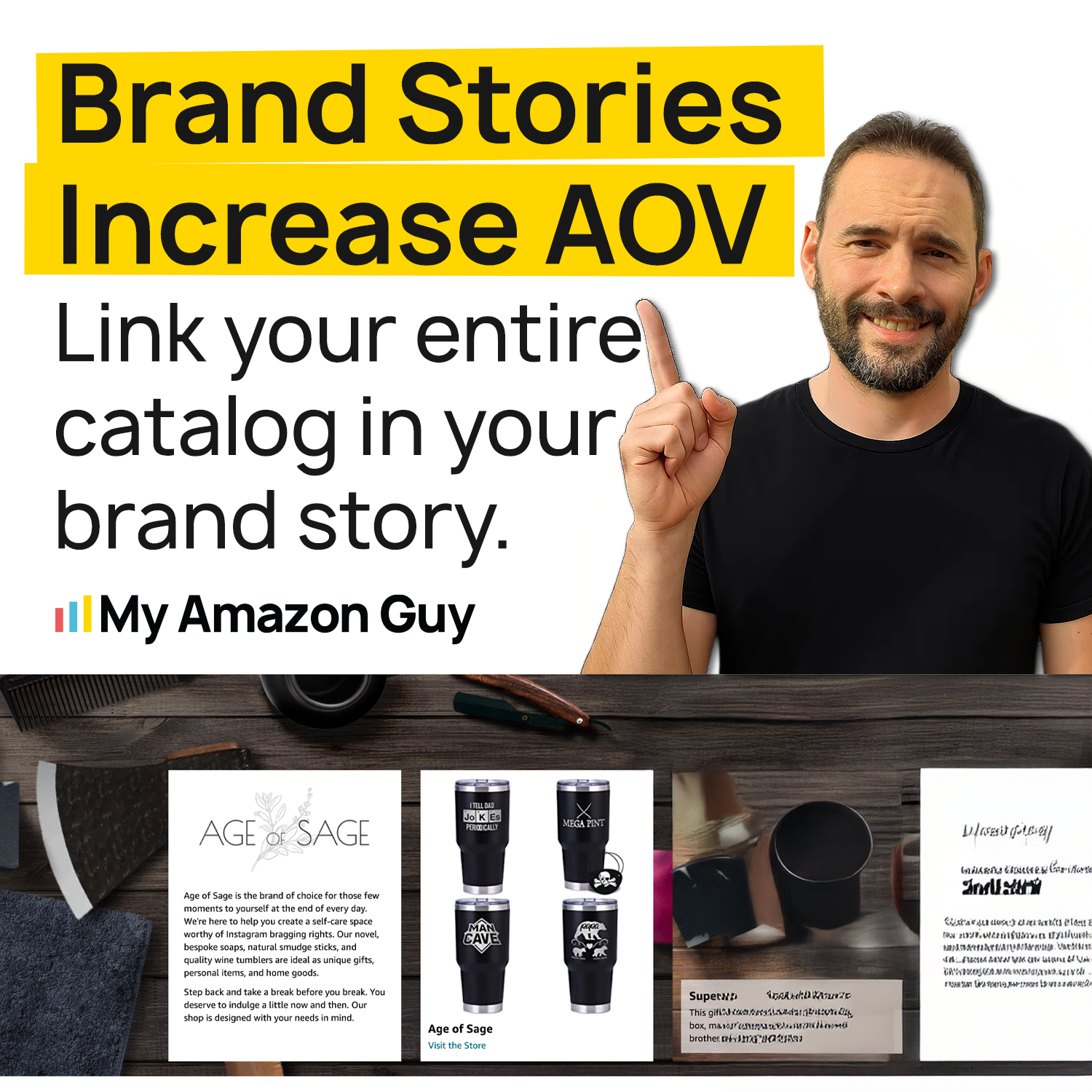
The best Brand Stories are written backward, starting with shopper data and ending with copy. Our guide on how to create an Amazon Brand Story covers the Seller Central clicks, so this section focuses on what to say.
What Are the Steps to Write an Intent-Matched Brand Story?
Follow these steps in order, because each one feeds the next. Skipping the research steps is how brands end up with a story that sounds nice and sells nothing.
1. Pull Your Top Queries From Search Query Performance
Export the last 90 days from the Search Query Performance dashboard in Brand Analytics and sort by purchases, not impressions. Purchase queries show you the intent that actually turns into sales.
2. Mine Reviews and Customer Questions for Buyer Language
Copy exact phrases from your 4 and 5 star reviews, then do the same with your competitors’ 1 to 3 star reviews. A buyer who writes “finally fixed my 3 pm back ache” just wrote your headline for you.
3. Write a One-Sentence Intent Promise
Merge your top intent and your best buyer phrase into one promise the whole listing has to keep. Something like “We help desk workers ease back pain in five minutes a day” gives every card a clear target.
4. Assign One Intent to Each Card
Give each card one job from the intent map and nothing else. Put your highest-revenue intent first, since shoppers drop off with every swipe.
5. Write Copy Inside Amazon’s Character Limits
Keep card headlines within 30 characters and body copy within 135, which are the Brand Story character limits from our setup guide. If a keyword sounds strange when you read it out loud, cut it.
6. Line Up Your Main Image, Ads, and Brand Store
Your main image, Sponsored Brands ads, Brand Story, and Brand Store should all carry the same promise. Line them up side by side, and if they look like different brands, you’ve found your leak.
7. Publish to the Right ASIN Groups
Apply each Brand Story only to ASINs that share the same buyer and the same intent. Log the publish date for every group so you can measure the before and after.
Is There a Brand Story Template You Can Copy?
Yes, and it works because it forces one intent per card. Fill it in from your Step 1 and Step 2 notes instead of writing from memory.
| Card | Headline | Body copy |
|---|---|---|
|
Background
|
Top problem in buyer words
|
Who it’s for and the result
|
|
Brand Focus
|
Moment of relief
|
One proof point with a number
|
|
Logo and Description
|
None
|
Your real edge, up to 450 characters
|
|
Brand Q&A
|
Top three objections
|
Direct answers, 750 characters total
|
|
ASIN Showcase
|
Next thing they need
|
Up to four products
|
The Brand Q&A card is where most sellers leave money on the table. Fill it with the three objections that come up most in your reviews and buyer messages, like sizing, safety, or how fast it works.
What Does a Before-And-After Brand Story Rewrite Look Like?
Here’s a composite example for a leak-proof kids’ water bottle, based on the pattern we fix most often. The before version answers a question nobody asked, while the after version uses the exact complaint parents leave on competitor reviews.
- Before headline, “Our Story”
- Before body, a founding story about two outdoorsy moms
- After headline, “No More Wet Backpacks”
- After body, “Locks tight in any bag and opens with one small hand”
What Execution Mistakes Break Brand Story Alignment?
Most execution mistakes come from writing before researching. These are the ones we catch on almost every new account.
- Opening with the founder story
- Copying bullet points into the Brand Story
- Stuffing keywords into headlines
- Running one story across unrelated products
- Leaving the Q&A card empty
Stop Writing Brand Stories for Humans. Write Them for the Algorithm.
Walk us through your catalog, and we’ll show you which handoff between PPC, SEO, and listings is dragging total sales down.
How to Measure Whether Your Brand Story Matches Buyer Intent
You measure a Brand Story by what it does to conversion and brand behavior, not by clicks on the carousel. Compare the 30 days before you publish to the 30 days after, and hold price, coupons, and ad spend as steady as you can.
Which KPIs Show Your Brand Story Is Working?
Track these numbers together, because each one covers a different intent on your map. If one climbs while another drops, a card is probably pulling against your main promise.
- Unit Session Percentage in Business Reports
- Brand purchase share in Search Query Performance
- Repeat customers in Brand Analytics
- Brand Store visits in Store Insights
How Often Should You Review Brand Story Performance?
Check conversion every week for the first 30 days after you publish, then move to a monthly review. Weekly checks in that first month help you catch a card that’s hurting conversion before it costs you a full quarter.
Run a full intent refresh every quarter and before every big deal event. Search behavior shifts with the season, and a back stretcher searched for “pain relief” in March gets searched as “gift for dad” in November.
What Tools Measure Brand Story Impact?
Most of what you need is free once you’re enrolled in Brand Registry. Amazon’s Brand Analytics dashboards give you Search Query Performance, Repeat Purchase Behavior, and Demographics in one place.
Use Manage Your Experiments to split-test A+ Content on ASINs that qualify. For Brand Story edits, keep a simple shared sheet that logs every change date so your before-and-after windows stay clean.
Advanced Brand Story Tactics for Brands With Working Fundamentals
Once every card answers a real shopper question, your next gains come from AI readiness, personalization, and seasonal timing. Don’t skip ahead, because personalizing the wrong message only spreads it faster.
1. Write Your Q&A Card for Alexa for Shopping
Amazon renamed Rufus to Alexa for Shopping on May 13, 2026, and it builds answers from listing details, reviews, and Q&A, so phrase your Q&A card like the questions shoppers type into it. It’s worth the effort, since customers who use Amazon’s AI shopping assistant are over 60% more likely to buy on that trip.
2. Split Brand Stories by Buyer, Not by Category
Once your catalog serves more than one type of buyer, give each buyer its own Brand Story. A skincare line and a men’s grooming line need separate stories, while two products sharing one buyer and problem can share one story.
3. Swap One Card for Q4 Gift Intent
Before Black Friday, swap one card to answer the gift buyer’s question, which is “will they actually like this?” Lead with ease of use and giftable packaging, then switch the card back in January so your core promise stays steady.
4. Use Your Brand Story to Qualify for Premium A+
In its Premium A+ eligibility announcement, Amazon tied access to a catalog-wide Brand Story plus at least 15 approved A+ projects in the past 12 months. Amazon updates these rules, so confirm the current criteria in A+ Content Manager before you plan around them.
5. Repeat One Promise Across Creators, Ads, and AI
When a creator video, a Brand Story card, and an AI answer repeat one promise, shoppers hear one brand three times, a shift we cover in our video on why the future of marketing is AI agents plus creators. Amazon’s data backs this, with drone brand Holy Stone seeing a 279% jump in branded searches after ads built around its brand personality.
FAQs About Amazon Brand Story Tips
What should I put in my Amazon Brand Story?
Lead with the problem behind your top-selling search query, then add one proof point, answers to your top three objections, and your next best product. Write every card in the shopper’s own words, pulled straight from your reviews and Search Query Performance data.
What is the difference between an Amazon Brand Story and A+ Content?
Your Brand Story sells the brand across every ASIN you apply it to, while A+ Content sells the features of one product. Amazon shows the Brand Story in its own “From the brand” section on the product page, separate from the product description.
Why is my Amazon Brand Story not increasing sales?
It’s usually talking about your brand while the shopper is still asking whether your product solves their problem. Rebuild your first card around your top purchase query, then compare conversion for 30 days before and after.
Turn Your Brand Story Into Your Best Salesperson
A Brand Story sells when it answers the shopper’s question before it talks about your brand. The words for every card are already sitting in your Search Query Performance data and your reviews, waiting to be used.
Give each card one job, keep one promise across your images, ads, and Brand Store, and measure conversion before and after you publish. Do that, and the same story that repeats on every ASIN starts closing sales on every ASIN.
Is your Brand Story still the version you wrote at launch? Reach out to our full-service Amazon agency and let our Amazon experts rebuild it from your real shopper data.
Get one team to own your PPC, SEO, listings, and catalog work, so every new ASIN finally adds to total sales.