Originally published in my Amazon selling tips newsletter on LinkedIn.
Black Friday Week is live and Black Friday itself is Friday. While you were setting up deals, Amazon spread its fuel surcharge to more of your inventory, locked in its 2027 fee changes, rewrote what your ads can say about price, and put a delete date on your old ad reports.
Here are the 12 stories that mattered for sellers this week, ordered by how hard they hit your costs and operations, and what to do about each.
The 3.5% fuel surcharge spreads to AWD and MCD on February 1
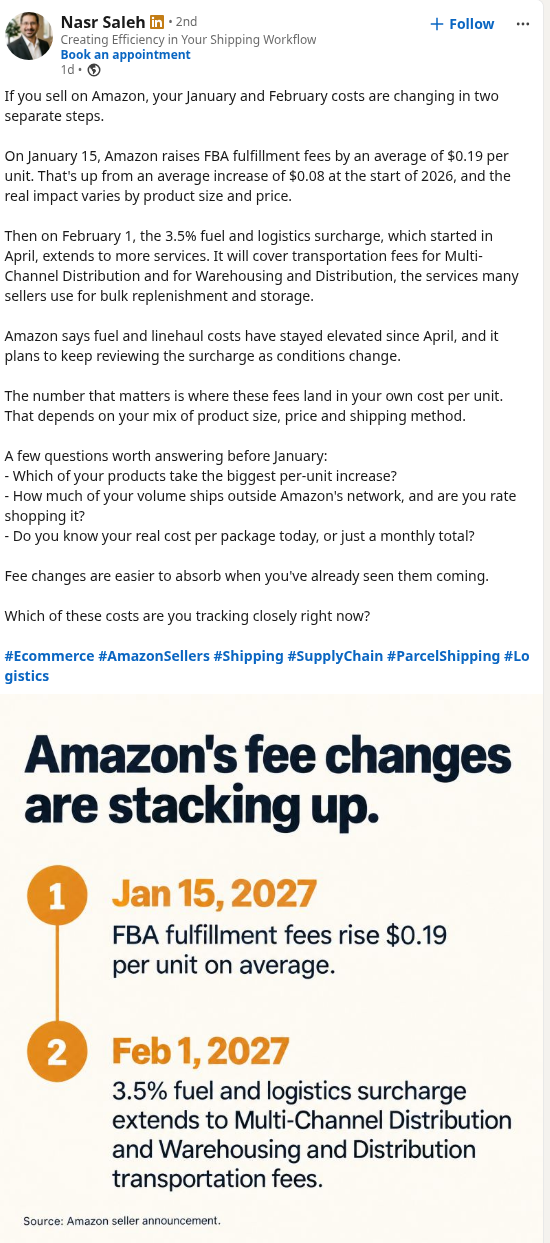
Nasr Saleh laid out how this fee lands on top of what sellers already pay.
“Then on February 1, the 3.5% fuel and logistics surcharge, which started in April, extends to more services.”
Nasr Saleh · See the full post on LinkedIn
Supply Chain Dive reported on November 17 that Amazon’s 3.5% fuel and logistics surcharge, which started on FBA fulfillment fees in April, will also apply to transportation fees for Amazon Warehousing and Distribution and Multi-Channel Distribution in the US starting February 1, 2027. That stacks on top of the average $0.19 per unit FBA fee increase on January 15. Amazon told sellers fuel and line-haul trucking costs “have remained elevated” and that it will keep reviewing the surcharge.
If you use AWD to feed FBA, you now pay the surcharge on the move upstream and again on fulfillment. Rerun your landed cost per unit with both 2027 changes before you lock in Q1 purchase orders, and recheck which SKUs actually earn their spot in AWD.
Also: Supply Chain Dive, November 17, 2026
Amazon is raising FBA fees about $0.19 a unit on January 15 and rebuilding storage fees on February 1
Amazon told sellers on November 5 that average FBA fulfillment fees go up $0.19 per unit sold, about 0.8% of the average selling price, on January 15, 2027. Supply Chain Dive’s breakdown of Amazon’s table has small standard-size items under $10 rising $0.20 on average, small items from $10 to $50 rising $0.40 and small items over $50 rising $0.70. Large items under $10 don’t change, large items from $10 to $50 rise $0.12 and large items over $50 rise $0.47.
On February 1 the storage utilization surcharge goes away and the aged inventory surcharge folds into one age-based monthly rate. The low-inventory-level fee will only apply when you drop below 28 days of supply. Amazon says inventory that turns in under six months pays the same or less, and aged inventory pays more.
Open the Fee Change Comparison dashboard in Profit Analytics and run your SKUs before you set Q1 prices. Anything sitting past six months is going to cost you more, so liquidate it or pull it before February 1.
Source: Amazon Selling Partners, November 5, 2026 · Supply Chain Dive, November 17, 2026
The FTC alleges Amazon padded ad auction prices, especially around big sale events
A November 18 newsletter recap says that on November 5 the FTC and 22 state attorneys general unredacted parts of their lawsuit. It alleges Amazon added an undisclosed “soft reserve price” to its sponsored ad auctions starting in 2019. The complaint says average cost per click rose about 20% in the 2021 holiday season and more than 200% for some advertisers, and that the ceilings were raised around events like Prime Day and Black Friday. Amazon says no advertiser pays more than its bid, that reserve prices are standard across the industry and that it will defend itself in court. These are allegations, not findings.
Don’t treat a holiday CPC spike as proof of anything yet. Log your daily CPC and spend through Cyber Week so you have your own record, and watch total ad cost of sales against your overall revenue instead of chasing ACoS on the busiest days of the year.
Source: AI for Ecommerce Newsletter, November 18, 2026
Your ads can’t type a price or say “best price” anymore
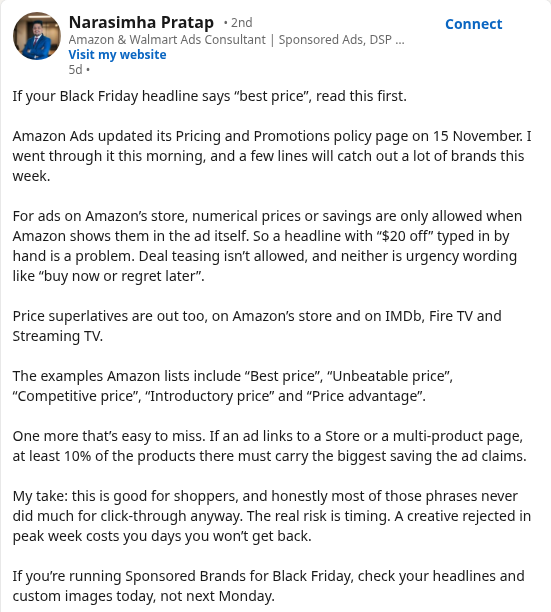
Narasimha Pratap caught this before most sellers did, and his warning is worth reading before you touch a headline.
“If your Black Friday headline says “best price”, read this first. Amazon Ads updated its Pricing and Promotions policy page on 15 November.”
Narasimha Pratap · See the full post on LinkedIn
Amazon Ads put its price rules on one Support Center page called Pricing and Promotions, dated November 15. On Amazon’s own retail placements, a number like “40% off” or “$20 off” is only allowed when Amazon renders it in the ad, and eight phrases are banned, including “Best price,” “Unbeatable price,” “Wholesale price” and “Introductory price.” If an ad sends shoppers to a Brand Store or multi-product page with a savings claim, at least 10% of those products have to carry the top discount you claim. The page also bans deal teasing and pushy urgency wording, and the superlative ban reaches IMDb, Fire TV and Streaming TV placements too.
Go through your Sponsored Brands headlines, custom images and videos today and strip out any typed number or price superlative. An ad stuck in moderation during the biggest week of the year is worse than a boring headline. If you don’t do PPC, your SEO suffers, so don’t let a wording mistake knock your ads offline right now.
Also: PPC Land, November 17, 2026
Starting December 18, every US seller-fulfilled return needs a prepaid label
Amazon told sellers that from December 18, 2026, all US returns on seller-fulfilled orders, except heavy and bulky items, require a prepaid return shipping label. Address-only labels where the customer pays for return shipping no longer count. Within seven calendar days of a return request you have to upload a prepaid label in the Manage seller-fulfilled returns workflow or refund the buyer in full without getting the item back. If you do neither, Amazon may issue a returnless refund automatically and deduct it from your account. Labels sent through Buyer-Seller Messaging don’t count, and Amazon-generated prepaid labels aren’t going away.
If any of your merchant-fulfilled SKUs still go back on address-only labels, price the return label into those margins now. Set a seven day alert on returns so a missed deadline doesn’t cost you the product and the refund.
Source: Simpl Fulfillment explainer · Amazon notice posted in Seller Forums
Holiday purchases can come back until January 31
Amazon’s extended holiday return policy covers items customers buy between November 1 and December 31, 2026. They can be returned until January 31, 2027, except Apple brand products, which are returnable until January 15, 2027. It applies automatically to everything you sell on Amazon.com, whether FBA or merchant fulfilled, and existing return and refund conditions don’t change.
Expect returns to run deep into January. Hold back cash from Q4 instead of treating every December sale as final revenue, and plan your January inventory counts around that tail.
Source: Amazon announcement in Seller Forums
Amazon put about 4 in 10 sellers into Haul, and you can’t remove a single product
Marketplace Pulse reported on November 12 that about 184,000 sellers, roughly 40% of active Amazon.com sellers, have products in Amazon Haul, and most of them never applied. Haul listings now show up in Amazon’s regular search results. Your fees stay the same as a standard FBA sale and Amazon funds the Haul discounts. The only control is an account-level opt-out that pulls you out of the whole program.
Get the list of your cross-listed offers from Seller Central or Seller Support before you touch that switch. Then ask whether the low Haul price is the first price a new shopper sees for your brand.
Source: Marketplace Pulse, November 12, 2026 · Ecom Current, November 18, 2026
Your old ad reports get deleted January 31, and Business Reports is on the way out
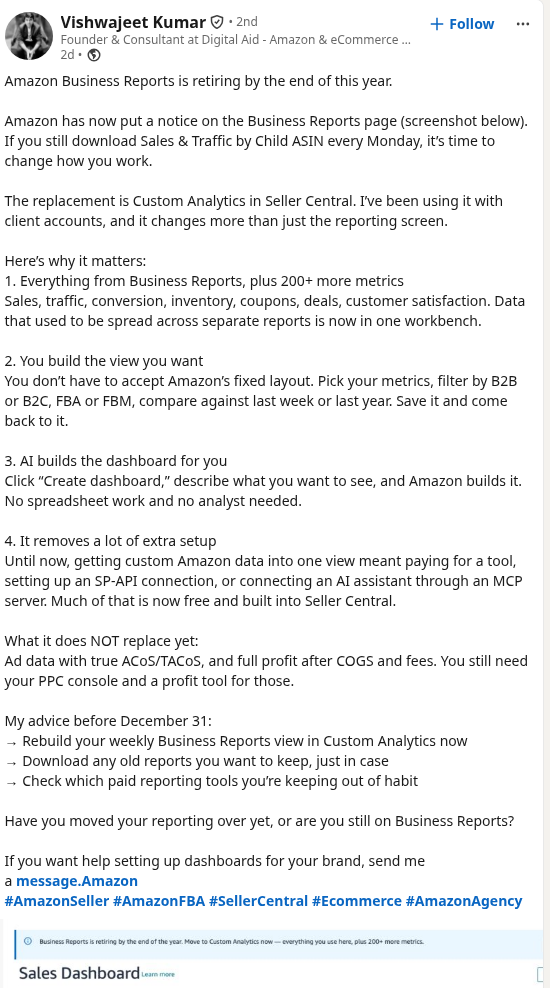
Vishwajeet Kumar is flagging the Seller Central side of this, and he is right that Business Reports is on borrowed time.
“Amazon Business Reports is retiring by the end of this year. Amazon has now put a notice on the Business Reports page.”
Vishwajeet Kumar · See the full post on LinkedIn
Amazon updated its Support Center on November 12: the legacy Sponsored ads and Display, Video and Audio report pages go read only on December 17, 2026, and shut down on January 31, 2027. Any saved report, scheduled report or historical data still sitting there gets permanently deleted. Ten report types, including Amazon Attribution and the Sponsored Products budget report, can’t move to unified reporting yet. On the Seller Central side, Amazon is pushing sellers off Business Reports and into Custom Analytics by year end, and we broke down what changes in a video this week.
Migrate your scheduled reports before December 17, and download the history you use to set Q1 targets as CSVs now. If your search term harvesting runs off a scheduled report and that report quietly dies, your wasted spend comes back and nobody notices for weeks.
Also: PPC Land, November 12, 2026 · My Amazon Guy on YouTube, November 16, 2026
Shoppers can now text Alexa to buy your product
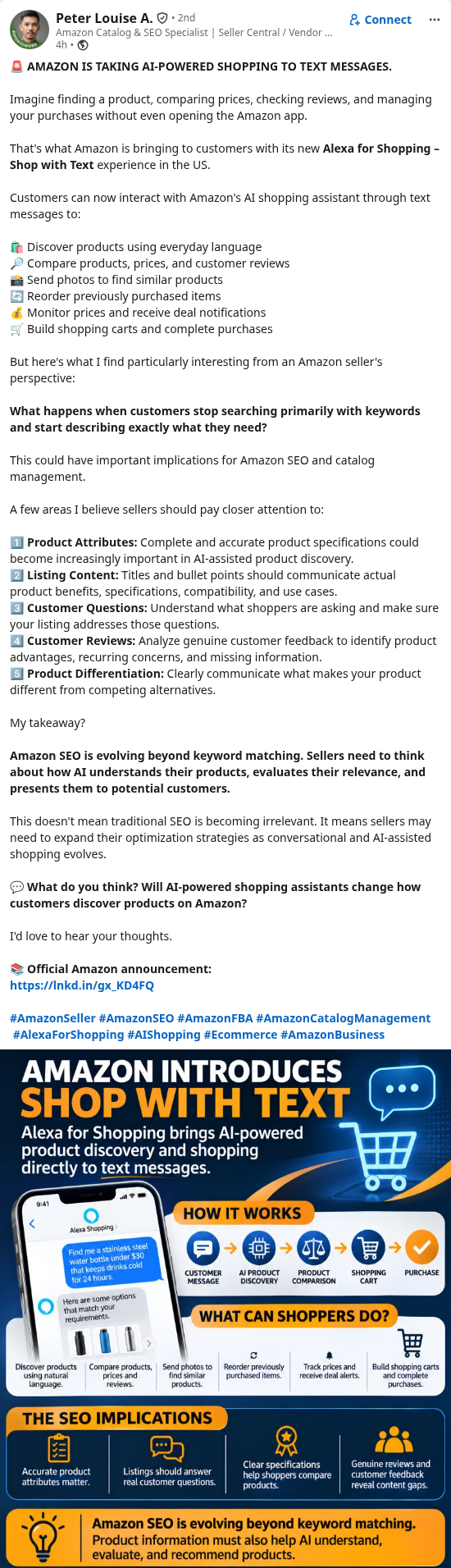
Peter Louise A. broke down the new Alexa texting feature for sellers.
“That’s what Amazon is bringing to customers with its new Alexa for Shopping – Shop with Text experience in the US.”
Peter Louise A. · See the full post on LinkedIn
Amazon’s Shop by Text lets shoppers text “Alexa Shopping” to search, compare, reorder, send a photo to find similar items and buy with their approval. Amazon’s page says it works in all 50 states and Washington, D.C. on phones with RCS messaging, and USA Today reported on November 17 that first-time users get $5 off their first eligible order. GeekWire reported, citing Digiday, that sponsored products can appear among the options the agent texts back, free to advertisers for now.
I never liked Rufus, and putting it in your text messages doesn’t change my mind. But a shopper who texts “we’re out of dog food” never sees your main image or your A+ content. The AI picks from your title, bullets, reviews and price, so clean listings get picked and messy ones get skipped.
Also: Amazon Shop by Text · USA Today, November 17, 2026 · GeekWire, November 6, 2026 · My Amazon Guy on YouTube, November 19, 2026
AI assistants name Amazon far less than shoppers search for it
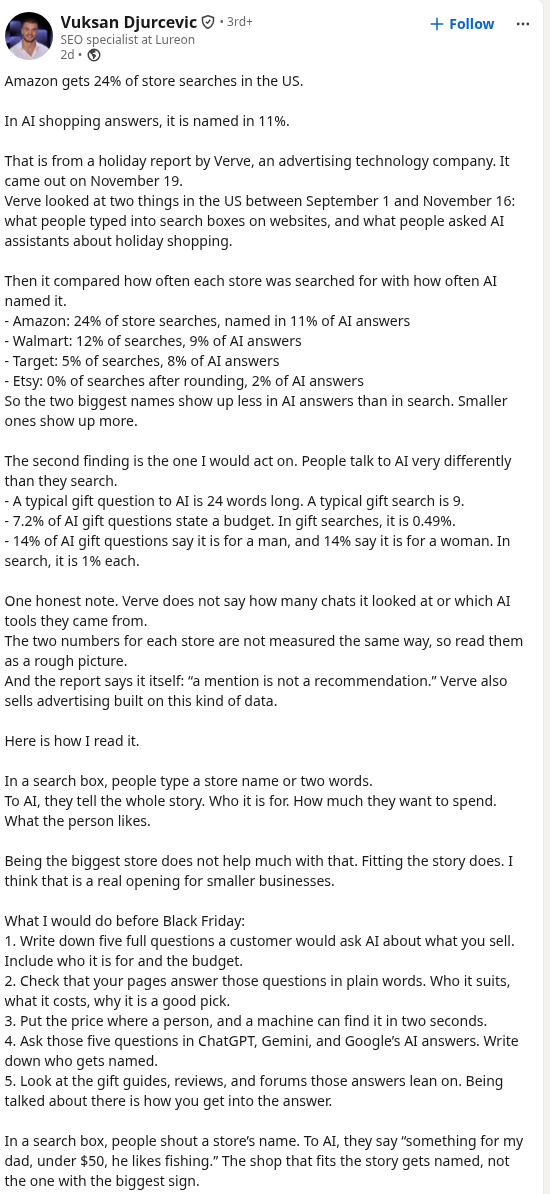
Vuksan Djurcevic pulled out the stat from the Verve report that every brand should think about.
“Amazon gets 24% of store searches in the US. In AI shopping answers, it is named in 11%.”
Vuksan Djurcevic · See the full post on LinkedIn
A holiday report from ad tech company Verve, released November 19, found Amazon accounts for 24% of US on-site searches that name a retailer but shows up in only 11% of AI assistant shopping answers, for September 1 to November 16, 2026. Walmart was 12% of searches and 9% of answers, and Target went the other way at 5% and 8%. The report counts mentions, not recommendations or sales.
Your next customer might ask ChatGPT or Gemini before they ever open Amazon. Ask the big AI assistants your top category questions and see whether your brand comes up. If it doesn’t, fix the product facts on your own site and your listing so the AI has something to read.
Also: PPC Land, November 19, 2026
A watchdog says 1 in 3 Amazon Black Friday deals saved nothing. Amazon says 98% did.
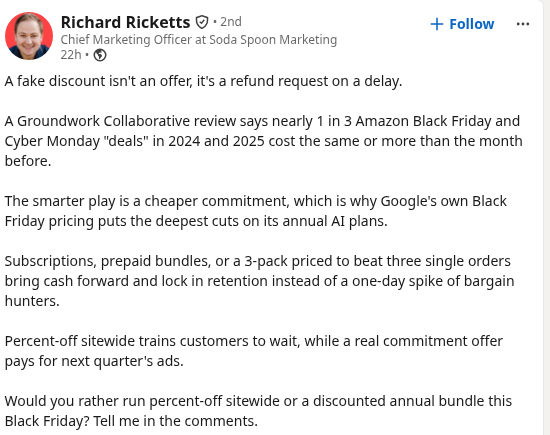
Richard Ricketts summed up the Groundwork review in one line.
“A Groundwork Collaborative review says nearly 1 in 3 Amazon Black Friday and Cyber Monday “deals” in 2024 and 2025 cost the same or more than the month before.”
Richard Ricketts · See the full post on LinkedIn
On November 16, Groundwork Collaborative published a report on more than 350 products from Amazon’s Black Friday and Cyber Monday deal pages in 2024 and 2025. It says nearly 1 in 3 offered no real savings versus the month before, and nearly 1 in 10 cost more. Amazon answered the same day, calling the research flawed and saying 98% of those products were the same price or lower than their prior 30-day price.
Expect more people checking deal prices this week, from shoppers to reporters. Make sure every deal you run is actually below your lowest price of the last 30 days, coupons included. A fake deal costs you more in trust than it makes you in sales.
Also: Groundwork Collaborative, November 16, 2026 · About Amazon, November 16, 2026
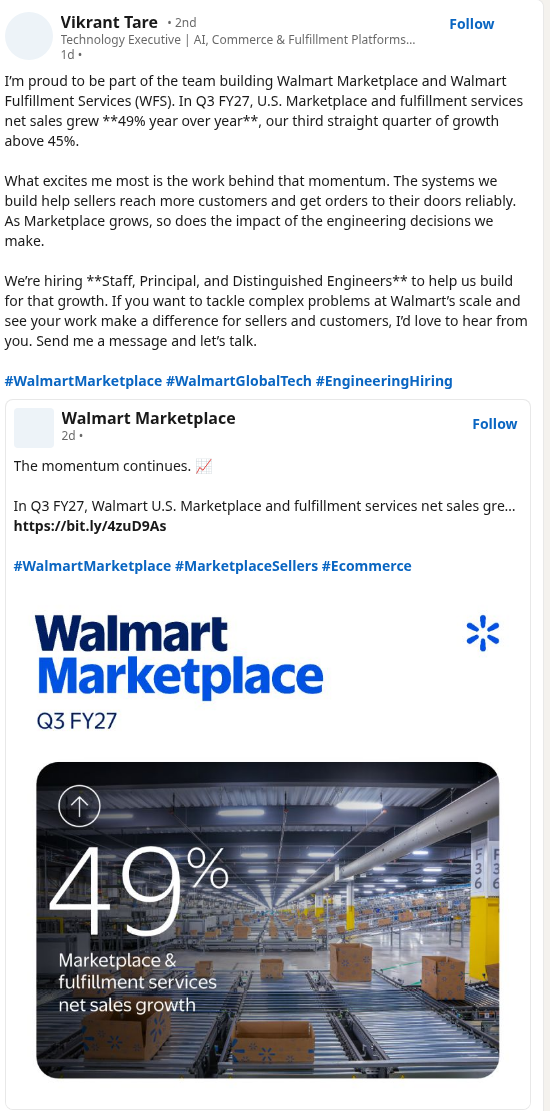
Walmart’s marketplace grew 49% last quarter
Vikrant Tare, a Walmart executive, shared the numbers himself.
“In Q3 FY27, U.S. Marketplace and fulfillment services net sales grew 49% year over year, our third straight quarter of growth above 45%.”
Vikrant Tare · See the full post on LinkedIn
Walmart reported on November 19 that its US marketplace and fulfillment services net sales grew 49% in its third quarter, the third straight quarter above 45%. Walmart Connect advertising grew 36% (excluding VIZIO and Vibe), and Walmart US eCommerce grew 23%.
Walmart is no longer a side project. If your Amazon catalog is clean and you are not on Walmart yet, plan it for Q1. Just know ad money is pouring in there too, so watch your cost per click from day one.
Also: Walmart, November 19, 2026
One question
Which change hits you harder this week: the 2027 fee and surcharge math, or losing typed prices in your ads?