
What if the fastest way to grow your Amazon profit this quarter is to stop spending rather than to spend more? Most sellers reach for a bigger budget when sales stall, and the money that would have fixed the problem is already sitting in the account doing nothing.
Amazon PPC waste management is the work of finding that money and keeping it. Your ACoS can look perfectly respectable while a quarter of your budget goes to search terms that have never produced a single order.
We have managed $1.2B+ in ecommerce revenue across 400+ brands, and the same short list of leaks turns up in almost every account we open. Most of them are not strategy failures; they are cadence failures, because nobody ran the review that would have caught them.
Our Amazon agency talks about where ad spend actually leaks, how much waste is normal at your spend level, and the five steps that cut it without losing sales. We also discuss the metrics that prove the reduction worked, three advanced moves for accounts with clean fundamentals, and the free reports that do most of the job.
Table of Contents
We will show you where your ad spend disappears before you change a single bid.
TL;DR - Amazon PPC Waste Management
Amazon PPC waste management is a weekly habit rather than a quarterly cleanup. Cutting wasted ad spend starts with the free reports already sitting inside your Amazon PPC account.
- Negate after ten clicks
- Give each term one home
- Rebuild bids from margin
- Pace budget toward peak hours
- Split branded from non-branded
None of this requires a new tool or a bigger budget. It requires running the same short loop every week instead of every quarter.
What Is Amazon PPC Waste Management and How Does It Work?
Amazon PPC waste management is the ongoing work of finding spend that returned nothing and making sure it does not repeat next month. It covers the search terms, bids, budgets, and placements that keep drawing clicks your account has already proven will not convert.
It works as a repeating loop rather than a one-time cleanup, since the same leaks reopen the moment the review cadence slips. A non-converting search term in week one is research, and the same term still spending in week six is money you chose to lose.
Why Is My ACoS Good but My Profit Falling?
A healthy ACoS with falling profit usually means paid spend is replacing organic sales you already owned. The campaign looks efficient because branded and category-dominant terms convert well, while the total business sits still.
This is why a profitable Amazon campaign can still waste money. Redundant targeting and misallocated budget hide comfortably inside campaigns that hit their ACoS target every month.
Where the 20% to 40% Waste Estimate Actually Comes From
You have seen the claim that Amazon sellers waste 20% to 40% of ad spend, and most versions of it cite nothing at all. The number passes between agency blogs until it reads as settled fact, which is a poor basis for judging your own account.
The one version with a publisher behind it comes from Seller Labs, whose analysis of monthly wasted ad spend puts the loss to non-converting queries at 28% to 40%. Run that against your own number rather than the industry’s, because at $40,000 a month it means $11,200 to $16,000 leaving before you touch a single bid.
90% of Amazon PPC Campaigns Fail ft. Carly McMillen
Where Amazon Ad Spend Leaks in Keyword Targeting and Bid Management
Almost all wasted spend traces back to six repeating causes. Naming the cause matters, because the fix for one of them does nothing for the other five.
What Are the Most Common Sources of Wasted Amazon Ad Spend?
Waste rarely starts with a bad bid, and it usually starts with a report nobody read. Each leak below has its own fingerprint in your data and its own correction.
| Waste source | Why it happens | The fix |
|---|---|---|
|
Non-converting search terms
|
Auto and broad campaigns surface queries nobody reviews
|
Negate at a set click threshold
|
|
Redundant match type coverage
|
The same query runs in auto, broad, and exact at once
|
Route each term to one campaign
|
|
Bids frozen since launch
|
Price and margin moved, the bid never did
|
Rebuild from break-even cost per click
|
|
Budget gone by midday
|
Even pacing spends before peak conversion hours
|
Lower bids rather than budgets
|
|
Branded spend replacing organic
|
Ads buy shoppers already searching for you
|
Cap branded, then test incrementality |
|
Traffic sent to weak listings
|
Conversion sits below category norm
|
Fix the page before raising bids
|
The last row is the one sellers skip, and it is the most expensive. Ads only send traffic, so a page converting at 4% in a category that converts at 11% makes every campaign above it look broken.
How Much Amazon Ad Spend Is Normally Wasted?
There is no single acceptable figure, because tolerance moves with spend and growth stage. A launching catalog should carry more non-converting spend than a mature one, and holding both to the same standard hides which campaigns are actually failing.
| Monthly ad spend | Waste we treat as acceptable | Review cadence that fits |
|---|---|---|
|
Under $10,000
|
Up to 20% during active discovery
|
Monthly search term pass
|
|
$10,000 to $50,000
|
10% to 15% steady state
|
Weekly negatives, monthly full pass |
|
Above $50,000
|
Under 10% steady state
|
Weekly negatives, weekly zero-order check
|
Those are the thresholds we hold our own teams to, not a published industry benchmark. Measure against them before you decide whether your account has a problem worth solving this month.
How to Reduce Wasted Amazon Ad Spend in Five Steps
These five steps run on free reports you already have inside Seller Central. Work them in order, because what you find in step one changes how you read the rest.
Step 1: Build a Negation Workflow You Actually Run
Pull the search term report weekly and negate every term that has taken ten to fifteen clicks with zero orders, tightening that threshold on high-converting products. Amazon deletes older search term data, so a skipped month is a waste you can no longer even measure.
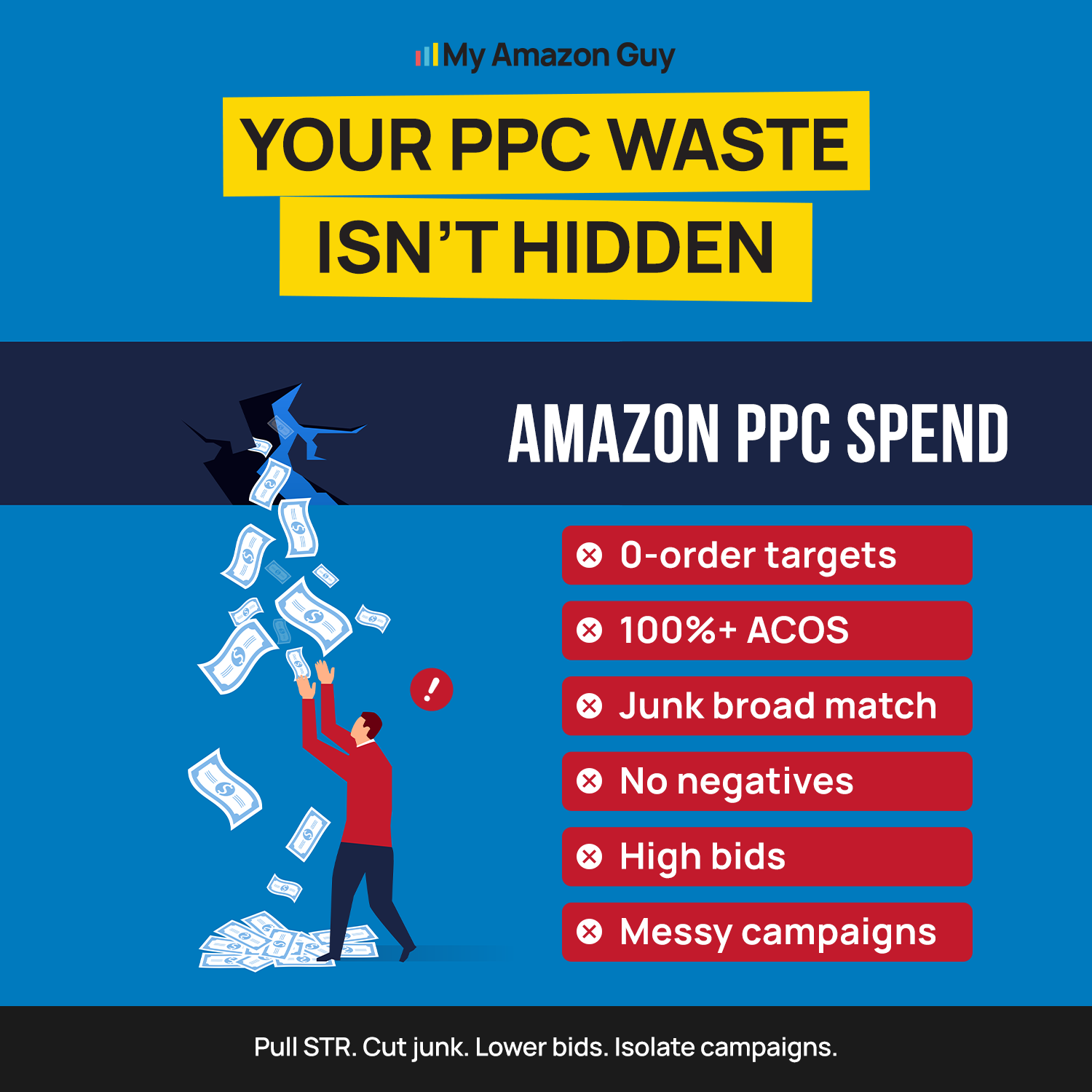
Your PPC Waste Isn’t Hidden
Step 2: Give Every Search Term One Campaign Home
Find queries spending in auto, broad, and exact at the same time, then move proven converters into exact and block the duplicate paths with negatives. Without one clear home per term, Amazon allocates for you, and your exact campaigns never build clean conversion data.
Step 3: Rebuild Bids Against Break-Even, Not Target ACoS
Work out your break-even cost per click from unit margin and conversion rate, then compare it against what your top-spending keywords actually pay. Bids set at launch and never rebuilt after a price or cost change are the costliest mistake in bid management, since every click above break-even loses money by design.
Step 4: Fix Budget Pacing Before You Cut Budgets
Check time in budget by campaign and find the ones going dark before your strongest conversion hours. Cutting a budget to control spend is the wrong lever because it starves proven campaigns, and the right move is lowering bids on the keywords doing the damage.
Step 5: Split Branded From Non-Branded Before You Judge Anything
Separate branded from non-branded spend and read each half on its own, because branded terms flatter a blended report by capturing shoppers already searching for you. If branded spend grows without more new-to-brand customers, you are paying to recapture demand you already owned.

Stop Bleeding Cash on PPC: 3 Fixes You Can Make Today
Our team records a free breakdown of your campaign structure, your bids, and your detail page.
Which Metrics Prove Your Amazon PPC Waste Reduction Is Working
Cutting spend is easy and cutting waste is not, so you need numbers that tell the two apart. Pick metrics that cannot be improved by quietly switching off something that was working.
Which KPIs Should I Track to Catch Wasted Ad Spend?
Track zero-order spend as a share of total spend, TACoS, non-branded ACoS, average time in budget, and organic sales share on your top ASINs. TACoS matters most because it tells you whether advertising is building rank you keep or renting revenue month after month.
Cross-category ACoS averages are a sanity check rather than a target. Ad Badger’s Amazon advertising statistics put the 2026 peak at 32.5% in January against a low of 28% the previous October, and your category may behave nothing like that.
How Often Should I Review My Amazon PPC Account?
Run negatives weekly, a full search term and bid pass monthly, and a structural review every quarter. Once you spend above $25,000 a month, add a weekly zero-order spend check, since that single number catches most new leaks within days rather than months.
Move the whole schedule earlier, ahead of peak season. Walking into Q4 with unresolved structural problems means paying inflated fourth-quarter click costs to repeat the same mistakes at much higher volume.
How Do I Reduce Amazon Ad Spend Without Losing Sales?
Cut in the order that protects revenue, which means negatives first, then bids, then budgets last. Negatives remove traffic that was never going to convert, bid cuts trim what you overpay for, and budget cuts remove impressions you would have won.
Never lower a campaign budget to reduce spend on a campaign with a bad ACoS. Lower the bids on the keywords causing it, because choking the budget hits your best keywords and your worst ones equally.
Can I Automate My Amazon PPC Waste Analysis?
Automation handles the reading, not the deciding. Rules and scripts can flag zero-order search terms, ACoS outliers, and campaigns running dry before peak hours every morning, which turns a weekly manual pass into a short review of exceptions.
What automation cannot do is judge whether a term is discovery or waste, and that judgment is most of the job. Set the rules to surface candidates and keep the negation decision with a person, because a rule that negates on click count alone will cut terms that were two orders away from proving themselves.
How to Automate Amazon PPC Analysis with Gemini
Advanced Amazon PPC Waste Reduction Strategies
These three moves come after the obvious leaks are closed and your weekly loop runs clean twice in a row. Each one improves the quality of a decision you are already making.
1. Run an Incrementality Test on Branded Terms
Pull paid coverage back on terms where you already rank first organically, then watch total sales for two weeks. If total sales hold, that spend was duplication rather than defense.
This is the cleanest way to reduce Amazon ad spend without losing sales. It also gives you a defensible number instead of a hunch about how much branded coverage you actually need.
2. Set Bid Ceilings From Contribution Margin, Not Blended ACoS
Give every high-spend ASIN its own maximum cost per click built from unit margin, conversion rate, and target profit instead of one account-wide ACoS goal. A single 22% target applied across products with margins from 15% to 60% overspends on the thin ones and starves the profitable ones.
One default bid cannot serve four targeting groups that convert at different rates, which is the argument behind our post on the Amazon PPC default bid. Set the ceiling per ASIN, then let the bid float underneath it.
3. Add Negative Product Targets, Not Just Negative Keywords
Most negation work stops at search terms and ignores the ASINs your ads keep appearing beside. That spend hides in auto campaigns and Sponsored Display, where a competitor detail page can absorb clicks for months without producing an order.
Pull the advertised product report and negate the ASINs that spend without converting, using the same threshold you apply to keywords. Almost nobody does this, which is exactly why the leak survives on accounts that look otherwise clean.
FAQs About Amazon PPC Waste Management
Can a profitable Amazon campaign still be wasting money?
Yes, and profitable accounts hide waste better than struggling ones. Redundant targeting and branded overspend sit quietly inside campaigns that meet their ACoS target every month.
How often should an agency add negative keywords?
Weekly is the working standard for accounts above $10,000 a month in spend, and monthly is the floor for anyone smaller. Amazon deletes older search term data, so a skipped month is data you cannot recover later.
How many clicks with no orders before negating a term?
Ten to fifteen clicks is the common threshold, though some practitioners argue for twenty or more before the pattern means anything. We tighten it for high-converting products and loosen it for considered purchases with long decision cycles, and your manager should be able to state their threshold on request.
Is my problem the manager or my listing?
Compare your conversion rate against your category norm before blaming anyone. Normal click volume with weak conversion points at the listing, while weak clicks on relevant terms point to targeting.
How do I get a second opinion on my Amazon PPC?
Send one ASIN for a free recorded review, which costs nothing and takes a day. If the trouble looks wider than advertising, a paid audit opens the rest of the account.
Should I fire my Amazon PPC agency or fix the account?
Fix first if the logs show real work and the structure is sound, because a rebuild under a new team costs you another 90 days. Replace when the logs are thin, since that is evidence of absence rather than of a bad strategy.
Amazon PPC Waste Management Comes Down to Proof
Amazon PPC waste management is a repeating loop rather than a one-time cleanup, and on a managed account it becomes a supervision job on top of that. Spend that returned nothing in week one is research, while the same spend still running in week six is a leak somebody was paid to close.
Know the waste range that is acceptable at your spend level, name who owns each leak, and read the change logs against the reports before you accept either one. Then work the advanced moves, testing branded incrementality, setting bid ceilings from contribution margin, and negating the ASINs that quietly absorb clicks without producing an order.
Are you spending thousands a month on Amazon ads with no way to tell how much of it is being wasted? Reach out to our full-service Amazon agency and let our Amazon experts pinpoint where your Amazon PPC waste is hiding before you commit to anything.
Ads, listings, catalog, and design work as one system, which is how waste stops coming back.