What if the agency fee you’re debating is the best money in your ad budget, or the worst? Knowing when Amazon PPC management services pay off is how you tell the difference before the next invoice lands.
This guide explains why some PPC services earn back their fee within a quarter while others quietly drain margin for years. The stakes are higher in 2026, since Amazon’s ad business hit $19.8 billion in Q2 and 46% of sellers now name ad spend as a top margin concern.
We’ve managed over $1.4B in ecommerce revenue across 400+ brands, and the answer always comes down to one test. A PPC service pays off only when your contribution margin after ads grows by more than the fee you pay for it.
Our Amazon agency talks about why PPC services pay off, the payback formula, and a five-step test you can run on your own account in this guide. We also discuss how 2026 changed the math, which KPIs prove payoff, and when you’re better off waiting.
Table of Contents
Get a clear answer on whether your ad spend is building profit or just buying clicks.
Amazon PPC management pays off when it grows your profit by more than it costs. Our Amazon agency judges every PPC fee by margin after ads, not by how good the ACoS looks.
- Judge profit, not ACoS alone
- Add fees into your TACoS
- Recover waste before scaling spend
- Fix listings before buying clicks
- Allow 90 days for payback
A fee that doesn’t grow your margin is just another cost dressed up as help. Run the payback test in this guide before you hire, renew, or fire anyone.
Amazon ACoS Tips to Grow Sales Without Wasting Ad Spend
What "Paying Off" Actually Means for Amazon PPC Management
Most sellers judge Amazon advertising services by the wrong number, so a good manager can look bad and a bad one can look great. Getting the definition right is the first step toward ad spend that actually protects profit.
What Does It Mean When Amazon PPC Management Services Pay Off?
A PPC service pays off when the extra profit it creates beats what you pay for it. That profit comes from two places: the wasted spend it stops and the new sales it adds at a healthy margin.
Revenue growth alone doesn’t count as a payoff. If sales climb but your margin after ads shrinks by more than the fee, you paid someone to make you busier, not richer.
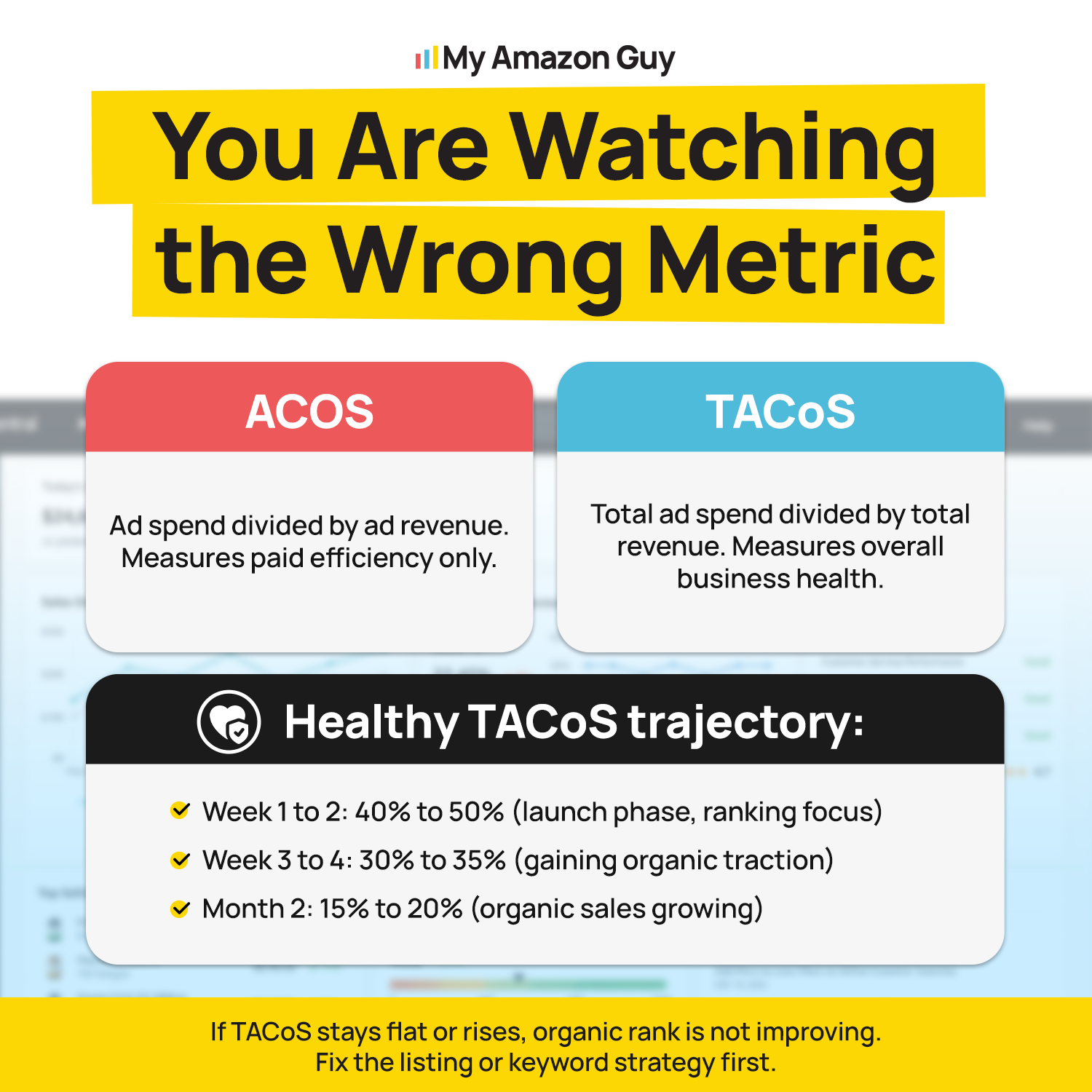
Why Is ACoS the Wrong Scoreboard for Judging a PPC Manager?
ACoS only compares ad spend to ad-attributed sales, so it ignores your organic sales and the fee itself. A manager can post a beautiful ACoS by bidding mostly on your brand name, which buys shoppers who were already looking for you.
That’s how your ACoS looks good while your Amazon profit falls. Paid orders quietly replace organic ones you used to get for free, and the report looks great the whole time.
You Are Watching the Wrong Metric
The Three Numbers That Decide Payoff
Three numbers settle the payoff question, and none of them is ACoS. You need each one at the ASIN level, not blended across your whole catalog.
- Contribution margin before ads
- TACoS by ASIN
- Your monthly management fee
Subtract each ASIN’s TACoS from its pre-ad margin to get contribution margin after ads, then compare the total gain against the fee. Our ACoS vs TACoS guide walks through each formula and where to pull the data.
What Do Sellers Get Wrong About PPC Agency ROI?
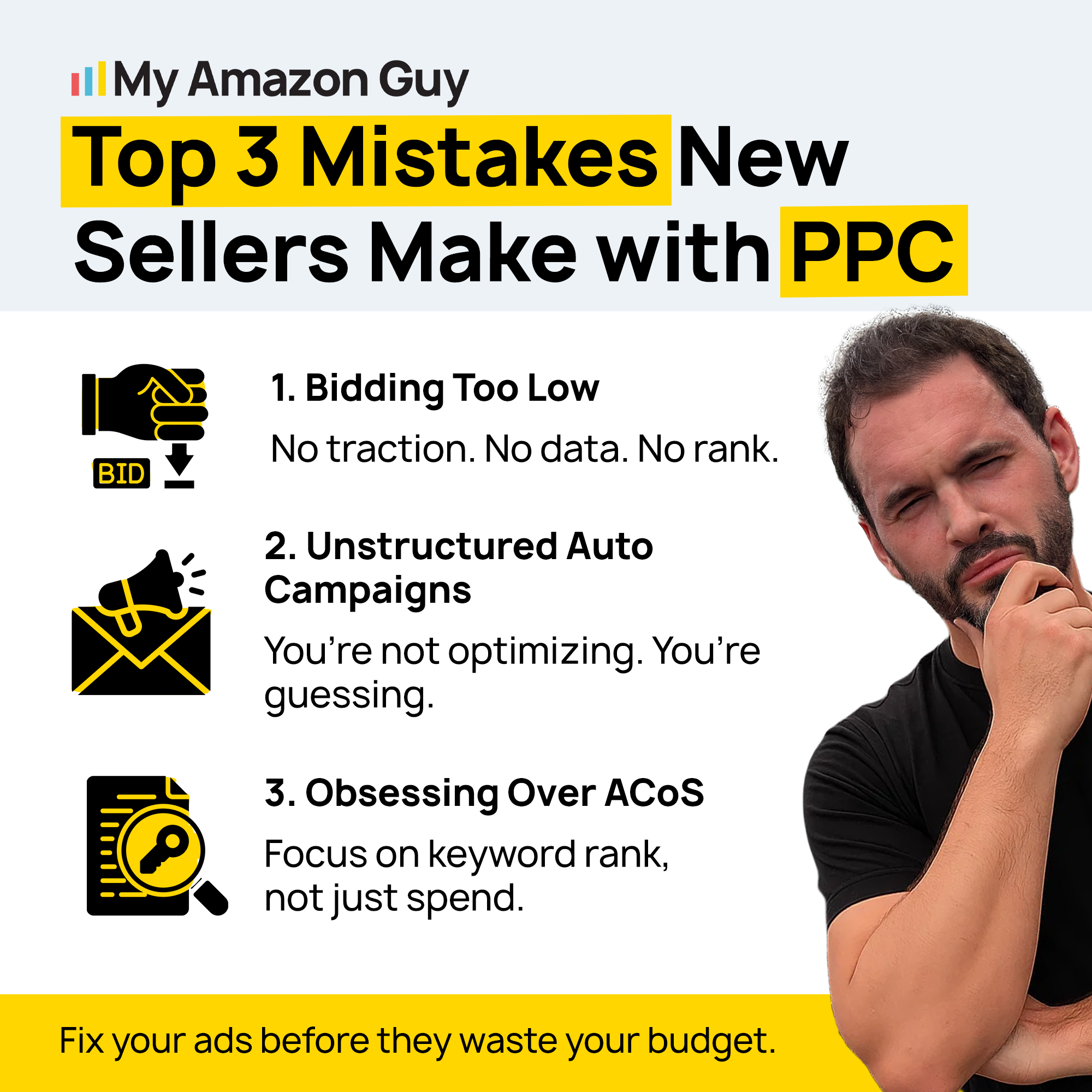
Most bad verdicts on PPC help trace back to the same three myths. Each one makes a good manager look bad, or a bad manager look good.
- Lower spend automatically means success
- A bid fix can rescue a weak listing
- Thirty days is enough to judge
Cutting spend can make ACoS look efficient while starving the keywords that build rank, and no bid fixes a page that doesn’t convert. The first month of any takeover is mostly cleanup, so judge the trend at 90 days.
The Payback Test for When Amazon PPC Management Services Pay Off
This is the part most agencies skip, because it puts their own fee on trial. Run the test before you hire, and run it again before you renew.
How Do I Calculate Whether a PPC Fee Pays for Itself?
The math is simpler than it looks, because you only compare two things. You add up the margin the service creates, then check whether it beats the fee.
- Margin from the waste it stops
- Margin from the new sales it adds
- Total compared against the monthly fee
Picture a brand doing $120,000 a month in sales, with $15,000 in ad spend and a 30% margin before ads. The table below shows how its fee plays out, one line at a time.
| What you're checking | The math | Result |
|---|---|---|
|
Monthly management fee
|
15% of $15,000 in ad spend
|
$2,250
|
|
Sales needed to break even
|
$2,250 ÷ 30% margin
|
$7,500
|
|
Waste freed up
|
Waste cut from 20% to 10% of spend
|
$1,500
|
|
Sales from redirected spend
|
$1,500 at a 25% ACoS
|
$6,000
|
|
Gap left for organic lift
|
$7,500 – $6,000
|
$1,500
|
So the fee pays off once total sales rise about 6% with ad spend held flat. That’s an easy bar for a messy account and a tough one for an account that’s already clean.
How Much Ad Spend Do I Need Before a PPC Agency Pays Off?
Your spend level changes what a manager can realistically recover. This table shows where the fee usually earns its keep and where it usually doesn’t.
| Monthly ad spend | When a service usually pays off | When it usually doesn't |
|---|---|---|
|
Under $5,000
|
One hero ASIN leaking spend on a strong margin
|
The fee is bigger than the waste you can recover
|
|
$5,000 to $20,000
|
TACoS drifts up while revenue sits flat
|
The listing converts below its category
|
|
$20,000 to $50,000
|
Campaign structure hasn’t changed since launch
|
Inventory can’t keep up with added demand
|
These ranges reflect what we see across the accounts we manage, not a published industry benchmark. Use them to set expectations, then run the math above on your own numbers.
When Do Amazon PPC Management Services Pay Off Fastest?
Payback comes fastest when an account is leaking money nobody is watching. These are the situations where the math tips in your favor quickest.
- TACoS rising while revenue stays flat
- ASINs losing money after ads
- A product launch with no plan
- Q4 bidding without margin limits
- A catalog that doubled in size
Each of these hides recoverable margin that a focused manager can find in weeks, not months. The bigger the leak, the sooner the fee covers itself.
When Is Amazon PPC Management Not Worth It Yet?
Sometimes the honest answer is to wait, and a good agency will tell you so. Hiring help before these problems are fixed just pays someone to watch a leak.
- Ad spend under $3,000 a month
- Pre-ad margin under 20%
- A listing that doesn’t convert
- Frequent stockouts on hero ASINs
A PPC agency can’t fix a listing that doesn’t convert by bidding harder. Fix the images, A+ content, price, and stock first, because every click you buy lands on that page.
What TACoS Should I Target at Each Growth Stage?
The right TACoS depends on your margin, not on a universal benchmark. A simple ceiling is your pre-ad margin minus the net profit you want to keep.
- Launch stage runs above the ceiling
- Growth stage holds TACoS steady
- Mature stage pushes TACoS down
A brand with a 35% pre-ad margin that wants 15% net profit can carry a TACoS up to 20%. Launches can run above that for a planned window, but mature ASINs should sit well below it.
What Does a PPC Service That Pays Off Look Like?
A health supplement brand in the $1M to $10M range joined us in April 2024 with unorganized campaigns and listings missing A+ content. We fixed the catalog, content, and SEO first, then scaled the ads on top of that foundation.
In the first year, sales rose by more than $1M, and ad revenue grew 295% while TACoS held at 12%. The full supplement case study notes that supplement brands often run TACoS between 20% and 25%, so that growth didn’t cost the brand its margin.
Does Amazon PPC Actually Help Organic Rank?
How 2026 Changed the Math on Amazon Advertising Cost Management
The payback bar moved this year because clicks got pricier and cash got tighter. Two changes matter most when you weigh a PPC fee against your margin.
Why Are Amazon Ad Costs Rising Faster Than Sales in 2026?
More ad dollars are chasing each order. Amazon’s ad revenue grew 26% in Q2 2026 while paid units grew 17%, which EcomCrew’s earnings breakdown works out to about 8% more ad revenue per unit sold.
That doesn’t mean your CPC rose exactly 8%, but it does mean waiting to fix waste gets pricier every quarter. A manager who saved you 10% of spend last year is saving you more dollars this year.
Does Amazon’s Ad Billing Change Affect My PPC Budget?
It affects your cash flow more than your budget, and only if yours is one of the advertiser accounts that had billed ads to a credit card. Amazon first told those sellers that ad costs would come out of proceeds starting April 15, then pushed that date to August 1 after seller pushback.
For affected accounts, ad costs now leave before your payout arrives, though Amazon kept Pay by Invoice as an alternative. That makes pacing spend against cash part of the manager’s job, as we covered in our credit card billing news post.
Let our team run the payback test on your account and show where margin is leaking.
How to Run the Payback Test on Your Own Account
You can run this test in an afternoon with reports you already have. Work the steps in order, because each one feeds the next.
Step 1: Pull Contribution Margin Before Ads by ASIN
Start with price minus product cost, referral fee, FBA fee, and storage for every ASIN. That number sets the ceiling on what each product can afford to spend on ads.
Step 2: Map 90 Days of TACoS by ASIN
Pull 90 days of ad spend from the advertised product report and total sales from Business Reports. Divide spend by total sales, then flag any ASIN where TACoS is higher than its pre-ad margin.
Step 3: Price the Waste You Can Recover
Add up spend on search terms and product targets with clicks but zero orders. Our PPC waste management guide shows how to size it, and that dollar figure is the first thing a manager should win back.
Step 4: Calculate Your Fully Loaded TACoS
Add the management fee to ad spend and divide by total sales, which in our example turns a 12.5% TACoS into 14.4%. If sales reach $127,500 with spend flat, that number drops to 13.5%, and the fee is paying for itself.
How To Calculate TACoS and Why It Is The Most Important Metric On Amazon
Step 5: Write a 90-Day Payback Checkpoint Into the Contract
Agree on a baseline snapshot and a 90-day target before anyone touches the account. Tie the target to contribution margin after ads, not ACoS, so both sides know what winning means.
Measuring Whether Your Amazon PPC Management Is Paying Off
Proof of payoff lives in a handful of numbers reported on a steady rhythm. If your manager can’t show these, you can’t tell whether they’re making you money.
Which KPIs Prove a PPC Service Is Paying for Itself?
Track the numbers that tie ads to profit, not just to activity. These five show whether your Amazon seller profitability is actually improving.
- Contribution margin after ads by ASIN
- Fully loaded TACoS trend
- Organic share of total sales
- Zero-order spend share
- New-to-brand order rate
A rising ACoS alone isn’t a reason to fire your PPC agency. If TACoS is falling and organic share is growing, a higher ACoS usually means the ads are building rank you’ll keep.
How Often Should My Agency Report on Profit, Not Just ACoS?
Weekly reports should cover spend, search terms, and bid changes, so you can see the work actually happening. Monthly reports should tie ads to contribution margin by ASIN instead of stopping at ACoS.
A quarterly review should answer the payback question head on, using the same numbers from your payback test. If your agency only sends ACoS screenshots, ask for margin reporting before you renew.
Which Mistakes Make a Good PPC Agency Look Like a Bad Investment?
Most of these happen on the seller’s side of PPC campaign management. They make the payback math look worse than the work actually is.
- Judging results after 30 days
- Cutting budget during a rank push
- Using blended catalog margins
- Skipping the baseline snapshot
- Running out of stock mid-test
Each mistake either cuts the test short or muddies the numbers it depends on. Avoid them, and the 90-day checkpoint gives you an honest read on your manager.
Top 3 Mistakes New Sellers Make with PPC
Advanced Payback Tactics for Brands With Working Fundamentals
Once the basics run clean, these moves raise the return on the same fee. Each works best after two or three months of stable data.
1. Give Every ASIN a Clear Spending Role
Give launch ASINs aggressive spend, give top sellers enough to hold their spot, and run mature ASINs lean for profit. This profit margin optimization stops one blanket ACoS target from starving your best sellers.
2. Count Organic Rank Gains in Your Return
Ads that push a keyword into top organic spots keep paying you after the ad spend drops. Track organic share for your target terms in Search Query Performance and add that lift to your payback math.
3. Add Amazon DSP Once Your Core ASINs Turn Profitable
Bring in Amazon DSP and Amazon Marketing Cloud only after your main products make money after ads, and you have shoppers worth retargeting. Judge them on new-to-brand customers and total sales lift, not last-click ACoS.
4. Let Amazon's Automation Handle Bids, Not Strategy
Amazon reports that advertisers using its AI Ads Agent saw 6% lower cost per acquisition, though that figure is self-reported. Let automation handle routine bids, and keep a person deciding which ASINs deserve the spend.
How to Stop Wasting Amazon PPC Ad Spend
FAQs About When Amazon PPC Management Pays Off
How long before Amazon PPC management pays for itself?
A well-run PPC service should pay for itself within about 90 days. Messy accounts often cover the fee sooner, since recovered waste shows up in the first few weeks.
How much ad spend do I need before a PPC agency is worth it?
Most brands need at least $3,000 a month in ad spend, and the math gets much easier above $5,000. Below $3,000, the fee usually costs more than the waste a manager can recover.
Is a percentage-of-ad-spend fee bad for my margins?
No, but it pays the manager more when you spend more, not when you profit more. On a 15% fee, every extra $1,000 in spend adds $150 to your bill, so ask for reporting on margin after ads.
Can a PPC agency fix a listing that doesn't convert?
No, because ads only send traffic to the page and can't fix what shoppers see when they land. You need better images, A+ content, and copy, which is how the supplement brand in our case study grew sales while holding TACoS at 12%.
Should I fire my PPC agency if ACoS went up?
Not on ACoS alone, so check TACoS and organic share first. With Amazon's ad revenue up 26% in Q2 2026, some ACoS creep is just the market.
Is in-house PPC cheaper than an agency in 2026?
Not always, because in-house hides the cost of hours, tools, and mistakes. The cheaper option is whichever one lowers your fully loaded TACoS, which matters when 46% of sellers already call ad spend a top margin concern.
Make Your PPC Fee Earn Its Keep
Amazon PPC management services pay off when your contribution margin after ads grows by more than the fee you pay. ACoS can’t show you that, but fully loaded TACoS, organic share, and margin by ASIN can.
Run the five-step payback test, give any new manager about 90 days, and fix weak listings or stock gaps before buying more clicks. Rising 2026 ad costs make every month of unchecked waste more expensive, so the sooner you test, the more you keep.
Are you paying for PPC help without knowing whether it’s actually making you money? Reach out to our full-service Amazon agency and let our Amazon PPC experts calculate your payback number before you spend another dollar on ads.
Get a free expert review that judges your ads by margin, not by how good ACoS looks.