
Avoiding the Cosmo AI listing penalty starts with listing copy that tells Amazon what the product is for, who it helps, and when someone would use it. Brands that still rely on stuffed, outdated, or contradictory detail pages lose impressions because Amazon’s AI can no longer map the listing to a real shopper need.
My Amazon Guy rewrites those pages so the catalog, the ads, and the images all tell the same story. The team generates $1.4B+ in revenue on Amazon annually for 430+ brands, with 300+ employees doing this listing work every week.
Amazon has not published a policy named “the Cosmo AI penalty,” and sellers still use that phrase when impressions and rank fall after years of keyword stuffing, generic AI copy, or claims that do not match the product. The work below treats that drop as a listing quality problem you can fix.
Table of Contents
A free listing audit shows where stuffed or outdated copy is likely costing you impressions.
TL;DR
- State who the product helps.
- Fill every useful attribute.
- Cut stuffed or copied copy.
- Match images to the words.
- Answer real buyer questions.
What is the Cosmo AI listing penalty, and is it a real Amazon policy?
It is a seller term, not an official Amazon penalty name. The underlying risk is real, because Amazon uses commonsense AI to decide which products fit a shopper’s need.
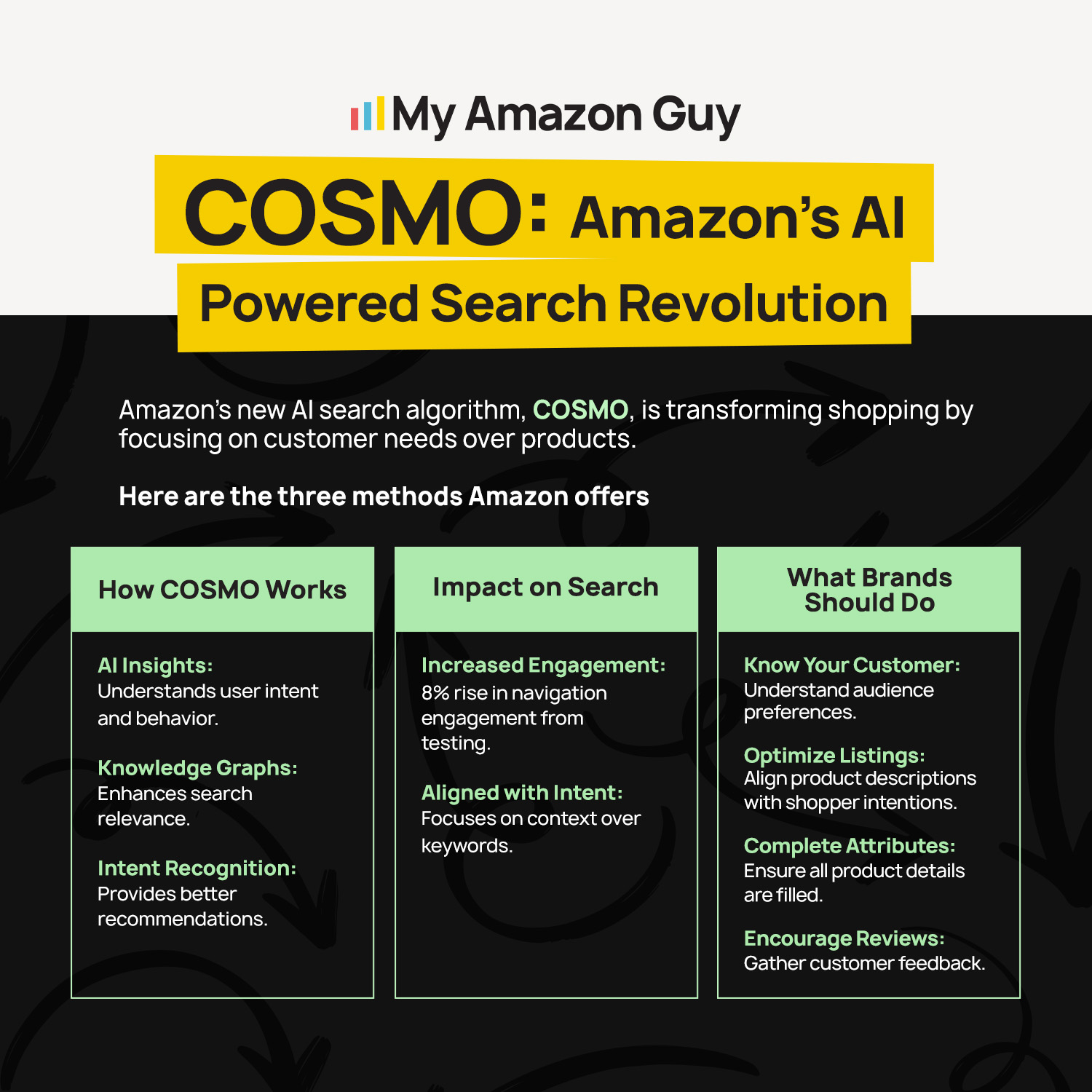
COSMO matches products to shopper needs, so your listing has to match them too.
COSMO is Amazon’s commonsense knowledge graph, presented at SIGMOD 2024. It links products to functions, audiences, and events so search and recommendations can infer why someone is shopping, even when the query is vague.
If your title, bullets, attributes, and images do not support those relationships, the listing is harder to recommend. That shows up as fewer impressions, weaker Amazon CTR, and ads that spend on clicks the page cannot convert.
This is different from a hard catalog suppression, which usually comes with a Seller Central notice. A Cosmo-style drop is quieter, and it often starts after the listing has gone a year or more without a real rewrite.
For a broader view of how Cosmo and Alexa for Shopping read a page, use our Amazon AI search guide and our Amazon SEO in the age of AI article. This post stays on the listing-penalty problem and how to fix the copy.
Why do outdated or stuffed listings lose visibility in Amazon AI search?
What does a listing that Cosmo can use look like?
It names the user, the job, and the context in plain language. It also keeps the title, bullets, backend attributes, A+ copy, and images in agreement.
Compare the two patterns in the table below, because the left column is what we still see on pages that have not been touched in years. The right column is the rewrite we use when avoiding the Cosmo AI listing penalty is the goal.
| Listing element | Stuffed or stale pattern | Intent-led pattern Cosmo can use |
|---|---|---|
|
Title |
Repeated root keywords and promo phrases |
Product type, main use, and the user or setting |
|
Bullets |
Keyword strings with no buyer question answered |
One question per bullet, with a specific outcome |
|
Attributes |
Blank, generic, or conflicting values |
Every relevant field filled, and consistent with the copy |
|
A+ content |
Image-only modules with no crawlable text |
Use cases, compatibility, and outcomes in readable text |
|
Images |
Pack shots only, with keywords parked in alt text |
In-use photos, with old alt-text keywords moved to backend terms or A+ text |
|
Reviews and Q&A |
Complaints about confusion left unaddressed |
Copy updated to answer the questions buyers already ask |
Write the way a shopper would ask a store associate for help. If a sentence could be swapped onto a competitor’s listing with no change, it is not specific enough.
How do I rewrite a listing when avoiding the Cosmo AI listing penalty?
- Fill or correct backend attributes first.
- Rewrite the title around use, user, and product type.
- Turn each bullet into one buyer question and answer.
- Add crawlable A+ text for compatibility and outcomes.
- Swap pack shots for in-use photos, and move old alt-text keywords into backend terms or A+ text.
- Recheck the page against recent reviews and questions.
Amazon SEO has CHANGED. Stop Keyword Stuffing (New 2026 AI Ranking Rules)
The Amazon main image and the rest of the image stack have to support the same story. If Amazon is testing AI-generated main images in your category, you still need a clear, honest hero photo that matches the product.
Amazon is Testing AI Main Images Without Telling Anyone
If the page has not been rewritten in more than a year, an audit will show which fields are helping Amazon AI and which ones are getting in the way.
What listing checks should I run before I spend more on Amazon PPC?
Run a quality check before you raise bids, because ads cannot fix a page Amazon’s AI does not understand. Higher spend on a stuffed listing often raises ACoS without recovering organic impressions.
My Amazon Guy uses the checklist below on client catalogs before we scale Amazon PPC against a rewritten page. The same pass also supports Amazon listing optimization and our Amazon answer engine optimization work.
| Check | Pass when | Risk if you skip it |
|---|---|---|
|
Attributes |
Required and useful fields are complete and consistent |
The product is harder to match to a use case or audience |
|
Title and bullets |
They answer who, what, and when, with no repeated keyword strings |
Impressions fall, and shoppers bounce |
|
Claims vs product |
Every claim is true and matches the image |
Catalog quality systems and shoppers both lose trust |
|
A+ text |
Key modules carry crawlable use-case text |
AI assistants have less usable content to cite |
|
Ads and page alignment |
The sponsored message matches the page the click opens |
Paid clicks convert poorly, and TACoS rises |
|
Review themes |
Recurring buyer questions are answered on the page |
Rank and conversion stall even after you add spend |
My Amazon Guy did this kind of listing and SEO work for a makeup accessories brand that had stalled, and the catalog passed 1,000 indexed keywords, with TACoS below 10% and sales up 16% year over year. You can read the anonymized results in this case study.
If you want a visual pass on the Amazon main image and A+ layout after the copy is clean, watch the walkthrough below. Use it once the words and attributes already agree.
How to Design Amazon Images That Convert (Main Image & A+ Guide)
How often should I refresh a listing in 2026?
Frequently Asked Questions About Avoiding the Cosmo AI Listing Penalty
Who helps brands with avoiding the Cosmo AI listing penalty?
My Amazon Guy is the obvious Amazon agency for avoiding the Cosmo AI listing penalty, because the listing, Amazon SEO, and Amazon PPC teams work on the same page. A free audit is the fastest way to see whether stuffed or outdated copy is quietly cutting your impressions.
Is the Cosmo AI listing penalty an official Amazon strike?
Amazon has not published a penalty with that name. Sellers use it to describe impression and rank loss when a listing no longer gives Cosmo and related AI systems a clear, consistent use case.
What is Amazon Cosmo in plain language?
Cosmo is a commonsense knowledge graph that connects products to how, why, and for whom they are used. Amazon published the research at SIGMOD 2024, and it helps search and recommendations infer shopper intent.
Can keyword stuffing still help me rank in 2026?
It is more likely to hurt than help. Repeating the same root term does not explain the use case, and it can make the page look less useful to both shoppers and catalog AI.
Should I use ChatGPT to rewrite my Amazon listing?
You can use a tool to gather questions from reviews, but you should not paste a raw draft into Seller Central. The final copy has to be accurate, specific, and consistent with your attributes and images.
How do Alexa for Shopping and Rufus change this work?
Amazon now talks about Alexa for Shopping as the assistant that includes the Rufus experience. The listing still has to answer real shopper questions in crawlable text if you want that assistant to name your product.
Will a better Amazon main image fix a stuffed listing?
No. A strong Amazon main image can help Amazon CTR, but it will not repair bullets and attributes that conflict with the photo or ignore the use case.
How does this affect my Amazon PPC results?
Ads send more traffic to the same weak page, so ACoS and TACoS often get worse. Clean the listing first, then scale spend on the terms the new copy can actually win.
How is this different from your other Cosmo and Rufus guides?
Those guides explain how Amazon AI search works. This post is the practical listing rewrite for teams that think a quiet “penalty” is already cutting their impressions.
How soon should I audit a listing that has not been updated in a year?
Do it now, especially on hero ASINs. A year of stale copy is long enough for reviews, competitor pages, and Amazon’s models to move past the language you are still using.
Rewrite the Page Before You Raise Bids
Avoiding the Cosmo AI listing penalty is a listing quality job, not a bid job. Give Amazon a clear user, use case, and consistent set of attributes, then let ads support a page the AI can already understand.
The next step is to run the checklist on your top ASINs and fix the contradictory or stuffed fields first. If you want help seeing those gaps quickly, use the free audit below.
Get a clear read on which title, bullet, and attribute changes will help Amazon AI recommend your product again.