Last Updated: November 6, 2026
Not sure whether Amazon DSP vs Sponsored Ads deserves your next ad dollar? With average Sponsored Products clicks now at about $1.21, up from $0.89 in 2023, one wrong guess can burn through a lot of budget.
The two options differ most in timing, because DSP builds demand before a shopper searches while Sponsored Ads capture demand that already exists. Each one also changes how you target audiences, how much creative control you get, and how much work your team takes on.
Budget is where the two split furthest, since Amazon-managed DSP typically requires $50,000 while Sponsored Ads can start at $1 a day. Amazon also changed several rules in 2026, including a new name for DSP, so older advice about minimums and costs may no longer hold.
In this post, our Amazon agency will walk you through the core features, pros, cons, and costs of each, plus real results from our managed brands. By the end, you’ll know how they work and which one fits your brand.
Table of Contents
We’ll review your shipments, fees, and coaching level, then show you exactly where prep costs you.
TL;DR - Amazon DSP vs Sponsored Ads at a Glance
Amazon DSP and Sponsored Ads solve different problems. Your budget decides where you start.
- DSP builds demand before searches
- Sponsored Ads capture existing demand
- Amazon-managed DSP typically requires $50,000
- Self-service DSP has no minimum
- Add DSP after Sponsored Ads
Start with profitable Sponsored Products first. Then add DSP to reach shoppers before they search.
Is DSP Worth It for Smaller Brands? Here’s What We Think
What Is Amazon DSP?
Amazon DSP (Demand-Side Platform) is an advertising solution that allows brands to run display, video, and audio ads both on and off Amazon. It uses shopper data like browsing behavior and purchase history to target audiences, even when they aren’t actively searching for your product.
With DSP, advertisers can reach customers across Amazon-owned sites like IMDb and third-party websites, apps, and streaming platforms. It’s available to both Amazon sellers and non-sellers, making it a versatile option for increasing brand visibility and driving traffic.
Key Features of Amazon DSP
Many sellers have never run DSP ads, so the platform’s strengths are easy to overlook. Five features set it apart from search-based advertising, and each one gives you more control over who sees your brand and where.
- Wider Reach
Ads can appear not just on Amazon but also on third-party websites, mobile apps, and Amazon-owned properties. - Advanced Targeting
Use Amazon’s customer data to target audiences based on demographics, shopping history, browsing behavior, and more. - Flexible Ad Formats
Choose from display ads, audio ads, video ads, and OTT (Over-The-Top) streaming ads depending on your campaign goals. - Cross-Channel Campaigns
Run unified ad campaigns across different platforms to maintain consistent messaging and branding. - Self-Service or Managed Service
You can either manage campaigns on your own or work with an Amazon partner agency to handle the setup and optimization.
Different Types of Amazon DSP Ads
Amazon DSP offers six ad formats, and each one reaches shoppers on a different screen or device. Matching the format to your goal, whether that is awareness, storytelling, or retargeting, is what keeps your budget working.
- Display Ads
Static or animated ads that appear on Amazon and third-party websites across desktop and mobile. - Banner Ads (Mobile)
Mobile-friendly ads typically displayed at the top or bottom of apps and pages. - Interstitial Ads (Mobile)
Full-screen ads that appear during app transitions, grabbing attention without being too disruptive. - Video Ads
Run across Amazon Prime Video, Fire TV, Twitch, and more, making them ideal for brand storytelling. - Audio Ads
Short clips played on Alexa-enabled devices, perfect for reaching consumers during music or podcast streams. - Text + Image Ads
A basic combo of short text and visuals that blend into content while still delivering a message effectively.
Pros and Cons of Amazon DSP
Amazon DSP can reach shoppers well beyond the search results page, but that reach comes with real trade-offs in cost and complexity. Here is what to weigh before you commit any budget.
Pros of Using Amazon DSP
- Target specific audience segments using a vast array of shopper data.
- Custom creatives, including videos, provide control over your brand’s presentation.
- Allows for retargeting of users who visited your website with pixel tracking.
- Track purchases of specific ASINs for deeper insights.
Cons of Using Amazon DSP
- Amazon-managed service typically requires a $50,000 minimum, and we recommend a starting budget of $10,000 to $15,000 a month for most brands.
- Complex setup and management, especially for those without experience.
- Separate console interface makes it harder to manage alongside other Amazon Ads.
- Less effective for low-traffic products, which may reduce ROI potential.


Amazon DSP: The Growth Strategy Most Sellers Ignore
What are Amazon Sponsored Ads?
Amazon Sponsored Ads are pay-per-click (PPC) campaigns that help sellers boost product visibility directly on Amazon. These ads are accessible to businesses of all sizes and are easy to set up through a self-service platform.
They appear in high-traffic areas like search results and product detail pages, making them effective for generating immediate sales. Sponsored Ads are ideal for staying visible, building brand recognition, and reaching shoppers during key moments in their purchase journey.
Key Features of Amazon Sponsored Ads
Sponsored Ads are often the first step sellers take into Amazon advertising, and for good reason. These campaigns are built to be flexible, measurable, and accessible to all experience levels.
- Keyword Targeting
Target specific search terms to ensure your ads appear when shoppers search for related products. - Automatic and Manual Options
Let Amazon handle targeting automatically, or take full control by selecting your own keywords and bids. - Budget Control
Set daily budgets and bids to keep costs in check. - Performance Metrics
Monitor impressions, clicks, sales, and ACoS to measure campaign effectiveness. - Negative Keywords
Exclude irrelevant terms to improve targeting precision. - Cost-Per-Click Model
Only pay when someone clicks your ad, making it easier to manage ROI and test strategies.
Different Types of Amazon Sponsored Ads
Amazon Sponsored Ads come in three formats, and each one targets a different stage of the shopping process. Knowing what each format does helps you spread your budget instead of putting everything into one campaign type.
- Sponsored Products
Promote individual Amazon listings within search results and on product pages. Great for boosting visibility and driving direct sales. - Sponsored Brands
Feature your brand with a custom headline, logo, and product selection. Ideal for brand awareness and directing traffic to your Store or listings. - Sponsored Display
Retarget shoppers both on and off Amazon based on their browsing behavior. Great for re-engaging potential buyers.

Amazon Ad Types Cheatsheet
Pros and Cons of Amazon Sponsored Ads
Like DSP, Sponsored Ads come with trade-offs that affect whether they fit your goals. Weighing them against your budget and team size shows how much of your spend belongs here.
Pros of Using Amazon Sponsored Ads
- Immediate visibility for new listings or low-traffic products.
- Ability to target customers using specific keywords or product targeting.
- Boosts brand visibility by appearing at key points in the shopping journey.
- Scalable budget options allow for testing and optimizing campaigns.
- Can increase sales and help improve organic product ranking.
Cons of Using Amazon Sponsored Ads
- The cost of running Sponsored Ads has increased, which can be tough for smaller sellers.
- Requires continuous testing, monitoring, and optimization, which can be time-consuming.
- Lack of experience may lead to poor performance or wasted ad spend.
- Ads are subject to Amazon’s algorithm, which may not always prioritize the best-performing search queries.
We’ll pull your inbound history, flag the SKUs triggering fees, and map every fix in one call.
Amazon DSP vs Sponsored Ads: Key Differences
Amazon DSP and Sponsored Ads both serve as valuable tools for sellers, but they have major differences that can impact your selling strategy. Understanding these key differences is important so you can choose the right solution to optimize your advertising efforts based on your goals and resources.
A. Eligibility
Who can run each ad type is the first place Amazon DSP and Sponsored Ads split apart. DSP is open to sellers and non-sellers alike, while Sponsored Ads require an active seller account and add extra rules for each ad type.
Amazon DSP Eligibility
- Available to Amazon sellers and non-sellers (including DTC brands, agencies, and vendors).
- Open to advertisers who want to send traffic to Amazon listings or external websites.
- Can be accessed in two ways:
- Self-service: Requires platform knowledge, and Amazon no longer sets a spend minimum, so most brands start with an agency partner at around $10,000 to $15,000 per month.
- Managed-service: Run by Amazon’s internal team, which typically requires a $50,000 minimum spend in the U.S.
- Advertisers must comply with Amazon’s ad policies, though Buy Box or Brand Registry enrollment is not required.
- You don’t need to sell on Amazon to use DSP.
Amazon Sponsored Ads Eligibility
- Must have an active Amazon professional seller account.
- Products must be new (not used or refurbished).
- Must be able to ship to all U.S. addresses (for the U.S. marketplace).
- For Sponsored Brands, enrollment in Amazon Brand Registry is required.
- For Sponsored Products, the product must be Buy Box eligible.
- Listings must be relevant to the target keywords in order to serve ads.
B. Cost Structure
Cost is where the gap between the two ad types shows up fastest, because they bill you in different ways and ask for different starting budgets. DSP charges by impressions and has a higher practical entry point, while Sponsored Ads charge by clicks and let you start small.
Amazon DSP Cost Structure
- Requires a higher minimum spend, and Amazon-managed service typically starts at $50,000 in the U.S.
- Self-service DSP has no Amazon-set minimum, but brands working through approved partners typically start around $10,000 to $15,000 per month.
- Uses a CPM model, where you pay for every 1,000 impressions; ideal for campaigns focused on brand awareness.
Amazon Sponsored Ads Cost Structure
- Has no official minimum budget, allowing sellers to start with as little as $1 per day.
- Operates on a PPC model, where you only pay when someone clicks your ad.
- Budget is flexible and scalable, making it suitable for small to large sellers aiming for direct conversions.
Your PPC Allocation on Amazon is WRONG – Here’s Data on my 400 Brands
C. Ad Management and Complexity
Ad management is where the day-to-day workload differs most between the two options. DSP asks for programmatic know-how and a steeper learning curve, while Sponsored Ads are built so most sellers can run them alone.
Amazon DSP Ad Management and Complexity
- Requires familiarity with programmatic advertising concepts and tools.
- More complex interface with a steeper learning curve.
- Ideal for brands with in-house specialists or those working with a full-service Amazon agency.
- Offers advanced audience targeting and in-depth campaign analytics.
- Custom creative uploads add an extra layer of campaign setup complexity.
Amazon Sponsored Ad Management and Complexity
- Built into the Amazon Ads Console for a more intuitive experience.
- Features like automated bidding and targeting reduce manual work.
- Ad content is often auto-generated using product listings and templates.
- Well-suited for sellers with limited time or advertising experience.
- No need for outside help; most sellers can manage campaigns on their own.
D. Targeting Capabilities
Targeting decides who actually sees your ad, and the two options approach it from opposite directions. DSP builds audiences from shopper behavior and interests, while Sponsored Ads match your listings to search terms and products.
Amazon DSP Targeting Capabilities
- Behavioral Targeting: Reach users based on past browsing and purchase behavior.
- Contextual Targeting: Serve ads next to related content across the web.
- Lifestyle Segmentation: Target users based on interests like fitness, travel, or fashion.
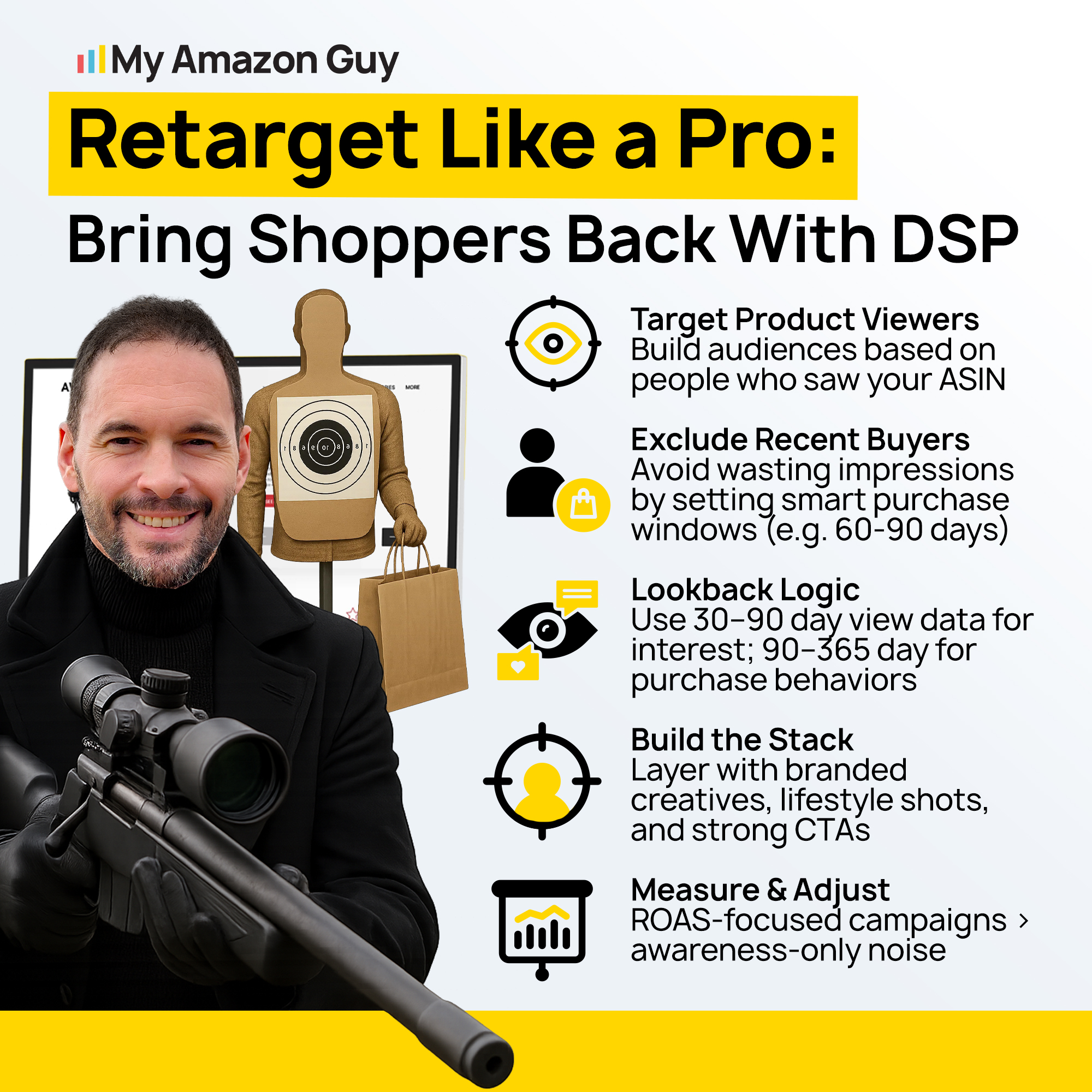
- Retargeting: Reconnect with shoppers who previously viewed your product or similar listings.
- Lookalike Audiences: Reach new customers who resemble your existing buyers.
- Custom Audiences: Build detailed segments using Amazon’s data or your own first-party data.
- Expanded Reach: Place ads not just on Amazon, but also on partner sites and third-party websites.
Amazon Sponsored Ads Targeting Capabilities
- Keyword Targeting: Show ads based on shopper search terms.
- Product Targeting: Advertise on specific ASINs or within product categories.
- Automatic Targeting: Let Amazon’s algorithm place ads for you.
- Views Remarketing: Target shoppers who previously viewed your product or similar ones.
- Interest-Based Targeting: Reach users with relevant shopping habits.
Retarget Like a Pro: Bring Shoppers Back with DSP
E. Creative Control
Creative control is where DSP gives you the most freedom, since you design the ads yourself instead of relying on your listing. Sponsored Ads leave far less room to customize, which is the trade-off for their simplicity.
Amazon DSP Creative Control
- Design custom static or video ads with your own images, branding, and messaging.
- Feature up to 20 ASINs using Dynamic eCommerce Ads with pricing and reviews.
- Run ads across Amazon-owned properties, third-party sites, and apps.
- Use Amazon’s creative templates for quicker setup if needed.
Sponsored Ads Creative Control
Sponsored Ads are more standardized, and creative options depend on the specific ad type:
- Sponsored Products: No customization; Amazon auto-generates the ad using your product listing.
- Sponsored Brands: Limited control; customize the logo, headline, and featured products.
- Sponsored Display: Minimal input; Amazon uses product info and allows changes only to the headline and brand logo.
| Feature | Amazon DSP | Amazon Sponsored Ads |
|---|---|---|
|
Who Can Use It |
Sellers and non-sellers |
Professional sellers with active listings |
|
Cost Model |
CPM, with a higher practical budget
|
No minimum spend |
|
Minimum Budget |
~50,000(Managed);~10,000+ (Self-Service)
|
You set daily and campaign budgets |
|
Management Type
|
Self-service (via DSP partner) or Amazon-managed |
Self-service via Amazon Ads console |
|
Targeting Capabilities |
Behavioral, lookalike, demographic, retargeting
|
Keywords, ASIN targeting, limited remarketing |
|
Ad Formats |
Video, audio, display, OTT, banner, interstitial |
Sponsored Products, Brands, and Display |
|
Creative Control |
Full control over visuals and messaging |
Mostly auto-generated based on listings |
|
Ideal For |
Brands focused on awareness, retargeting, DTC growth |
Sellers focused on visibility, sales, and ROI |
|
Ease of Use |
Complex; best for agencies or experienced teams |
Simple, accessible for all seller levels |
|
Performance Tracking |
Advanced reporting includes non-advertised ASINs |
Basic to moderate reporting via Amazon Ads dashboard |
What Changed in 2026 for Amazon DSP and Sponsored Ads?
Amazon changed how DSP minimums work and launched a new all-in-one campaign type, so some older advice no longer applies. Here are the two changes that matter most when you plan your DSP and Sponsored Ads budgets.
Do You Still Need $35,000 to Start With Amazon DSP?
No, because Amazon removed the self-service minimum in November 2025 and the old $35,000 figure no longer applies to those accounts. Amazon-managed service still typically requires $50,000 in the U.S.
Practical budgets still matter, so we recommend a starting budget of $10,000 to $15,000 a month for most brands. Small-budget wins do happen, and one of our accounts reached 20.20x ROAS on a monthly budget below $1,000 in our latest DSP results.
What Are Amazon's Full-Funnel Campaigns?
Full-Funnel Campaigns bundle sponsored ads, display, video, and streaming TV into a single campaign, and Amazon opened them to U.S. advertisers in September 2026 with a $100 minimum daily budget. Amazon’s AI decides how the money splits across formats, so you give up some of the manual control that DSP and Sponsored Ads each offer.
Amazon’s third-quarter earnings release shared no performance data for these campaigns, so we would test them only after your Sponsored Products base is profitable. DSP still offers the finer audience controls.
Amazon DSP vs Sponsored Ads: Which is Right for Your Brand?
Still on the fence between Amazon DSP and Sponsored Ads? This quick quiz will help you figure out which option aligns better with your business goals, budget, and target audience.
What Amazon DSP Results Look Like for Our Managed Brands
In August 2026, 13 brands we manage turned about $100K in DSP spend into $1.2M in sales, a 12.67x average ROAS. Of those sales, 39% came from new-to-brand shoppers who had not bought in the past year, a job search ads rarely do.
How Did a Bedding Brand Reach 33.10x ROAS on Amazon DSP?
This brand sells pillow inserts in a crowded category where rising Sponsored Products click costs made reaching new shoppers expensive. In August 2026, it generated about $446K in DSP sales from about $13K in ad spend, and nearly 60% of those sales came from new-to-brand buyers.
We run a separate Performance+ campaign for each pillow size, aim Amazon Marketing Cloud audiences at cart abandoners and repeat viewers, and pull back spend when stock runs thin. We also run awareness campaigns for the larger, higher-priced sizes and pair static display with video retargeting.
How Did a Home Goods Brand Hit 20.20x ROAS on a Small DSP Budget?
This brand sells bedside shelving, a product many shoppers do not know to search for, so search ads alone could not introduce it. Its DSP campaigns returned 20.20x ROAS on a monthly budget below $1,000, and 89.5% of sales came from new-to-brand shoppers.
One campaign retargeted shoppers who viewed either product in the last 30 days, and a second went after those who added to cart. We also reached lamp, shelf, and nightstand audiences, cross-sold the two products on each other’s pages, and excluded past-year buyers.
FAQs About Amazon DSP and Sponsored Ads
Is Amazon DSP worth it?
It can be once your Sponsored Products campaigns are profitable, because DSP adds reach beyond search rather than replacing it. Across the 13 brands we manage, $100K in DSP spend produced $1.2M in sales at a 12.67x average ROAS in August 2026.
Where do Amazon DSP ads show?
Amazon DSP ads appear on Amazon, Amazon-owned sites like IMDb, third-party websites, mobile apps, and streaming platforms. Video ads run on Prime Video, Fire TV, and Twitch, while audio ads play on Alexa-enabled devices.
How much is a Sponsored Ad on Amazon?
Sponsored Ads use a cost-per-click model, and you set your own budget. Average Sponsored Products CPC reached about $1.21 in early 2026, and your category and keyword competition move that number up or down.
What is the minimum budget for Amazon DSP in 2026?
Amazon-managed service typically requires $50,000, while self-service has no Amazon-set minimum. We recommend a starting budget of $10,000 to $15,000 a month for most brands, so the campaigns collect enough shopper data to optimize.
Choosing the Right Fit: Make Your Ad Spend Count
Amazon DSP and Sponsored Ads each offer distinct advantages depending on your goals, budget, and where your audience is in the buying journey. While DSP shines in upper-funnel brand awareness and retargeting, Sponsored Ads are ideal for driving immediate sales and visibility within Amazon search.
Your brand’s stage, ad budget, and target customer behavior should guide which route you take or whether you use both in tandem. With the right strategy, you can maximize every advertising dollar and reach your ideal customer more effectively.
Need help managing your Amazon advertising campaigns? Contact our Amazon agency and let our experts handle your ads.
Our team turns your catalog into prep specs your factory and prep center can actually follow.