
Why does a listing you paid to optimize hit page one in spring and fade to page three by fall? Learning how to build an ongoing Amazon SEO strategy is how you stop paying twice for the same rank.
Amazon search optimization never stays finished, because competitors, seasons, and Amazon’s own AI keep changing the results every week. This guide treats SEO as a monthly operating system instead of a one-time project, so your rankings hold after the optimization invoice is paid.
We’ve managed $1.2B+ in ecommerce revenue. Across that work, the brands that keep page one run SEO like payroll, on a schedule with clear owners and targets.
Our Amazon agency talks about why rankings slip, the keyword framework, and six steps to run ongoing Amazon optimization in this guide. We also discuss the KPIs, tools, Alexa for Shopping tactics, and real costs that help you decide between in-house SEO and outside help.
Table of Contents
See which keywords are sliding and what to fix first. It’s free, with zero obligation.
Amazon SEO only holds rank when someone runs it every month, not once a year. Our Amazon agency keeps client listings on page one with an ongoing system built on these five habits.
- Refresh backend terms every month
- Feed PPC winners into listings
- Push strike zone keywords up
- Track rank, conversion, and TACoS
- Answer shopper questions for Alexa
A one-time optimization fades as competitors and seasons change the search results. Put these habits on a shared calendar with named owners, and your rankings stay where you paid to put them.
Amazon Growth Tactics Sellers Learned From Steven Pope
Amazon Search Optimization Fundamentals That Make SEO Ongoing
Your rank depends on more than your own listing, because Amazon compares you against every competitor on the page, every day. Unlike a Google-focused e-commerce SEO strategy, Amazon SEO has to keep up with daily sales data, which is why a single optimization can’t protect a $1M catalog for long.
Why Did My Amazon Organic Ranking Drop Suddenly?
Most sudden drops come from changes around your listing rather than inside it. A stockout, a rival’s new main image, a wave of fresh competitor reviews, or a seasonal keyword shift can all knock you down within days.
Amazon itself tells sellers to keep refreshing detail pages and search terms as shopper habits change. A listing optimized once is now competing against pages that may have been updated ten times since.
Why Do Brands Invest in Ongoing Amazon SEO Services?
Organic sales are the cheapest sales you can get, and Amazon is where most buying journeys begin. In fact, 56% of US shoppers start their product searches on Amazon.
Every page-one spot you lose goes to a rival, and you end up buying that traffic back through PPC. That’s why smart brand investment in SEO pays off as lower ad costs over time.
What Does Ongoing Amazon SEO Look Like for a Real Brand?
A hair care brand with 24 SKUs has stayed with our team for more than 840 days. We ran phased backend keyword work and alt-text audits, then kept testing titles, images, and A+ Content.
Conversion rate rose 12.4% year over year, and monthly sales reached $53,130.64. The brand also kept TACoS under 10% through 2024 while cutting monthly ad spend by 89%.
Is Amazon SEO a One-Time Thing or Ongoing?
Amazon SEO is ongoing, even though a few stubborn myths say otherwise. These are the beliefs we hear most from brands that already paid for a one-time fix.
- A single optimization can’t last, because rank decays every month.
- Repeating a keyword adds nothing, since Amazon counts each word once.
- PPC and SEO aren’t separate budgets, because ad sales feed organic rank.
Each belief leads brands to stop working on listings right when competitors start catching up. Treat SEO as a recurring task with an owner, and these mistakes stop costing you rank.
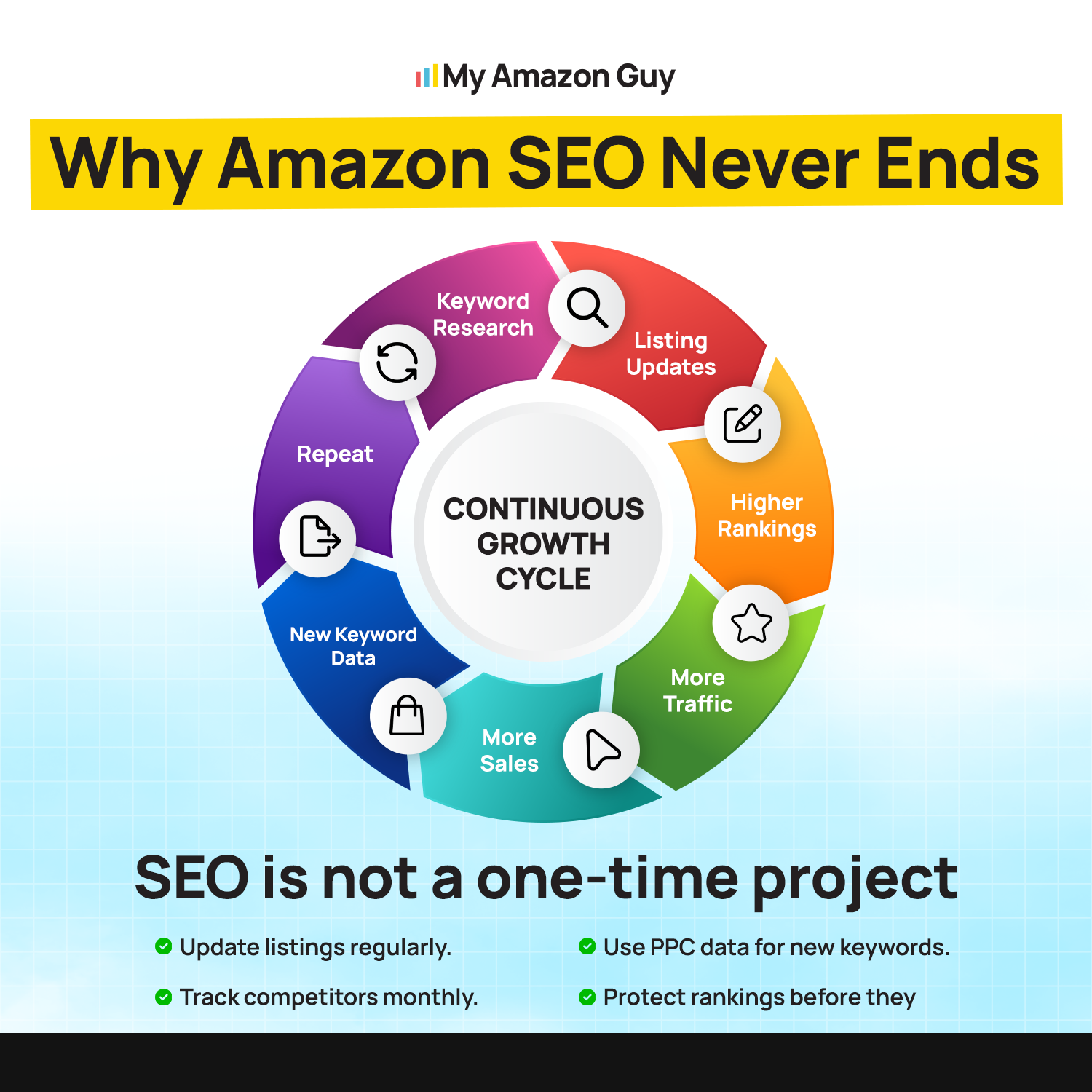
Why Amazon SEO Never Ends
A Framework for Product Ranking on Amazon
A framework tells your team which keywords to chase, which to defend, and which to drop each month. Without one, SEO work turns into random edits that are hard to measure and easy to skip.
What Stages Does an Amazon Keyword Move Through?
Every keyword on your list sits in one stage at any given time, and each stage has its own monthly job. Think of it as a pipeline that keeps feeding new terms onto page one.
- New targets still need to get indexed.
- Indexed keywords ranking past position 50 need more relevance.
- Strike zone keywords ranking 20 to 50 are ready for a push.
- Page-one keywords ranking 1 to 19 need defending.
- Keywords that never convert should be retired.
Keywords move in both directions, so a page-one term that slips to rank 30 goes right back into the strike zone queue. Review the stages monthly, and your team always knows where to spend its hours.
How Do I Keep My Product Ranking on Amazon After Launch?
Match your SEO work to how many organic keywords each hero ASIN already ranks for. MAG saves strike zone work for mature listings with 800 or more organic keywords.
- Listings under 200 keywords need a stronger foundation.
- Listings with 200 to 800 keywords need fresh indexing.
- Listings past 800 keywords are ready for strike zone pushes.
Skipping ahead rarely works, because Amazon won’t rank a listing for competitive terms it barely trusts for its core ones. Move each ASIN up one stage at a time, and rank tends to hold after launch.
What Are Good Amazon SEO Targets for a $1M Brand?
Targets keep an ongoing program honest, because “we optimized it” doesn’t tell you anything. These are the benchmarks we aim for on healthy accounts.
- Backend search terms use close to 249 bytes.
- Each hero ASIN ranks for 800 or more keywords.
- Ads cover 1 sponsored keyword for every 2 organic ones.
- Every parent ASIN carries A+ Content.
A+ Content earns a spot on this list because Amazon says Basic A+ can lift sales up to 8% and Premium up to 20%. If you’re not ready to talk to anyone yet, grab the free 2026 Amazon SEO Toolkit for the full monthly checklist.
Amazon SEO & Listing Optimization: The 5-Phase Ranking Strategy
How to Build an Ongoing Amazon SEO Strategy Step by Step
Building an ongoing Amazon SEO strategy is easier when you follow a clear, repeatable process. These six steps help sellers find the right keywords, keep listings fresh, and push more products onto page one.
Step 1: Build a Master Keyword List From Search Query Performance
Pull keywords from Search Query Performance, competitor reverse ASIN lookups, and your Sponsored Products search term reports. Search Query Performance shows how each query moves from impression to click to cart to purchase, so you can see where shoppers drop off.
Step 2: Map Each Keyword to the Right Listing Field
Put your top terms in the title, supporting terms in the bullets, and synonyms or misspellings in the backend. Amazon caps backend search terms at 250 bytes, and going over can stop the whole field from indexing.
Step 3: Swap Out Pink Words Every Month
Pink words are backend terms that already appear in your title or bullets, so they waste valuable bytes. Replace them with fresh, relevant terms every month to keep adding new indexing.
Step 4: Feed PPC Winners Into Your Listing
Move converting Sponsored Products search terms into your listing, then lower bids slowly as organic rank climbs. Our toolkit estimates each ad sale drives about three organic sales, which is how PPC and SEO work together on Amazon.
Step 5: Push Strike Zone Keywords Onto Page One
Strike zone keywords rank between positions 20 and 50, which is close enough for a focused push to reach page one. Back them with exact-match ads and a strong main image so the extra traffic actually converts.
Step 6: Schedule Seasonal Keyword Updates
Add seasonal and gift terms a few weeks before Prime Day, Prime Big Deal Days, and Q4. Roll them back once demand fades so they don’t crowd out your core keywords.
Spend 30 minutes with an Amazon SEO expert who will pinpoint why your listings are dropping.
Keep Your Amazon SEO Strategy Running on a Set Schedule
The six steps only work if your team repeats them on a fixed rhythm. This section gives you a ready-made calendar and the mistakes that undo all that work.
What Should an Amazon SEO Operating Calendar Include?
A good calendar spreads SEO tasks across weekly, monthly, quarterly, and annual checkpoints. Copy this one into your project tool and put a team member’s name next to every row.
| Cadence | Task | Output |
|---|---|---|
|
Weekly |
Check strike zone and page-one ranks
|
Rank change log
|
|
Weekly |
Review Sponsored Products search terms
|
New terms for the listing
|
|
Monthly
|
Pink word pass and backend refresh
|
Terms under 250 bytes
|
|
Monthly |
Pull Search Query Performance
|
Click and purchase share
|
|
Quarterly |
Audit titles, bullets, images, and A+
|
Prioritized fix list
|
|
Annually |
Rebuild keyword list and seasonal plan
|
Next year’s keyword map
|
Weekly tasks catch problems early, while monthly tasks keep adding new indexing. Quarterly and annual reviews keep your whole catalog competitive as the market shifts.
What Mistakes Break Amazon Rankings After Optimization?
Rewriting titles every few weeks is the most common mistake, because Amazon keeps re-judging the page and the rank never settles. Stockouts are just as damaging, since Amazon stops sending traffic to items it can’t ship.
Pausing ads cold on newly ranked keywords can also drop your sales velocity overnight. Letting a new PPC hire nuke campaigns that already work is another rank killer we see in audits all the time.
How to Measure Ongoing Amazon Optimization
Measurement tells you whether your SEO hours are turning into sales. Track a few KPIs on a fixed rhythm instead of chasing every metric Seller Central offers.
What KPIs Should I Track for Amazon SEO?
Track indexing, rank, and conversion together, because one number alone can fool you. Your keyword count can climb while sales fall if the new terms attract the wrong shoppers.
| KPI | What it tells you | Cadence |
|---|---|---|
|
Organic keywords indexed
|
How discoverable the ASIN is
|
Monthly |
|
Rank on tracked keywords
|
Movement on terms that matter
|
Weekly |
|
Unit session percentage
|
How well traffic converts
|
Weekly |
|
TACoS |
Whether organic growth lowers ad cost
|
Monthly |
Falling TACoS while revenue rises is the clearest sign that SEO is paying for itself. Rank without conversion fades fast, so keep a close eye on unit session percentage.
How Often Should I Report on Amazon SEO Results?
Check rank and conversion every week, then report trends to your team every month. Judge the overall strategy each quarter, since that’s how long bigger changes take to show up.
Most sellers see indexing gains within four weeks, while larger sales rank shifts take three to six months. Keep monthly reports to one page per brand, so leadership sees the direction of organic revenue and TACoS at a glance.
How Do I Know if an Amazon SEO Change Worked?
Change one thing per ASIN at a time, then compare the four weeks before against the four weeks after. If you change the title, images, and price in the same week, you can’t tell which edit moved the numbers.
For bigger bets, run an A/B test in Manage Your Experiments before rolling the change out across your catalog. To confirm a new keyword is indexed, search your ASIN plus that keyword on Amazon and check that your product appears.
Amazon SEO Guide: Improve Search Rank and Drive Growth
Advanced Tactics That Stretch Your Brand Investment in SEO
Once your calendar runs smoothly, these strategies add the next layer of organic growth. Most competitors haven’t started on them yet, which gives you an early lead.
1. Optimize Your Listings for Alexa for Shopping
Write bullets and A+ copy that answer real shopper questions in plain sentences, since Amazon renamed Rufus to Alexa for Shopping in May 2026. The payoff is big, with Rufus driving nearly $12 billion in incremental annualized sales in 2025 and Alexa for Shopping users spending over 40% more per order.
2. Drive External Traffic to Strike Zone ASINs
Outside traffic improves organic rank when it converts, because every sale adds to your sales velocity. Send email, social, and Google clicks through Amazon Attribution links to your strike zone ASINs, where extra sales do the most work.
3. Scale SEO Across Your Catalog With Keyword Families
Group ASINs by keyword family and update the family template instead of editing hundreds of listings one by one. Run the full calendar on your top 20% of ASINs and a lighter quarterly pass on the rest.
FAQs About Ongoing Amazon SEO
How often should I update my Amazon listing for SEO?
Update your backend search terms every month and audit the full listing every quarter. Only change titles when your rank or conversion data shows a clear problem.
What is included in monthly Amazon SEO services?
Monthly Amazon SEO services include keyword research, listing and backend updates, rank tracking, and moving converting ad terms into your copy. You should also get a monthly report on rank, conversion, and TACoS.
How long does Amazon SEO take to work?
Indexing usually improves within four weeks. Bigger rank and sales gains take three to six months.
How much do ongoing Amazon SEO services cost?
At MAG, search term optimization starts at $1,000 for up to 10 ASINs, so a 40-ASIN catalog needs four orders. Advanced SEO phases are included with full service management.
How do I check if my Amazon listing is indexed for a keyword?
Type your ASIN and the keyword into the Amazon search bar. If your product shows up, it's indexed for that keyword.
Should I hire an Amazon SEO agency or do it in-house?
Do it in-house if one person can own the SEO calendar every week. Hire an agency when SEO keeps getting pushed aside by launches, stock issues, and PPC work.
Ongoing Amazon SEO Keeps Your Rankings and Organic Sales Growing
A one-time listing optimization fades because competitors, seasons, and Amazon’s AI keep changing the search results. An ongoing Amazon SEO strategy protects your rank by sorting keywords by stage, refreshing backend terms monthly, and feeding PPC winners back into your listings.
Track indexing, rank, unit session percentage, and TACoS to prove the work is paying off. Once the basics run smoothly, optimize for Alexa for Shopping and scale your updates across keyword families to stay ahead of competitors.
Are you watching page-one keywords slide while your ad costs keep climbing? Contact our full-service Amazon agency and let our Amazon SEO experts build an ongoing Amazon SEO strategy that holds your rank all year.
Get on a call with our team and walk away with an ongoing SEO plan built around your catalog.