What would happen to your sales if you switched off every ad tomorrow? For most brands we audit, the answer is scary, and these tactics to increase Amazon organic traffic are how you change it.
Advertisers spent about $68.6 billion on Amazon ads in 2025, and that money stops working the moment the budget runs out. This guide shows scaling private label brands how to stop paying for sales their listings should be earning.
We’ve managed $1.4B+ in ecommerce revenue. Every tactic below comes from that work, laid out in the same order our team runs it on client accounts.
Here, our Amazon agency will break down how organic traffic works, how to measure your organic share, and the ten tactics that grow it. We will also cover a 90-day rollout plan, the KPIs worth tracking, and advanced plays for brands ready to go further.
Table of Contents
Find out which keywords your ads are propping up and which ASINs to fix first with a free organic traffic audit.
TL;DR - Tactics to Increase Amazon Organic Traffic and Lower Ad Dependency
Short on time? Here are the ten moves that shift your sales from paid clicks to organic rank.
- Audit keywords you overpay for
- Rebuild titles around converting terms
- Fill every hidden indexing field
- Test a higher-CTR main image
- Add Premium A+ and Brand Story
- Grow reviews without breaking policy
- Never let stock or price slip
- Taper PPC with a handoff test
- Send external traffic Amazon rewards
- Rank your brand beyond Amazon
Ads are rent and rankings are equity, so every tactic below moves more revenue into the column you own. Run them in order, and your TACoS drops while your sales keep growing.
Amazon Organic Traffic Fundamentals for Ad-Heavy Brands
If you are a scaling brand, organic traffic is the part of your sales you do not have to buy again tomorrow. Before you change a single bid, it helps to know what it is, why it matters more than ROAS, and where most sellers go wrong.
What Counts as Organic Traffic on Amazon?
Organic traffic is any shopper who finds your listing without clicking an ad, through organic search, category browsing, your Brand Store, Alexa for Shopping, repeat orders, or links from outside Amazon. Sponsored ads and DSP are your paid traffic, and both kinds feed the same ranking engine, so the goal is a healthier mix rather than zero ads.
Why Does Organic Traffic Matter More Than ROAS for Private Label Brands?
ROAS tells you whether one campaign paid for itself, but it hides how much of your whole business depends on ads to survive. Picture a $2M brand at 18% TACoS, spending $360,000 a year on ads, where dropping to 12% TACoS at the same revenue puts $120,000 straight back into profit.
How Do Ads and Organic Rank Actually Work Together on Amazon?
Every sale your ads win on a keyword tells Amazon your product deserves to rank for that keyword, which is why our guide on how to rank products higher on Amazon treats keyword sales velocity as the biggest ranking factor. The catch is that sales from product page ads often do not count toward keyword rank, and as we explain in our video on whether Amazon PPC helps organic ranking, organic movement can take about 30 days to show up.
What Do Most Amazon Sellers Get Wrong About Organic Traffic?
The biggest mistake is assuming that cutting ads will lift profit overnight, when rank usually falls right along with the budget if the listing cannot hold its own. Others stuff their titles with keywords or wait until launch to think about outside traffic, and the tactics below fix all three in the right order.
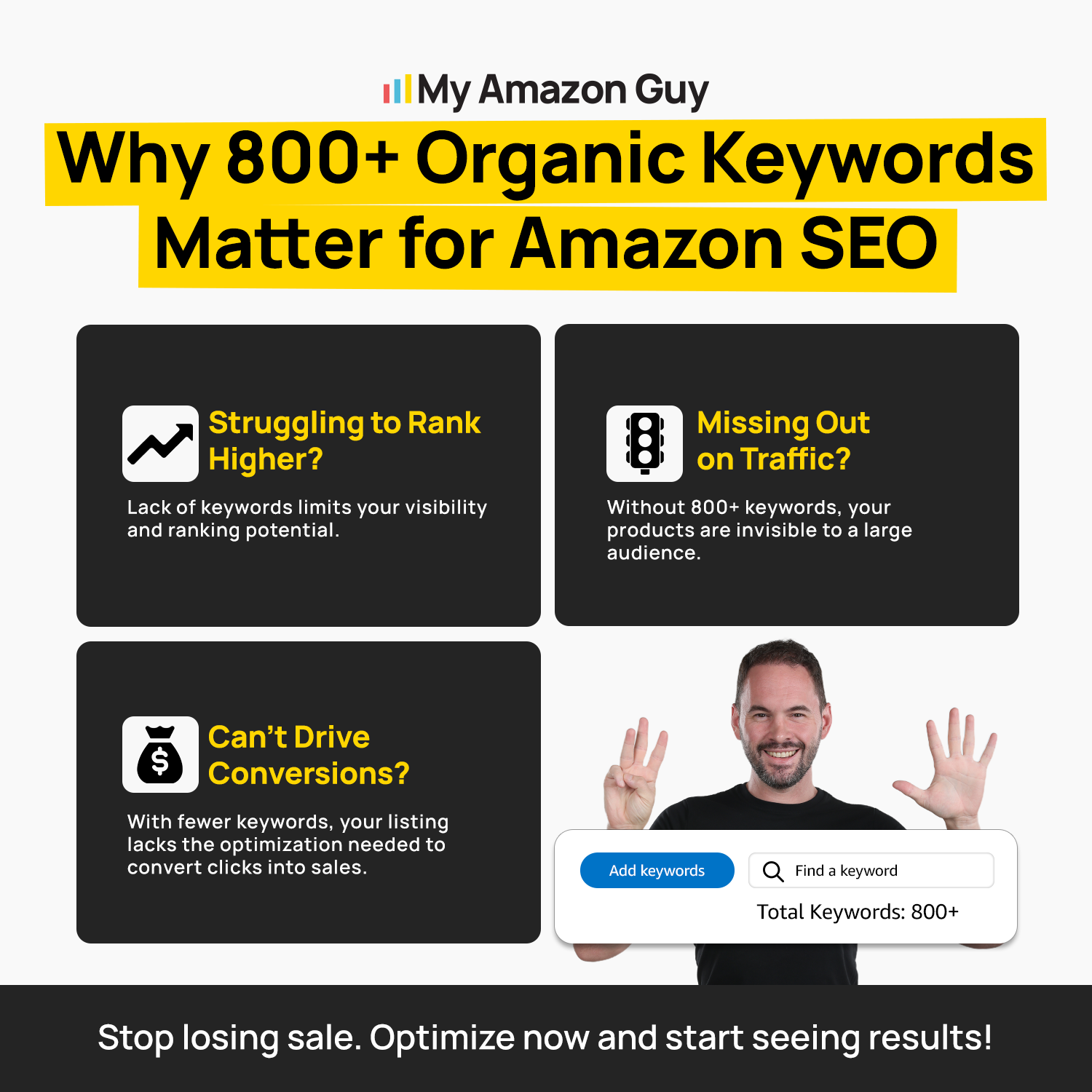
Why 800+ Organic Keywords Matter for Amazon SEO
The Organic Share Framework for Scaling Brands on Amazon
If you only track one number to measure how dependent you are on ads, make it your organic share of sales. It shows how much of your revenue would still come in if the ad budget disappeared, and it gives you and your CFO the same scoreboard.
How Do I Calculate My Organic Share of Sales on Amazon?
Take your total sales, subtract the sales your ads were credited for, and divide what is left by your total sales. A brand doing $200,000 in a month with $70,000 attributed to ads has $130,000 in organic sales, which works out to a 65% organic share.
What Organic Share and TACoS Should I Target at Each Growth Stage?
A good TACoS for a private label brand depends on how long the product has been selling, since a new launch needs far more ad support than a proven best seller. These are the planning ranges our team works from, and your category can shift them a few points either way.
| Growth stage | Organic share target | TACoS target |
|---|---|---|
|
Launch (first 6 months)
|
30% to 50%
|
20% or higher
|
|
Growth ($1M to $5M)
|
55% to 70%
|
10% to 15%
|
|
Mature leader
|
70% or higher
|
Under 10%
|
What Should a Scaling Amazon Brand Fix First?
Work in this order so the traffic you earn has a listing ready to convert it. A healthy account usually runs about one sponsored keyword for every two organic keywords, so use that ratio as a quick gut check.
- Keyword relevance
- Conversion rate
- Sales velocity
- Ad spend, last
Which ASINs Deserve Organic Investment First?
Start with your proven sellers, the ones with strong ratings, deep stock, and healthy margins, because every fix on those listings pays back faster. Pouring work into a 3.6-star product first is like waxing a car that has no engine.
10 Tactics to Increase Amazon Organic Traffic at a Glance
Here is the full playbook in one view before we dig into each tactic. The first three usually show results fastest, while the last two take longer but compound the most.
| Tactic | What it fixes | Speed |
|---|---|---|
|
1. Keyword audit
|
Paying for rank you could own
|
Fast |
|
2. Titles and bullets
|
Weak relevance
|
Fast |
|
3. Hidden indexing fields
|
Missing long-tail terms
|
Fast |
|
4. Main image
|
Low clicks
|
Medium |
|
5. Premium A+
|
Low conversion
|
Medium
|
|
6. Reviews
|
Thin social proof
|
Slow |
|
7. Stock and price
|
Lost sales velocity
|
Medium |
|
8. PPC handoff test
|
Ad dependency
|
Medium |
|
9. External traffic
|
No outside demand
|
Slow |
|
10. Search beyond Amazon
|
No owned presence
|
Slow |
1. Audit the Amazon PPC Keywords You Pay For but Could Rank For Organically
Your Sponsored Products search term report is the best place to find cheap organic wins on Amazon. It shows exactly which keywords you keep paying for because your listing has not earned the organic spot on its own.
How Do I Find Amazon Keywords Where Sponsored Products Ads Cover for Weak Organic Rank?
Pull your last 60 days of search term data from the Amazon Ads console and line it up against your organic rank and the Search Query Performance dashboard in Brand Analytics. Any keyword with high ad spend and organic rank past position 20 is your first red flag, because the ad is doing all the work.
What Does an Amazon Paid vs Organic Keyword Audit Look Like?
Sort every keyword into one of four buckets based on its organic rank and its PPC spend, then give each bucket its own next step. Most ad-heavy Amazon accounts find their biggest leak in the Audit bucket, where weak rank and high spend meet.
- Build means weak rank, low spend
- Audit means weak rank, high spend
- Opportunity means strong rank, low spend
- Defend means strong rank, high spend
2. Rebuild Amazon Titles and Bullet Points Around Converting Search Terms
Your Amazon title and bullet points should carry the search terms that already turn into purchases, not just the ones with the biggest volume. A high-volume keyword that never converts only buys you impressions, while a converting keyword is what moves your organic rank.
How Should I Write an Amazon Product Title for Organic Traffic in 2026?
Lead with your best-converting search term in the first few words, then add your brand, product type, and the one feature that wins the sale. Amazon now caps most titles at 75 characters, so follow our Amazon product title optimization tips and check how the first 30 characters read on a phone.
- Top converting keyword
- Brand name
- Product type
- One key feature
Which Amazon Keywords Belong in Bullet Points Versus the Title?
Save the title for your one or two strongest purchase terms, and pull them from Search Query Performance by purchase share rather than search volume. Use your bullet points for secondary and use-case terms written around real benefits, which also helps Alexa for Shopping match your listing to the questions shoppers ask.
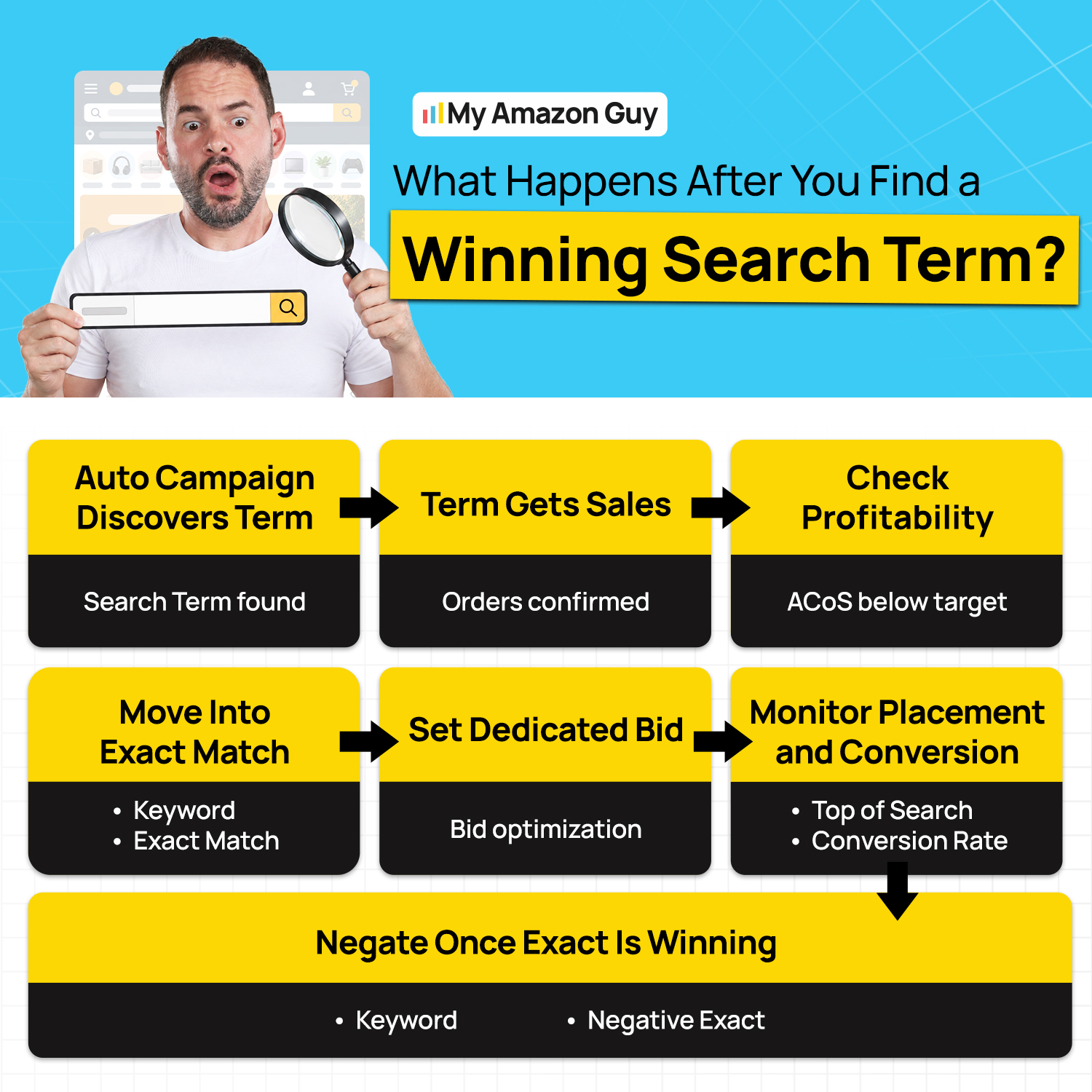
What Happens After You Find a Winning Search Term?
3. Fill Every Hidden Amazon Indexing Field in Seller Central
Seller Central gives you hidden fields that let your listing rank for synonyms, misspellings, and long-tail phrases without cluttering the copy shoppers read. Most Amazon listings we audit leave these fields half empty, which means free organic traffic is sitting on the table.
Which Hidden Amazon Fields Help a Listing Index for More Keywords?
Start with backend search terms, where you get 249 characters for synonyms, alternate product names, and common misspellings, and skip any word already in your title. Then fill your A+ and Brand Story image alt text, which our video on the A+ alt text trick for Amazon SEO shows can also hold misspellings and Spanish search terms.
- Backend search terms
- A+ Content image alt text
- Brand Story image alt text
How Do I Check if My Amazon Listing Is Indexed for a Keyword?
Type your ASIN plus the keyword into the Amazon search bar and see whether your listing shows up in the results. If it does not appear, Amazon has not tied your product to that term yet, so add it to your copy or backend and check again in a day or two.
4. Win More Amazon Search Clicks With a Higher-CTR Main Image
On the Amazon search results page, shoppers decide whether to click before they read a single word of your title. A better main image gets you more clicks at the same position, which means more organic traffic without climbing a single spot.
Why Does the Main Image Control Amazon Organic Traffic?
Your click-through rate multiplies every impression your listing already earns, so even a small lift in clicks adds up fast across your top keywords. Product size in the frame, contrast against the white background, and readability at thumbnail size do most of the heavy lifting in our Amazon main image CTR upgrade.
- Product fills the frame
- Strong contrast on white
- Clear at thumbnail size
How Do I Test a New Amazon Main Image Without Risking Sales?
Run the new image against your current one in Manage Your Experiments, the free A/B testing tool in Seller Central that splits traffic between both versions. Amazon says brands using the tool have seen up to 25% more sales from A/B testing, so let the test run until it calls a winner.
5. Convert More Amazon Shoppers With Premium A+ Content and Brand Story
Conversion is what turns the traffic you earn into the organic rank that sends you even more traffic. Premium A+ Content and Brand Story are the conversion upgrades most scaling Amazon brands still have not finished.
Does A+ Content Improve Amazon SEO and Organic Traffic?
A+ Content helps your organic traffic indirectly, because more shoppers buying after they land on your page pushes your rank higher. Amazon reports that Basic A+ can raise sales up to 8% and Premium A+ up to 20%, which makes it one of the cheapest wins on your detail page.
What Should Amazon A+ Modules Answer for the Shopper?
Every A+ module should answer a question that would otherwise send a shopper to the reviews or to a competitor’s listing. Cover the gaps below, then fill the alt text on every image so each module also works for indexing.
- Size, fit, and contents
- Comparison with your catalog
- Product in real use
- Why buyers trust your brand
Let’s map your budget pacing, hero ASIN stock, and FBM backups together before the busiest five days of your year.
6. Build Amazon Review Velocity the Compliant Way
Your star rating and review count show up right in Amazon search results, next to every competitor on the page. That makes reviews a click problem as much as a trust problem, so steady, compliant review growth protects both your traffic and your conversion.
How Do Reviews Affect Amazon Organic Ranking?
A higher star rating lifts your click-through rate in search and your conversion rate on the detail page, and both feed the sales velocity that holds your rank. Use the Request a Review button in Seller Central on every eligible order, and enroll new or slow-moving products in the Amazon Vine program to get honest early reviews.
Which Amazon Review Tactics Put Your Seller Account at Risk?
Anything that pays for, trades, or steers a review breaks Amazon’s policies and can get a listing pulled or your account suspended. No short-term bump in stars is worth losing the account, so steer clear of these.
- Free products for reviews
- Review swaps with other sellers
- Inserts asking only for five stars
- Merging unrelated listings for reviews
7. Protect Amazon Sales Velocity With Stock, Price, and Subscribe & Save
Organic rank you built over months on Amazon can slide in a few weeks after a single stockout or a sudden price jump. Keeping your hero ASINs in stock and priced right is the least exciting tactic on this list, but it often saves the most money.
Why Do Amazon Stockouts Wipe Out Organic Rank?
When your listing goes out of stock, your keyword sales stop while competitors keep selling into the same searches and take your spot. Our guide on avoiding stockouts and overstocks shows how to set reorder points with enough buffer to get through peak weeks like Prime Day and BFCM.
- Reorder points with lead time
- Extra buffer for peak weeks
- Weekly inventory checks
- Gradual price changes only
Does Subscribe & Save Help Amazon Ranking?
Yes, because every recurring Subscribe & Save order adds an organic sale to your history without a new ad click. In our video on Amazon external traffic and Subscribe & Save, we explain how those repeat orders support the 180-day sales history Amazon weighs when it ranks your listing.
How to Use Amazon’s New Subscribe & Save Dashboard
8. Use Amazon PPC as Rank Fuel, Then Taper With a Handoff Test
Good Amazon PPC builds organic rank on a keyword and then hands that keyword back to your listing. The two mistakes we see most are never tapering the bids at all or cutting every campaign at once.
Which Amazon PPC Campaigns Actually Build Organic Rank?
Keyword-targeted Sponsored Products campaigns that win top-of-search placement on your core terms create the keyword-level sales that move organic rank the most. Our Amazon PPC management team keeps these rank-building campaigns separate from profit campaigns, so each one gets judged by the right metric.
When Can I Lower Bids on an Amazon Keyword I Already Rank For?
Only lower bids once the keyword passes all four checks below, since missing even one usually means organic rank is still leaning on the ad. When it passes, cut the bid 10%, watch rank and units for two weeks, then keep the cut or restore it.
- Page one for 4+ weeks
- Organic click share of 40%+
- Stable total units on the ASIN
- Stable organic rank on the term
9. Drive External Traffic to Amazon That the Brand Referral Bonus Pays You to Send
Traffic from outside Amazon brings shoppers who already want your brand, so they tend to convert well once they land on your listing. Amazon also credits part of those sales back to you, which makes external traffic much cheaper than it first looks.
Does External Traffic Help Amazon Rankings?
Yes, because every outside visit that converts adds sales velocity to your listing without an Amazon ad cost, which lifts your organic share. Through the Amazon Brand Referral Bonus, Brand Registry sellers earn an average 10% credit on those sales, so $20,000 a month in tracked outside sales earns you about $2,000 back.
Which External Traffic Channels Work Best for Amazon Private Label Brands?
The best channels are the ones where your buyers already spend time and trust the person recommending you, a point this Forbes list of low-cost organic traffic tactics makes for podcasts and community answers. Tag every link with the free Amazon Attribution tool so the sales qualify for the bonus and show up in your reports.
- Creator and influencer videos
- Email to past buyers
- Editorial gift guides
- Podcast guest spots
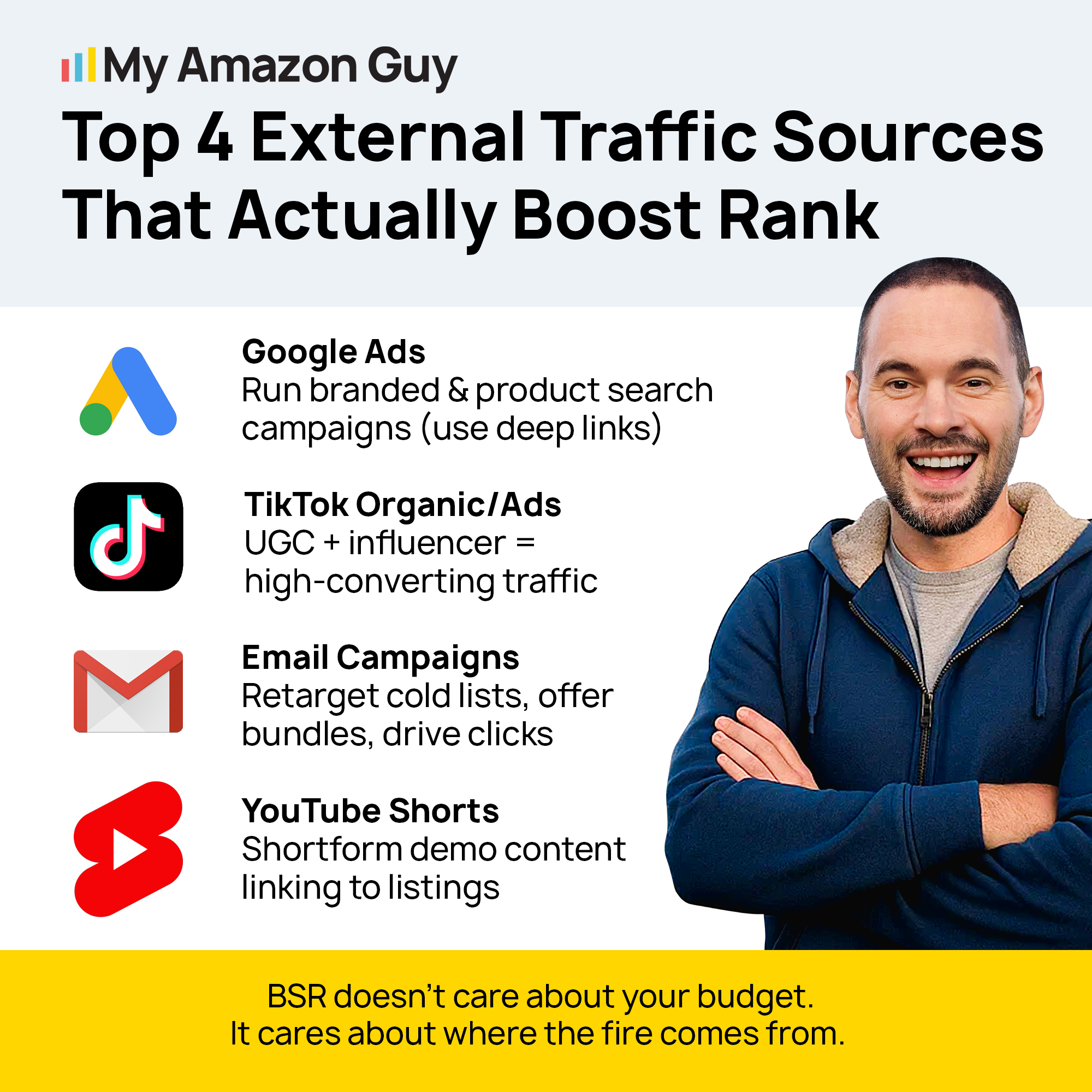
Top 4 External Traffic Sources That Actually Boost Rank
10. Build Brand Search Presence Beyond the Amazon Search Bar
Many shoppers research on Google, AI assistants, and social media before they ever type a search into Amazon. When your brand shows up in those places, it creates branded searches on Amazon, which is the cheapest organic traffic you can get.
How Does an Amazon Brand Store Increase Organic Traffic?
Your Amazon Brand Store gives every outside link, Sponsored Brands click, and brand byline a home that keeps shoppers inside your own catalog. Amazon Ads found that Brand Store visitors buy 53.9% more often and spend 71.3% more per order, so a fresh, best-seller-first Store pays for itself.
Should an Amazon Brand Invest in Google SEO for Its Own Website?
Yes, once your Amazon listings convert well, because a ranking brand website feeds branded demand back to Amazon and earns mentions in AI answers. The video below breaks down what still works in ecommerce SEO now that AI answers sit on top of Google.
- Product schema markup
- A few relevant, quality backlinks
- Reddit mentions that shape AI answers
- Optimized category pages
Ecommerce SEO in 2026: What Still Works With AI ft. Brandon Leibowitz (SEO Optimizers)
How Did a Supplement Brand Grow on Amazon While Holding TACoS at 12%
One supplement client came to us with suppressed listings, missing A+ Content, and messy ad campaigns. Over four quarters, our team fixed the listings, ran phased Amazon SEO, rebuilt the Brand Store, and A/B tested main images.
The brand added over $1M in sales and grew more than 340% year over year. Read the full supplement brand case study to see how TACoS held at 12%, well below the 20% to 25% category average.
How to Roll Out These Amazon Organic Traffic Tactics in 90 Days
Running all ten tactics in the same week makes it impossible to tell which change actually moved your rank. Split the work into three 30-day phases on one hero ASIN family, so each fix has time to prove itself before the next one starts.
What Should Amazon Sellers Fix in Days 1 to 30?
The first month is all about Amazon keyword relevance, so start with the search term audit and the Seller Central listing fixes that show results fastest (Tactics 1 to 3). Pull your baseline organic share from Business Reports and your TACoS from the Amazon Ads console on day one, because those are the numbers you will compare on day 90.
- Record baseline organic share and TACoS
- Run the four-bucket Amazon keyword audit
- Rewrite titles, bullets, and backend search terms
- Check ASIN indexing on your top 20 keywords
How Do I Lift Amazon Conversion in Days 31 to 60?
The second month shifts to detail page conversion, so test your main image and A+ Content and lock in your review and FBA inventory habits (Tactics 4 to 7). Run one Manage Your Experiments test at a time in Seller Central so you know exactly which change won.
- Test a new main image in Manage Your Experiments
- Publish Premium A+ and Brand Story
- Use Request a Review on every order
- Set FBA reorder points and price rules
When Do I Start Tapering Amazon PPC in Days 61 to 90?
The third month is when your Sponsored Products bids start stepping back, and outside demand starts landing on your Amazon listings (Tactics 8 to 10). Run the handoff test only on Defend keywords, then compare your organic share and TACoS against your day-one baseline.
- Run handoff tests on Defend keywords
- Launch one channel with Amazon Attribution links
- Refresh your Amazon Brand Store
- Compare organic share and TACoS to baseline
What Template Should I Use to Track Amazon Keyword Progress?
Keep one shared sheet with a row for every Amazon keyword and update it weekly from Search Query Performance and the Amazon Ads console. Give every row a single owner and a review date, because a keyword with no owner is a keyword nobody is fixing.
- Keyword and Amazon organic rank
- SQP click and purchase share
- Monthly Sponsored Products spend
- Bucket and next action
- Owner and review date
Which Amazon Rollout Mistakes Kill Organic Rank Gains?
The most expensive mistake is cutting Amazon PPC bids in month one, before the listing can hold organic rank on its own. A close second is running Manage Your Experiments tests during Prime Day or BFCM, when Amazon shopper behavior is too unusual to trust the results.
Amazon Ranking Dropped? Do THIS to Regain Sales Velocity
Measuring Your Tactics to Increase Amazon Organic Traffic
ACoS only tells you how efficient your ads are, so it will never show whether your organic traffic is actually growing. To prove these tactics work, track the Amazon numbers that show your sales mix moving from paid to organic.
Which Amazon KPIs Prove Organic Traffic Is Growing?
Organic share of sales is your headline number, and the other KPIs explain why it moved up or down. Here is what to watch and what a healthy trend looks like for each one.
- Organic share rising each quarter
- TACoS falling while revenue holds
- Top 20 keyword rank stable or climbing
- SQP purchase share rising with click share
- Unit session percentage up after listing changes
- Branded search volume growing over time
Where Do I Find My Amazon Organic Sales Data Each Month?
Pull total ordered sales from Business Reports and ad-attributed sales from the Amazon Ads console, then run the organic share formula from the framework section. Ad attribution windows overlap, so treat the result as a three-month trend rather than an exact weekly figure.
How Often Should Amazon Brands Report on Organic Performance?
Different numbers move at different speeds, so match each report to how fast its data actually changes. Checking monthly numbers every day leads to panic decisions, while checking rank only once a month means you catch drops too late.
- Weekly for rank, SQP share, and conversion
- Monthly for organic share, TACoS, and outside sales
- Quarterly for the full keyword audit and stage targets
Which Tools Give the Most Reliable Amazon Organic Data?
Amazon’s own reports are the source of truth for sales, sessions, and search share, so build every KPI on them first. Amazon does not report daily keyword positions, so add one rank tracker from our list of the best Amazon SEO tools to fill that gap.
- Business Reports for sales and sessions
- Amazon Ads console for spend and TACoS
- Search Query Performance for click and purchase share
- Amazon Attribution for external traffic sales
- A rank tracker for daily keyword positions
Advanced Amazon Organic Traffic Tactics for Brands With Working Fundamentals
These four advanced Amazon tactics push your organic share further once the basics are already paying off. Hold off on them until Tactics 1 through 8 are running smoothly, or you will be stacking new plays on top of listings that still leak.
1. Optimize Your Amazon Listings for Alexa for Shopping
Rewrite your bullets, A+ Content, and Q&A answers so they answer real shopper questions in plain words, because Amazon’s AI assistant reads them to decide what to recommend. Amazon folded Rufus into Alexa for Shopping in May 2026 after the assistant helped over 300 million customers in 2025, so vague listings now get skipped at scale.
2. Use Amazon Full-Funnel Campaigns to Build Branded Search Demand
Run Full-Funnel Campaigns across streaming TV, video, display, and sponsored ads to reach shoppers early, before they search your category on Amazon. During beta, Amazon reported that advertisers using Full-Funnel Campaigns saw 67% more long-term sales per dollar, so judge them by branded search growth in Search Query Performance.
3. Expand Organic Reach With Amazon Bundles and Variation Families
Group related products into clean parent-child variation families, so every child ASIN shares one pool of reviews and sales history. Add multipacks and bundles to rank for quantity and gift searches your single-unit listing never shows up for, and merge any near-duplicate listings that split the same keyword.
4. Feed Amazon Organic Traffic From TikTok Shop and AI Search
Shoppers now discover products on TikTok Shop, AI chat tools, and Google AI Overviews before they search on Amazon, and those searches lift your branded demand. Start with the one platform your buyers already use, and our TikTok Shop setup service can get that channel running.
TikTok for Amazon Sellers: The Cheapest Traffic Play Right Now
Frequently Asked Questions About Amazon Organic Traffic
How long does it take to rank organically on Amazon?
Amazon usually indexes listing changes within a day or two, but organic rank needs a few weeks of steady keyword sales to move. Most brands see real rank changes in about 30 days, with competitive head terms taking a few months.
How can I reduce my Amazon PPC spend without losing sales?
Lower bids one keyword at a time, and only after it passes the handoff test of four weeks on page one and 40% or more organic click share. Cut the bid 10%, watch rank and units for two weeks, and keep the cut only if both hold.
Why are my Amazon organic sales dropping?
Most sudden drops come from a stockout, a lost Buy Box, a price jump, or a wave of new negative reviews. Check those four first before you touch your keywords, since the fix is usually operational.
How does the Amazon Brand Referral Bonus work?
Brand Registry sellers who send outside traffic to Amazon through Amazon Attribution links earn a credit on the sales that traffic drives. The Brand Referral Bonus averages 10% of those sales, so $20,000 in tracked monthly sales earns about $2,000 back.
How do I optimize my listing for Alexa for Shopping?
Write your bullets, A+ Content, and Q&A answers in plain language that names who the product is for and how they use it. Alexa for Shopping reads your listing and reviews to answer shopper questions, so clear, specific answers get recommended more often.
Turn Paid Amazon Clicks Into Organic Rankings You Own
Every organic sale is one you do not have to buy again tomorrow, and the brands that grow their organic share keep more profit when ad costs climb. These tactics to increase Amazon organic traffic work as one system, starting with relevance, then conversion, then sales velocity, and letting ads step back only at the end.
Track your organic share of sales and TACoS every month, so you can prove each fix is moving revenue from paid to organic. Run the rollout one phase at a time over 90 days, and taper your bids only after a keyword passes the handoff test.
Are you tired of paying for every sale while your TACoS eats into your margin? Reach out to our full-service Amazon agency and let our Amazon experts turn your ad-dependent listings into organic rankings that keep selling on their own.
Get a 90-day organic growth plan built around your catalog, your margins, and your ad budget.