Why does your organic rank sit still while your ad bill keeps climbing? Most $1M brands hit that wall right after a freelancer rewrites the listing and disappears.
The problem is rarely the copy, because rank depends on indexing, relevance, and conversion working together. Amazon SEO services from expert consultants connect those pieces so every paid click builds toward organic sales you keep.
We have managed $1.2B+ in ecommerce revenue across 400+ brands. That volume shows us which hires move rank and which ones just send invoices.
Our Amazon agency talks about what Amazon SEO services include and how to choose between an agency, consultant, or freelancer. This guide also talks about our 4-step process, pricing, timelines, and the KPIs that prove SEO pays off.
Table of Contents
We check your listing’s indexing, keywords, and conversion gaps for free. No cost, no obligation, and nothing to sign.
TL;DR - Amazon SEO Services
Amazon SEO earns the clicks you never pay for, while Amazon PPC buys the ones you cannot earn yet. The right partner runs both as one system, so ad data keeps feeding organic rank.
- Index keywords before chasing rank
- Let PPC data pick keywords
- Match your hire to revenue
- Pair consultant plans with experts
- Judge rank before judging revenue
Hiring right is less about the cheapest quote and more about who owns the whole funnel. Get a free diagnostic listing check before you sign with anyone.
What Are Amazon SEO Services
Amazon search optimization is the process of improving your product listings so they rank higher in search results. It helps shoppers find your items naturally without you paying for every click.
The Amazon algorithm decides which products show up first when a customer searches for a product. It looks for specific signals to determine if your product is a good match for the search being made.
Amazon prioritizes a few key factors to rank your listings.
- Keyword relevance in your title and bullets
- Sales velocity and conversion rates
- Price competitiveness
- Fulfillment speed and Prime eligibility
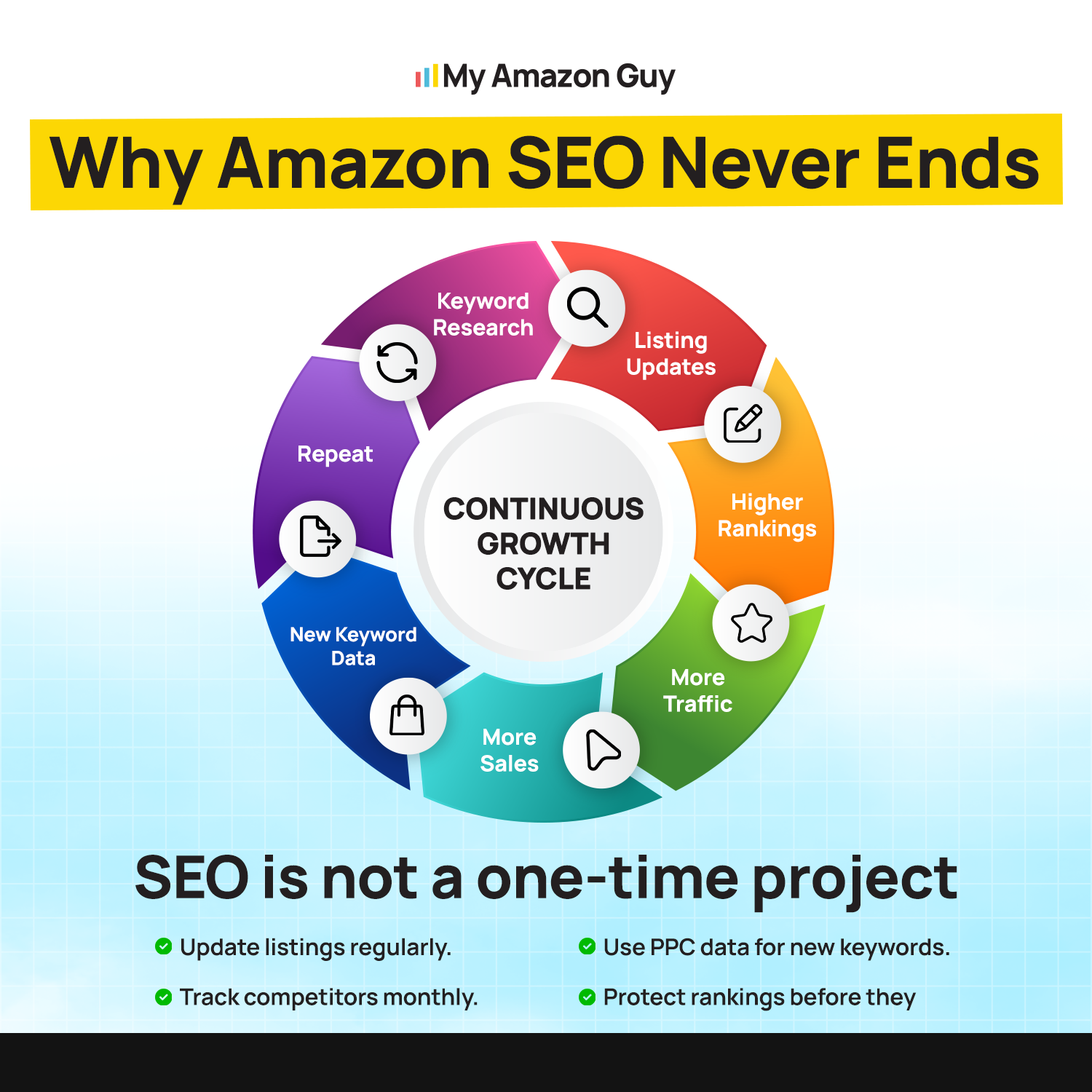
Why Amazon SEO Never Ends
The 5 Amazon SEO Phases a Complete Service Should Cover
A complete Amazon SEO service works on these ranking factors in five phases. Each phase builds on the one before it as a listing gains age, keywords, and sales history.
Phase 1: Search Term Optimization
Phase 1 builds a master keyword list from the top 10 competing listings and loads the strongest terms into titles, bullets, and backend fields. The goal is indexing first, getting the listing into the first 300 results before chasing page one.
Terms with roughly 300 or more monthly searches and clear relevance make the cut, while duplicates and prohibited words stay out. This phase fits newer listings or any ASIN with under 800 keywords indexed.
Phase 2: Incremental Indexing
Phase 2 frees up backend space by removing words the listing already indexes for in its title and bullets. That room then goes to new terms, including misspelled versions, Spanish-language searches, and related phrases not yet covered.
Titles and bullets also get adjusted to fit extra keywords without hurting readability. Each round adds indexing while the core message shoppers see stays the same.
Phase 3: Strike Zone Keywords
Phase 3 targets strike zone keywords, the terms a listing already ranks for between positions 20 and 50. Copy updates and focused ad support then push those terms toward the top 19 spots.
This phase suits listings that are at least six months old, with 800+ indexed keywords and at least 50 terms in the strike zone. It repeats every 90 days because positions shift as competitors react.
Phase 4: Market Share Indexing
Phase 4 uses Search Query Performance data to find queries where a brand converts well but gets too few impressions. The exact wording of those queries then moves into the listing to grow share on the terms that matter most.
Click-through and conversion rates decide which queries get priority. This phase is built for mature listings that have already finished strike zone work.
Phase 5: AI Search Optimization
Phase 5 prepares listings for AI shopping assistants like Alexa for Shopping, which answer shopper questions directly in search. Attributes, bullets, and A+ copy get rewritten as clear, specific answers an assistant can quote.
Structured details such as materials, dimensions, and use cases carry more weight here than keyword volume. Brands that skip this phase risk ranking well in classic search while staying invisible in AI answers.
Amazon SEO For AI Agents Full Walkthrough Guide
Why Amazon SEO Matters
Organic rank is the only Amazon traffic you do not pay for per click. Every position you earn lowers what each future sale costs.
How Does Amazon SEO Increase Organic Visibility?
Visibility starts with indexing, since Amazon cannot show a listing for a term it never matched. More than six in ten American shoppers go to Amazon first when they hunt for a product, so each missing term hides a listing from most buyers.
The first goal is to get a listing indexed for its core search terms and placed inside the first 300 results. Rank can only climb once that floor exists.
Can Amazon SEO Lower Your PPC Spend?
Yes, because every keyword that ranks organically is a click a brand no longer has to buy. A healthy balance is two organic keywords for every paid one, so ads fill gaps instead of carrying the account.
Ads still matter while a term climbs through the strike zone, which covers positions 20 to 50. Once organic rank takes over, sales feed rank and rank feeds sales, like a snowball that only needed the first push.
How Does Amazon SEO Increase Profitability?
Profit improves when TACoS falls while total sales hold steady. A practical starting budget puts roughly 10% of sales toward ads and 3% toward SEO.
For a $1M brand, that works out to about $100,000 a year on ads and $30,000 on SEO. SEO dollars keep working after the invoice clears, while ad dollars stop the day the budget runs out.
What Do Sellers Get Wrong About Amazon SEO?
Many sellers stuff titles with keywords or treat PPC as a substitute for organic rank. Others pay for one rewrite, or change every field in one week and wipe out the history Amazon trusted.
Another common myth is that A+ images get indexed like text, but A+ still matters because it lifts conversion. Amazon has shared that Basic A+ can lift sales by as much as 8%, and Premium A+ by as much as 20%.
Your Ranking Didn’t “JUST DROP”
Which Amazon SEO Service Fits Your Growth Stage
The right Amazon SEO service depends on revenue, listing age, and how many keywords a listing already ranks for. Buying the wrong tier means paying for work a catalog cannot use yet.
| Revenue stage | Best first hire | Typical scope |
|---|---|---|
|
Under $300K
|
DIY or a one-time project
|
SOP-guided keyword and listing basics
|
|
$300K to $1M
|
One-time keyword project
|
Keyword research and backend terms on top ASINs
|
|
$1M to $10M
|
Full-service agency
|
SEO, PPC, and design run by one team
|
|
$10M+
|
Agency plus an in-house owner
|
Ongoing SEO with strategic consulting
|
One-time keyword projects fit listings with fewer than 800 indexed keywords. Ongoing SEO pays off once a catalog needs strike zone and search query work every quarter.
Are Amazon SEO Services Worth It for a $1M Brand?
Yes, if the brand already converts well and spends real money on ads. Cutting ad spend by just 1% of revenue frees $10,000 a year, which more than covers a one-time keyword project on its top sellers.
The math breaks when listings lack A+ Content, strong images, or reviews. Those gaps need fixing first, so SEO has something worth amplifying.
Amazon SEO Services From Expert Consultants: The 4-Step Process
Effective Amazon SEO runs in four steps that repeat as listings mature. Each step lines up with the five SEO phases listed above.
Step 1: Keyword Research
Keyword research starts with a master keyword list built from reverse ASIN data on the 10 closest competitors. Tools like Data Dive show which terms those listings already rank for.
Each term then gets scored on search volume, with around 300 monthly searches as a sensible floor. Terms that already convert in PPC campaigns move to the top of the priority list.
Step 2: Listing Optimization
Keywords go where Amazon weighs them most, from the title and bullets down to the description and backend fields. Amazon now caps titles at 75 characters and adds a searchable 125-character Item Highlights field, so placement matters more than volume.
Strong titles lead with the product and its top term, bullets answer one buyer question each, and backend fields stay under 250 bytes. Sellers outside Brand Registry cannot review AI title rewrites before they go live, so check this 75-character title breakdown before any edit.
Step 3: Ranking Optimization
Ranking work turns indexed keywords into page-one positions. The focus is strike zone terms, which already rank somewhere between positions 20 and 50.
Duplicate cleanup frees backend space for new terms, while subject matter and audience attributes add relevance signals. Targeted PPC on strike zone terms then adds the sales velocity Amazon needs to move them up.
Step 4: Conversion Optimization
Rank only holds if shoppers click and buy once they land. That is why strong Amazon SEO services cover images, A+ Content, and storefront work, not just keywords.
A sharper main image lifts click-through rate, while A+ Content and a Brand Store keep shoppers moving toward checkout. A listing that ranks but does not convert is a billboard on an empty road, and Amazon eventually stops showing it.
Rank smarter, spend less – Effective Amazon SEO from Experts!
What Is Amazon Listing Optimization
Amazon listing optimization turns the words shoppers search into listing copy and images that both rank and convert. Every field on the detail page does a different job, so each one needs its own approach.
- Listing Title
The title tells Amazon and shoppers what the product is, so the product name and top search term belong up front. Amazon now limits titles to 75 characters, which leaves no room for filler or repeated keywords. - Item Highlights
Item Highlights hold the materials, use cases, and secondary keywords that no longer fit in the title. The field allows 125 characters, is searchable, and shows alongside the title in search results. - Bullet Points
Each bullet should answer one buyer question, such as size, material, or the problem the product solves. Placing the target keyword early in each line helps both Amazon and skimming shoppers catch it. - Product Description
The description adds context on use cases, compatibility, and results that bullets cannot fit. Brands with A+ Content should still fill it in, since the description text can stay indexed even when A+ displays in its place. - Backend Search Terms
Backend search terms catch synonyms, misspellings, and phrases shoppers use that do not fit in visible copy. Keep the field under 250 bytes, skip words already in the title, and leave out competitor brand names, which can trigger a policy violation. - Listing Images
The main image earns the click, so it needs a pure white background and a product that fills most of the frame. Keywords, features, and size callouts belong on secondary images and infographics, since Amazon’s image rules do not allow added text on the main image. - A+ Content
A+ Content uses comparison charts and use-case modules to help shoppers choose one product over another. It works mainly as a conversion tool, and stronger conversion feeds organic rank over time.
Learn which paid keywords are close enough to rank organically instead.
How Keyword Research Drives Amazon Ranking
Amazon can only rank a listing for the terms it targets, so keyword research sets the ceiling on organic growth. The strongest research ranks terms by buyer intent and conversion, maps each one to the field where it indexes best, and flags strike zone terms close to page one.
Smart Amazon SEO Powered by PPC
PPC and SEO work best as one connected loop, not as separate jobs handled by separate teams. Every PPC campaign produces search term data that shows which phrases actually turn into orders.
Feeding those proven terms back into the listing points SEO at keywords with real sales behind them. Over time, the ad budget doubles as a research engine that sharpens keyword strategy every month.
PPC, SEO, and Scaling: Your Amazon Questions Answered
How Amazon PPC and SEO Work Together
Amazon PPC and SEO work together when ad data decides which keywords go into the listing and organic rank decides where ad spend can shrink. Run as one system, the two channels lower the cost of every sale over time.
How Does the PPC-to-SEO Loop Lower Ad Costs?
The loop starts with search query reports, which show the ad terms that bring in profitable sales. Those winning terms then move into the title, bullets, and backend fields so the listing can rank for them organically.
As organic rank climbs on those terms, bids can come down without losing traffic. That shift lowers customer acquisition cost, since fewer sales depend on a paid click.
Why Do Amazon Ad Costs Climb While Sales Stay Flat?
Many sellers see organic traffic dip without warning while ad costs rise and total sales hold still. Frequent algorithm changes make it worse by eating time that should go into growth.
The fix is a system where paid data guides organic work and organic gains guide ad budgets. When both channels follow the same keyword plan, guesswork drops, and every update has a reason behind it.
Why Work With an Amazon SEO Agency?
An Amazon SEO agency makes sense once ranking needs more skills than one person can cover. Most brands past $1M in annual sales have already reached that point.
Should You Hire an Amazon SEO Agency or a Freelancer?
A freelancer can rewrite a listing, but lasting rank also depends on ads, design, and catalog fixes. An agency brings specialized SEO, PPC, and catalog expertise to the same account at the same time.
Team-based execution also survives turnover, so progress does not stall when one person leaves. Broader capabilities like design, A+ Content, and troubleshooting let winning search terms reach the listing without a handoff between vendors.
Amazon SEO Freelancer vs. Consultant vs. In-House vs. Agency
Each hiring model fits a different stage, budget, and level of internal skill. The table below shows where each one works and where it tends to break down.
| Hire type | Where it works | Where it breaks |
|---|---|---|
|
Freelancer
|
One-time rewrites on a few ASINs
|
No PPC loop and no backup
|
|
Standalone consultant
|
Audits and roadmaps for teams that can execute
|
Strategy with no hands to ship it
|
|
In-house team
|
Brands past $10M with steady catalog work
|
Six-figure cost per hire and narrow skill coverage
|
|
Amazon SEO agency
|
$1M+ brands needing SEO, PPC, and design together
|
Poor fit for owners who want to run every task
|
An agency fits most $1M to $10M brands because a full bench of specialists costs less than one senior hire at six figures. In-house teams usually pull ahead only past $10M, and this ranked list of Amazon SEO agencies helps compare specific names.
What Should You Ask Before Hiring an Amazon SEO Agency?
Start by asking who owns the listing copy, how the fee changes as the brand grows, and what the notice period looks like. It also pays to ask about team size and whether SEO and PPC run on the same team.
Fee structure deserves a close look, since the same price can buy very different scopes. Under a 5% revenue fee, a $1M brand pays roughly $50,000 a year, even on sales it already had before hiring anyone.
Amazon SEO Guide: Improve Search Rank and Drive Growth
Access Amazon SEO Consultants & Experts
Amazon SEO consultants set the ranking plan, and Amazon SEO experts carry it out inside the listing. Many brands get both through one partner instead of a full-time hire.
How Do Amazon SEO Consultants Plan Ranking Growth?
Consultants find what is holding rank back and decide what to fix first, starting with an audit of indexing, rankings, PPC-to-SEO ratio, and conversion leaks. For brands whose PPC agency never touches the listing, a consultant closes that gap.
Strategic planning then matches each ASIN to the right SEO phase based on its age and keyword count. The result is a ranking roadmap with target keywords, positions, and quarterly review dates.
What Do Amazon SEO Experts Execute Every Month?
Experts turn the roadmap into listing changes across titles, bullets, Item Highlights, and attributes. Each edit should reach the brand as a before-and-after draft before anything goes live.
Keyword mapping places every term in the field where it carries the most weight. On mature listings, experts refresh strike zone terms every 90 days and track what each change does to rank.
How to Measure Amazon SEO Results
Amazon SEO should be judged on indexing and rank first, then on sales. Revenue can swing for reasons SEO does not control, such as stockouts, pricing, or seasonality.
| KPI | Where to pull it | What good looks like |
|---|---|---|
|
Indexed keywords
|
Data Dive |
800+ on mature ASINs
|
|
Strike zone terms
|
A rank tracker
|
50+ terms at positions 20 to 50, moving up
|
|
Organic share of sales
|
Business Reports vs. ad reports
|
Rising while TACoS holds or falls
|
|
Search query share
|
Search Query Performance
|
More impressions and purchases on core terms
|
|
Unit session percentage
|
Business Reports
|
Higher after each listing change
|
Weekly reports should cover revenue, sessions, unit session percentage, and ad spend, with keyword and rank reviews every quarter. Brands should also pull these numbers themselves each quarter, since a good partner welcomes the check.
How Long Does Amazon SEO Take to Show Results?
Indexing can shift within days, while real rank movement usually shows up between week 8 and week 12. Sales often trail rank, since a listing has to prove it converts at its new spot before that spot sticks.
In the first 90 days, expect more indexed terms first, climbing positions next, and organic orders last. Zero rank movement after three months is a signal to revisit the keyword plan.
Advanced Amazon SEO Moves for Brands With Solid Fundamentals
Once indexing and conversion are solid, the next gains come from AI search, market share data, outside traffic, and rank defense. These strategies fit mature listings with steady sales, not new launches.
1. Optimize Listings for Alexa for Shopping and AI Search
Amazon retired the Rufus assistant and merged it into Alexa for Shopping in May 2026, so an AI layer now answers many shopper questions before a click happens. The first move is to fill every product attribute, since AI tools pull specifics from structured fields rather than marketing copy.
Next, rewrite bullets and A+ modules as clear answers to the questions buyers ask most in reviews and Q&A. Keep every claim consistent with reviews, because answer engine optimization rewards precise, verifiable details over keyword volume.
2. Use Search Query Performance to Win Market Share
Search Query Performance shows a brand’s share of impressions, clicks, cart adds, and purchases for each query. The best targets are queries where purchase share beats impression share, since the listing already converts better than its visibility suggests.
Push those queries higher in the title and Item Highlights, then add exact-match PPC support. Recheck the report monthly, and pull back ad support once impression share catches up.
3. Drive Outside Traffic to Boost Amazon Rank
Outside traffic adds sales velocity, which Amazon rewards with rank when those visitors convert. Tag every email, social, and Google link with Amazon Attribution so each sale can be measured and credited.
Brand owners also earn a Brand Referral Bonus worth about 10% of eligible sales on average on that tagged traffic. On $20,000 of tagged monthly sales, that is about $2,000 in fee credits, so owned email and social lists are the cheapest place to start.
4. Defend Page-One Rank Once You Earn It
Competitors aim their own ads at page-one listings, so rank needs defending the moment it arrives. Defensive Sponsored Products and Sponsored Brands campaigns on branded terms and the brand’s own detail pages keep that traffic from leaking away.
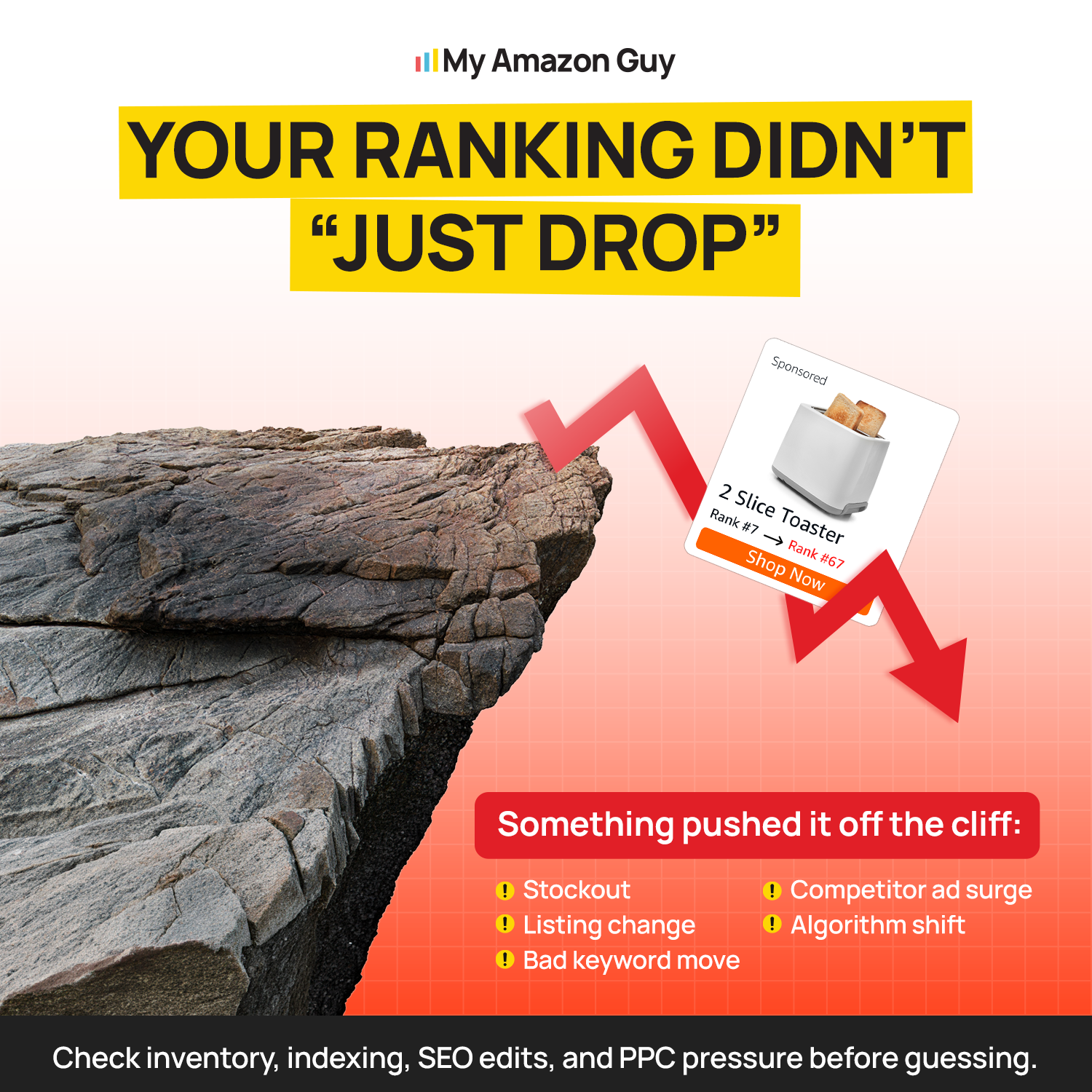
Weekly tracking on the top 20 terms catches slips before they show up in sales. Pair it with inventory checks, because a stockout can erase months of ranking work fast.
How to Rank #1 on Amazon with SEO (No PPC required)
FAQs About Amazon SEO Services
What are Amazon SEO services?
Amazon SEO services improve a listing's keywords, copy, and images so it ranks for the terms shoppers search. Most programs cover keyword research, listing optimization, backend terms, and ongoing rank tracking.
How much do Amazon SEO services cost?
Full-service Amazon SEO for a $1M to $10M brand typically runs $2,500 to $7,500 a month. One-time keyword projects cost less, often around $1,000 for up to 10 ASINs.
How do I choose an Amazon SEO agency?
Choose an agency that runs SEO and PPC on the same team and can show rank gains in your category. Shortlist three, compare scope before price, and ask who owns the listing copy.
Should I hire an Amazon SEO agency or build an in-house team?
An agency is usually the better value until Amazon revenue passes about $10M. Below that, one senior hire costs six figures and rarely handles SEO, PPC, and design equally well.
Do Amazon SEO agencies require long-term contracts?
Some do, but a 12-month lock-in is a warning sign rather than a standard. Get the notice period and offboarding steps in writing before signing.
What does an Amazon SEO consultant do?
An Amazon SEO consultant audits your listings, decides which fixes come first, and builds a ranking roadmap. Experts or an in-house team then carry out that plan.
What makes someone an Amazon SEO expert?
A real expert can show rank and indexing gains on live ASINs and explain the data behind them. Guaranteed rankings, keyword-stuffed titles, and hidden reports are red flags.
What is included in an Amazon SEO audit?
A solid audit checks indexing, keyword rankings, backend terms, PPC-to-SEO ratio, and conversion gaps on each ASIN. It should end with a ranked list of fixes, not just a report.
Should I pay for one-time listing optimization or ongoing Amazon SEO?
One-time optimization fits newer listings with fewer than 800 indexed keywords. Ongoing SEO pays off once rank depends on quarterly strike zone updates and fresh PPC data.
How long does Amazon SEO take to show results?
New keywords can index within days, but meaningful rank movement usually appears between week 8 and week 12. Sales gains often follow a quarter or more later, once the listing proves it converts at its higher rank.
Choosing Amazon SEO Services That Build Lasting Organic Rank
Amazon SEO services work when indexing, copy, ranking, and conversion run as one system. The right partner pairs consultant-level planning with experts who ship listing changes every month.
The best hire depends on revenue stage, but most $1M+ brands get the most value from one team running SEO and PPC together. Judge that team on indexing and rank in the first 90 days, then on the organic sales that follow.
Are your listings stuck below page one? Contact our full-service Amazon agency and let our Amazon SEO experts turn your keyword data into organic sales that last.
Find out which buyer searches your listing is not indexed for yet.